Quick Answer
The safe storage window for cooked beef depends on temperature, handling, and how quickly it was refrigerated. Keep it at 40°F (4°C) or colder, follow the specific time limits below, and discard it sooner if its storage history is uncertain.
Practical note
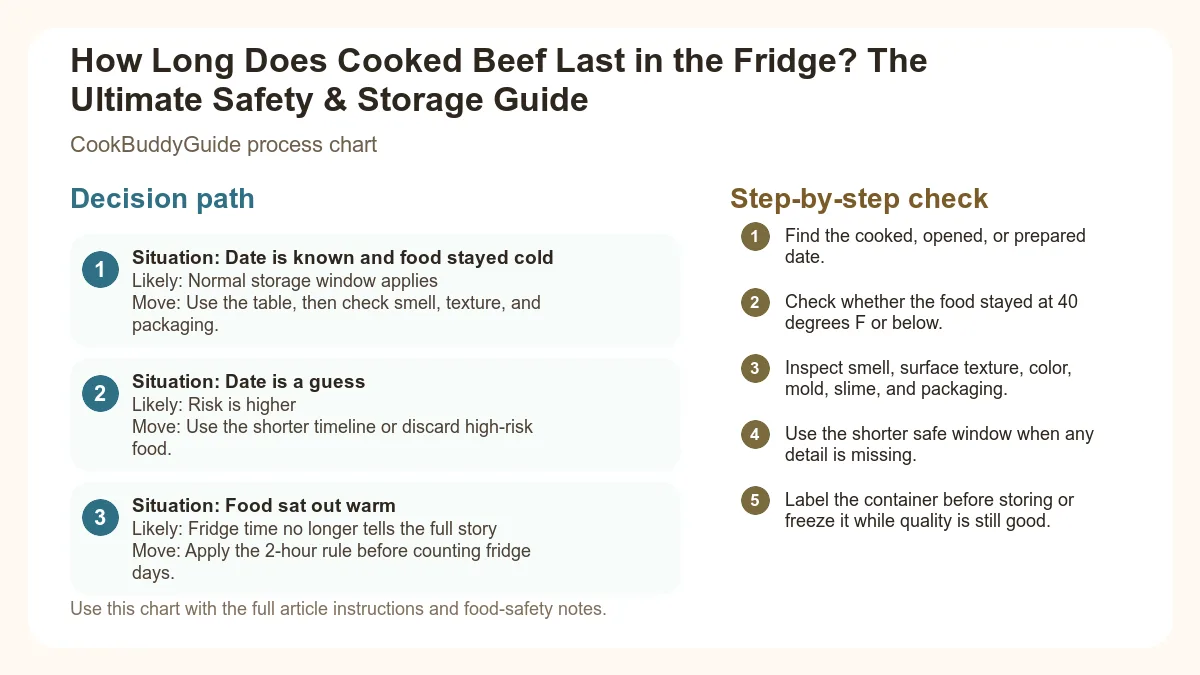
For cooked beef storage, the home-kitchen check is not only the number of days. We look at the start date, fridge temperature, container seal, serving time, and spoilage signs. If one of those facts is missing, the safer move is to use the shorter window.
Decision table
| Situation | Likely cause or meaning | Best move |
|---|---|---|
| Date is known and food stayed cold | Normal storage window applies | Use the table, then check smell, texture, and packaging. |
| Date is a guess | Risk is higher | Use the shorter timeline or discard high-risk food. |
| Food sat out warm | Fridge time no longer tells the full story | Apply the 2-hour rule before counting fridge days. |
Step-by-step fix
- Find the cooked, opened, or prepared date.
- Check whether the food stayed at 40 degrees F or below.
- Inspect smell, surface texture, color, mold, slime, and packaging.
- Use the shorter safe window when any detail is missing.
- Label the container before storing or freeze it while quality is still good.
Common mistakes
- Counting fridge days from the day you noticed the container instead of the day it was made.
- Ignoring time spent on the counter, in a lunch bag, or on a serving table.
- Trusting smell alone when the date or temperature history is unknown.
- Putting warm food into a deep container that cools slowly.
Related topic hubs
How Long Does Cooked Beef Last in the Fridge? A Practical Safety & Storage Guide
Table of Contents
- The Golden Rule: How Long Does Cooked Beef Last?
- Shelf Life Breakdown by Type of Beef Cut
- Critical Factors That Affect Beef Longevity
- Essential Tools for Cooked Beef Storage
- How to Tell if Cooked Beef Has Gone Bad
- Freezing Cooked Beef: Timelines and Best Practices
- Reheating Leftover Beef Without Drying It Out
- Practical Tips for Meal Prepping Beef Safely
The Golden Rule: How Long Does Cooked Beef Last in the Fridge?
USDA Guidelines vs. Real-World Kitchen Experience
The Science of Bacterial Growth in Cooked Meats
Why the 4-Day Mark is the Industry Standard
The 4-day rule exists because it accounts for the "lag phase" of bacteria—the time it takes for them to adjust to their environment before they begin rapid exponential growth. By day five, even if you’ve followed perfect cooked beef storage protocols, the risk of foodborne illness increases exponentially. Always remember: when in doubt, throw it out. Your health is worth more than a $10 steak.
Shelf Life Breakdown by Type of Beef Cut
Steaks and Roasts (Whole Muscle)
Whole muscle cuts like ribeye, sirloin, or a chuck roast have a slightly better storage profile than ground meat. Because the interior of the muscle is sterile, bacteria only exist on the surface. When you sear a steak, you kill those surface bacteria.
- Fridge Life: 3–4 days
- Pro Tip: Store roasts whole and slice them only when you are ready to reheat to maintain moisture.
Ground Beef, Burgers, and Meatballs
Ground beef is the "high-risk" category of the beef world. During the grinding process, the surface area of the meat increases a thousandfold, and any bacteria on the surface are mixed throughout the entire batch. This creates more "real estate" for bacterial growth.
- Fridge Life: 2–3 days
Beef Stews, Soups, and Sauces
Liquid-based dishes are fascinating. Many people claim a beef stew tastes better the next day—and they’re right! The flavors meld and the starches thicken. However, the high moisture content also makes these dishes a playground for bacteria if not cooled quickly.
- Fridge Life: 3–4 days
- Resource: Check this cold food storage chart for a full breakdown of liquid-based meat dishes.
Deli Beef and Sliced Roast Beef
Commercial deli meats often contain preservatives like sodium nitrites that extend their life, but "home-cooked" sliced roast beef does not. Once you slice into that roast, you are exposing more surface area to oxygen and potential cross-contamination.
- Fridge Life: 3 days
The "Perfect Storage" Checklist for Cooked Beef
- Cool Down: Allow beef to stop steaming, but never leave it at room temperature for more than 2 hours.
- Portioning: Divide large roasts into smaller portions to speed up the cooling process.
- Container Choice: Use an airtight container or vacuum sealed bags to minimize oxygen exposure.
- Placement: Store beef on the bottom shelf of the fridge (the coldest part) and away from raw foods to prevent cross-contamination.
Critical Factors That Affect Beef Longevity
The Importance of the 'Danger Zone' (40°F - 140°F)
Bacteria love the "Danger Zone." This is the temperature range between 40°F and 140°F where pathogens can double in number every 20 minutes. According to expert advice on handling leftovers safely, if you leave your cooked beef on the counter for more than two hours, the bacterial load may already be too high for the fridge to keep it safe. In temperatures above 90°F (like a summer BBQ), that window shrinks to just one hour.
Initial Freshness: The 'Garbage In, Garbage Out' Rule
Cooking Method and Moisture Content
Dry-heat methods like grilling or roasting create a "pellicle" or a dry outer layer that is slightly more resistant to bacteria than the wet environment of a braise or stew. However, very moist beef (like that in a slow cooker) is more prone to spoilage because bacteria require water to thrive. If you're making crockpot freezer meals, the cooling and storage steps are even more critical.
Essential Tools for Cooked Beef Storage
After a decade of testing, I’ve realized that the container you choose is just as important as the temperature of your fridge. Using the right airtight containers can mean the difference between a delicious Monday lunch and a dried-out, "fridge-smelling" mess.
Glass vs. Plastic: Which is Better for Beef?
The Magic of Vacuum Sealing for Leftovers
If you are serious about meal prep tips, buy a vacuum sealer. By removing all oxygen, you virtually eliminate oxidation and slow down aerobic bacterial growth. A vacuum sealed cooked steak can easily maintain its quality for the full 4 days, whereas a loosely wrapped one will start to taste "off" by day two.
Why Shallow Containers are Safer for Cooling
How to Tell if Cooked Beef Has Gone Bad
Even if you’ve followed every rule, things can go wrong. Maybe your fridge had a power hiccup, or the seal on your container wasn't tight. You must know the signs of beef spoilage.
The 'Sniff Test' (And Why It’s Not reliable)
Your nose is a powerful tool, but it’s not perfect. Spoilage bacteria produce odors, but pathogenic bacteria (the ones that make you sick) are often odorless. However, if you detect a scent of ammonia, sulfur, or a "sour" tang, that beef is destined for the trash. You can find more details on these sensory changes in this article on signs of beef spoilage.
Texture Changes: Slimy, Sticky, or Dry?
Visual Cues: Graying, Green Hues, and Mold
Cooked beef will naturally turn a slightly duller brown in the fridge—that’s just oxidation. However, if you see any hints of green, iridescent sheen, or fuzzy white/blue spots (mold), do not attempt to "cut it off." Mold has "roots" (hyphae) that penetrate deep into the meat before they are visible on the surface.
The "Is It Safe?" 3-Point Inspection
Before you reheat, perform these three checks:
- Sight: Check for any fuzzy growth or unusual colors (green/grey).
- Smell: Does it smell like the day you cooked it, or is there a sharp, acidic, or "funky" note?
- Touch: With clean hands, touch the meat. If it feels slimy or leaves a sticky residue on your fingers, toss it.
Freezing Cooked Beef: Timelines and Best Practices
If you realize on day two that you aren't going to eat that beef, move it to the freezer! This is the ultimate way to stop the clock and prevent waste.
How Long Does Cooked Beef Last in the Freezer?
Technically, food kept at 0°F is safe indefinitely. However, for quality, you want to consume cooked beef within 2 to 3 months. After that, freezer burn sets in, which is when moisture evaporates out of the meat and is replaced by oxygen, leading to dry, leathery patches.
Preventing Freezer Burn: The Double-Wrap Method
To keep my leftover steak tasting fresh, Use the double-wrap method:
- Wrap the beef tightly in plastic wrap or heavy-duty aluminum foil.
- Place the wrapped beef inside a freezer-safe bag.
- Squeeze out every bit of air before sealing.
Thawing Safely: Fridge vs. Cold Water vs. Microwave
Never thaw cooked beef on the counter. This brings the outside of the meat into the Danger Zone while the middle is still frozen.
- The Fridge: The safest method. Takes 24 hours for most portions.
- Cold Water: Place the beef in a leak-proof bag in a bowl of cold water, changing the water every 30 minutes.
- Microwave: Use only if you plan to reheat and eat the beef immediately.
Reheating Leftover Beef Without Drying It Out
The biggest complaint about reheating leftovers is that the beef becomes tough. This happens because the proteins have already been denatured once, and the second round of heat can squeeze out the remaining moisture.
The Low and Slow Oven Method
For roasts and steaks, the oven is your best friend. Place the beef in a baking dish with a splash of beef broth or water, cover tightly with foil, and heat at 250°F until the internal temperature reaches 165°F. The steam helps "relax" the muscle fibers.
The 'Water Trick' for Microwaving Beef
If you're in a rush, place your beef in a microwave-safe bowl. Add a teaspoon of water and cover with a damp paper towel. The towel creates a mini-steam chamber, preventing the edges of the beef from turning into leather. Use 50% power to ensure even heating.
Using the Sous Vide for Leftover Steak
If you own a sous vide immersion circulator, it is the only way to reheat a medium-rare steak without turning it well-done. Set the water to 130°F, drop in your vacuum sealed steak, and let it warm through for about 45 minutes. It will taste exactly like it did the night you grilled it.
Practical Tips for Meal Prepping Beef Safely
Successful meal prep tips are built on organization. If you don't know what’s in your fridge, you can't eat it safely.
Labeling and Dating Your Containers
The 'First In, First Out' (FIFO) Method
Home kitchens live by FIFO. When you put new leftovers in the fridge, move the older ones to the front. This visual cue ensures you use the items closest to their expiration first.
Batch Cooking Strategies for Busy Families
- Tonight's Dinner: Served hot.
- Tomorrow's Lunch: Sliced thin for sandwiches, stored in the fridge.
- Future Meal: Cubed for a future stew, stored in freezer-safe bags.
Frequently Asked Questions
A: It is not recommended. While it might not smell bad, the risk of bacterial growth and foodborne illness is significantly higher after the 4-day mark.
A: Yes, in small portions. Modern refrigerators can handle the heat. However, it’s best to let the steam subside for 15-20 minutes first. Just don't let it sit out for more than 2 hours.
A: This is often just "iridescence" caused by light hitting the fat and minerals in the meat fibers. If the meat smells fine and isn't slimy, it’s usually safe. However, if the sheen is accompanied by a smell, toss it.
Final Thoughts from the Kitchen
Mastering how long does cooked beef last in fridge is a fundamental skill for any home cook. By sticking to the 3-4 day rule, using airtight containers, and respecting the 40 degrees Fahrenheit safety threshold, you can enjoy your leftovers with total peace of mind. Remember, your freezer is your "pause button"—use it early and often to prevent waste. Happy (and safe) cooking!