Quick Answer
Many cuts can be cooked from frozen in an oven, on a stovetop, or in an electric pressure cooker, but they need additional time and a thermometer check. Do not rely on color; cook poultry to 165°F (74°C) and ground meat to 160°F (71°C), and follow appliance guidance before using a slow cooker.
Practical note
For Cooking Frozen Meat Without Thawing, this guide centers on Thickness Matters, Surface Area, The "Gray Band" Effect. Those are the checkpoints we would use first in a normal home kitchen before making a bigger change.
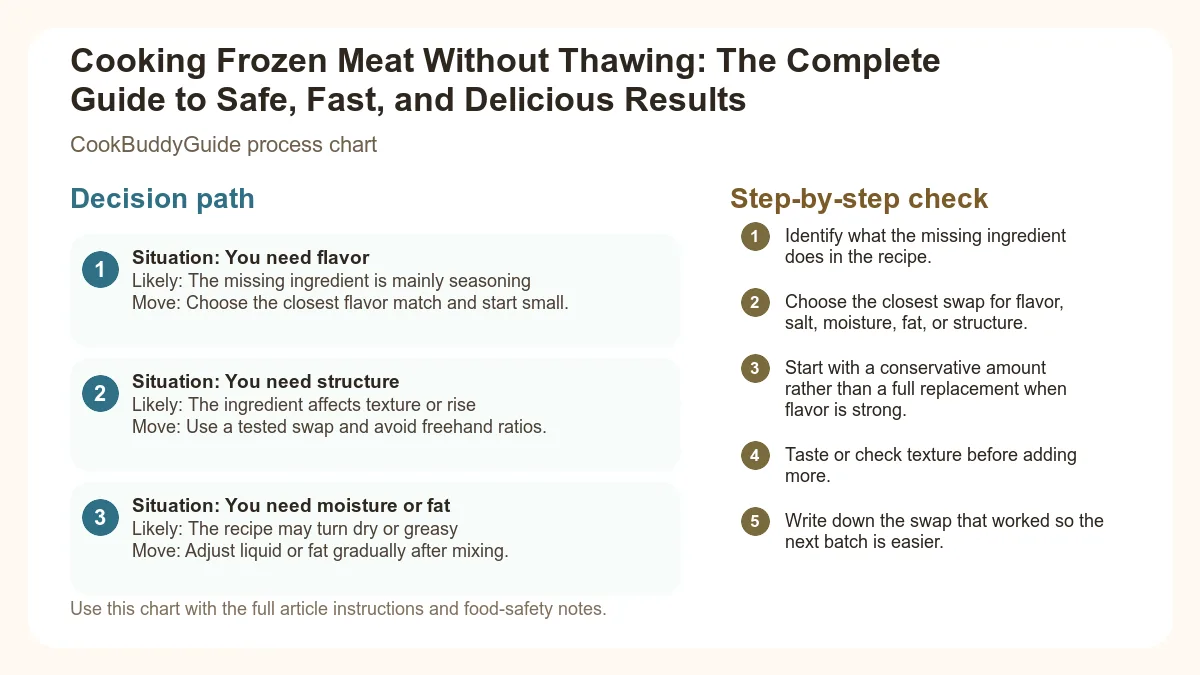
Decision table
| Situation | Likely cause or meaning | Best move |
|---|---|---|
| You need flavor | The missing ingredient is mainly seasoning | Choose the closest flavor match and start small. |
| You need structure | The ingredient affects texture or rise | Use a practical swap and avoid freehand ratios. |
| You need moisture or fat | The recipe may turn dry or greasy | Adjust liquid or fat gradually after mixing. |
Step-by-step fix
- Identify what the missing ingredient does in the recipe.
- Choose the closest swap for flavor, salt, moisture, fat, or structure.
- Start with a conservative amount rather than a full replacement when flavor is strong.
- Taste or check texture before adding more.
- Write down the swap that worked so the next batch is easier.
Common mistakes
- Replacing a strong ingredient 1:1 before tasting.
- Choosing a flavor match when the recipe actually needs structure.
- Forgetting that salty swaps can change the whole dish.
- Adding extra liquid before the batter, dough, or sauce has time to hydrate.
Related topic hubs
Table of Contents
- The Science and Safety of Cooking Frozen Meat
- The Golden Rule: Adjusting Cooking Times
- Best Method 1: Oven Roasting from Frozen
- Best Method 2: The Instant Pot and Pressure Cooking
- Best Method 3: Skillet Cooking for Ground Meat
- Unsafe Methods: What to Avoid
- Specific Guides by Meat Type
- Practical Tips for Flavor and Seasoning
- Common Mistakes and How to Fix Them
The Science and Safety of Cooking Frozen Meat
The first question every home cook asks is: can you cook meat from frozen safely? According to the USDA Food Safety Guidelines, the answer is a definitive yes. As long as you are using a method that applies consistent heat, the meat will pass through the "Danger Zone" quickly enough to prevent bacterial growth.
Understanding the "Danger Zone"
In the world of food safety, the Danger Zone is the temperature range between 40°F and 140°F. This is where bacteria like Salmonella and E. coli can double in number in as little as 20 minutes. When you are defrosting meat safely in the refrigerator, you keep the meat out of this zone. When you cook from frozen, the exterior of the meat hits this zone first while the interior remains icy. The key to safety is ensuring the heat source is powerful enough to move the entire piece of meat through this range and up to a safe internal temperature within a reasonable timeframe.
The Importance of a Meat Thermometer
The Golden Rule: Adjusting Cooking Times
The most important "kitchen hack" for meal prep from frozen is the 50% Rule. If a recipe calls for a 20-minute cook time for thawed chicken, you should expect it to take at least 30 minutes when starting from frozen.
Why does it take so much longer? It’s all about the ice crystals in meat. The energy from your oven or stove must first work to melt those crystals (latent heat of fusion) before it can actually begin raising the temperature of the protein fibers.
- Thickness Matters: A thin frozen fish fillet might only take 20% longer to cook. A thick, 2-inch frozen steak will likely require the full 50% increase.
- Surface Area: Pieces of meat with more surface area (like wings or sliced stir-fry meat) cook much faster than dense, spherical roasts.
- The "Gray Band" Effect: One benefit of cooking from frozen is that the cold center prevents the edges from overcooking as quickly, often resulting in a smaller "gray band" of overcooked meat near the surface.
Best Method 1: Oven Roasting from Frozen
The "Low and Slow" Frozen Roast Technique
Temperature: Set your oven to 325°F or 350°F. Do not go higher than 375°F, or the outside will char before the inside thaws.
Steps:
- The Oil Trick: Seasonings won't stick to ice. Brush the frozen meat with a thin layer of oil or melted butter first. This creates a "glue" for your salt, pepper, and herbs.
- The Rack: Place the meat on a wire roasting rack set inside a baking sheet. This allows heat to reach the bottom of the meat, preventing it from sitting in a pool of "defrost water."
- The Foil Tent: After about 20 minutes of cooking, if the outside is browning too fast, loosely tent the meat with aluminum foil.
Best Method 2: The Instant Pot and Pressure Cooking
If you have an Instant Pot, you have the "Holy Grail" of pressure cooker frozen meat. Pressure cooking uses high-pressure steam, which has incredible thermal conductivity. It can penetrate the frozen core of a chicken breast or a small roast far faster than dry oven air.
Pro Tip: Always ensure the pieces of meat are not frozen together in a giant "clump." If you freeze your chicken breasts in a flat, single layer, they will cook evenly. If they are frozen in a solid ball, the outside will be rubbery by the time the center is safe.
Liquid Ratios for Frozen Proteins
When cooking from frozen, the meat will release more liquid than usual as the ice crystals melt. Consider reducing your added liquid (broth or water) by about 1/4 cup to prevent your sauce from becoming too watery. Use a "Quick Release" for lean meats like chicken breasts to prevent them from becoming tough, but use a "Natural Release" for fattier cuts like frozen pork shoulder chunks.
Best Method 3: Skillet Cooking for Ground Meat
Can you turn a frozen block of ground beef into taco meat in 15 minutes? Yes, and it’s a lifesaver for kitchen hacks for busy moms. The trick is not to wait for the whole block to thaw in the pan.
The "Scrape and Brown" Method
This is the best way to brown ground meat from frozen without ending up with a boiled, gray mess.
- Place the frozen ground beef skillet over medium heat with a tablespoon of water and a lid. The steam helps soften the exterior.
- After 3 minutes, remove the lid. The surface should be soft. Use a sturdy spatula to scrape the browned, softened meat off the block and move it to the sides of the pan.
- Flip the block over and repeat. Keep scraping the "thawed" outer layers into the pan as they cook.
- Once the entire block is broken up, turn the heat to medium-high to evaporate the excess water and achieve a true sear.
Unsafe Methods: What to Avoid
Cooking frozen meat without thawing can work, but the following methods create food-safety or quality problems.
1. The Slow Cooker (Crock-Pot)
This is a hard "No." According to slow cookers and food safety guidelines, a frozen roast takes too long to heat up in a Crock-Pot. It will sit in the Danger Zone for hours, allowing bacteria to multiply to dangerous levels before the heat finally kills them. If you love slow cooking, stick to our Crockpot Freezer Meals that are properly thawed before the heat goes on.
2. Grilling Frozen Steaks or Burgers
Grilling uses intense, direct infrared heat. If you put a frozen burger on a 500°F grill, the outside will be charred to a crisp before the center even reaches 100°F. You’ll end up with a "burnt-raw" burger that is both unappealing and unsafe.
3. Deep Frying
Never, ever put frozen meat (especially poultry) into a deep fryer. The ice crystals in meat will instantly turn to steam when they hit the hot oil, causing the oil to bubble over violently. This is the leading cause of turkey fryer fires during the holidays.
Specific Guides by Meat Type
| Meat Type | Recommended Method | Est. Cook Time (Frozen) | Safe Internal Temp |
|---|---|---|---|
| Chicken Breasts | Instant Pot / Oven | 12-15 mins (IP) / 45 mins (Oven) | 165°F |
| Steak (1-inch) | Reverse Sear (Oven then Pan) | 20-25 mins (Oven) + 2 min sear | 145°F |
| Ground Beef | Skillet (Scrape & Brown) | 15-20 mins | 160°F |
| Fish Fillets | Oven / Air Fryer | 12-18 mins | 145°F |
| Pork Chops | Oven Roasting | 30-35 mins | 145°F |
The Frozen Steak Hack
Believe it or not, some experts argue that the best way to cook frozen steaks is to skip the thaw entirely. In a side-by-side test, steaks cooked from frozen lost less moisture and had a more uniform pink center than their thawed counterparts. The trick is to sear them in a pan for 90 seconds per side to get a crust, then finish them in a 275°F oven until they reach your desired temperature.
Practical Tips for Flavor and Seasoning
One of the biggest complaints about cooking frozen meat without thawing is that it can taste bland. Since you can't marinate a block of ice, you have to be strategic with flavor.
- The "Mid-Way" Glaze: Don't apply sugary sauces (like BBQ sauce) at the beginning. They will burn before the meat thaws. Apply them in the last 10–15 minutes of cooking.
- Aromatics in the Steam: If using a pressure cooker or the skillet method, add smashed garlic, ginger, or onion to the liquid. The steam will carry these flavors into the meat as it thaws.
- Acid is Your Friend: Frozen meat can sometimes have a slightly "flat" flavor. A squeeze of fresh lemon juice or a splash of apple cider vinegar right before serving can brighten the whole dish and mask any "freezer" taste.
Common Mistakes and How to Fix Them
Forgetting the Absorbent Pad
We’ve all done it. You take the frozen meat out of the Styrofoam tray and put it in the pan, forgetting that the little "soaker pad" is frozen to the bottom of the meat. If this happens, wait 5 minutes until the heat loosens it, then use tongs to peel it off. Do not leave it in! It is not food-safe at high temperatures.
Overcrowding the Pan
When frozen meat hits a pan, it drops the temperature of the cooking surface instantly. If you crowd the pan with too many frozen breasts, they will release so much water that they end up boiling in their own juices. Cook in batches if necessary to ensure you get that Maillard Reaction.
Relying on a Timer
cooking times for frozen food are just estimates. Factors like the thickness of the meat, the accuracy of your oven, and even the altitude can change the timing by 10 or 15 minutes. Always, always check the internal temperature with a probe thermometer before serving.
Frequently Asked Questions
A: Yes, but it takes a very long time (usually 50% longer than thawed) and requires a low oven temperature (325°F) to ensure the center reaches 165°F without the skin burning. It's safe, but usually not the most delicious way to eat a turkey.
A: This usually happens from overcooking the exterior while waiting for the interior to finish. Using a lower oven roasting temperature (325°F) or a pressure cooker can help prevent this.
A: Absolutely! Air fryers are essentially high-powered convection ovens. They are excellent for frozen wings, nuggets, and even steaks.
Conclusion: Dinner is Saved
Forgetting to thaw meat isn't the end of the world—it’s just a change of plans. By understanding the 50% Rule, utilizing the right tools like an Instant Pot or a wire roasting rack, and always keeping your meat thermometer handy, you can serve a safe, delicious meal even when you're starting from zero.
The next time you find yourself staring at a frozen block of beef at 6:00 PM, don't panic. Reach for your skillet, remember the "scrape and brown" technique, and dinner will be on the table before you know it. Happy cooking!