Quick Answer
This guide explains the USDA danger zone rules and find out if food is safe after sitting out 4 hours in this practical guide.
Practical note
For Food Left Out for 4 Hours, this guide centers on 0 Minutes, 20 Minutes, 1 Hour. Those are the checkpoints we would use first in a normal home kitchen before making a bigger change.
Decision table
| Situation | Likely cause or meaning | Best move |
|---|---|---|
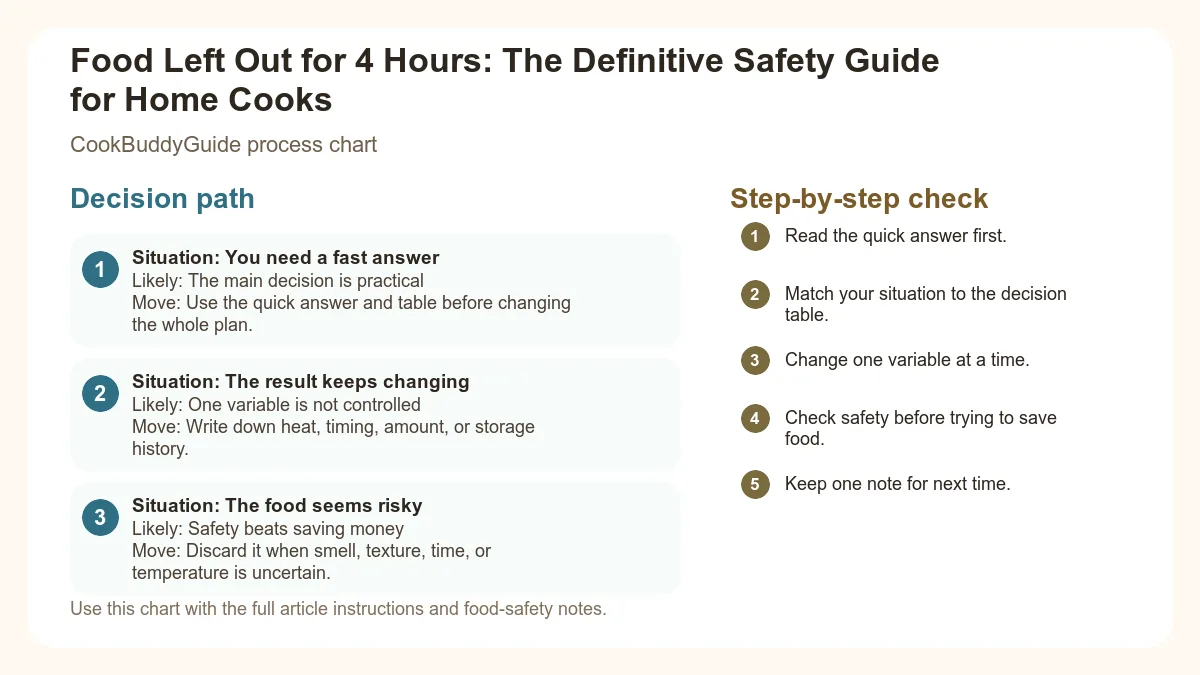
| You need a fast answer | The main decision is practical | Use the quick answer and table before changing the whole plan. |
| The result keeps changing | One variable is not controlled | Write down heat, timing, amount, or storage history. |
| The food seems risky | Safety beats saving money | Discard it when smell, texture, time, or temperature is uncertain. |
Step-by-step fix
- Read the quick answer first.
- Match your situation to the decision table.
- Change one variable at a time.
- Check safety before trying to save food.
- Keep one note for next time.
Common mistakes
- Skipping the quick answer and changing too much at once.
- Treating quality problems and safety problems the same way.
- Not writing down the detail that caused the repeat problem.
Related topic hubs
It is 11:30 PM. You have just finished a long day, and as you walk into the kitchen for a glass of water, you see it: the remains of the Sunday roast, still sitting on the carving board, glistening under the range hood light. Your heart sinks. It has been sitting at room temperature since dinner ended at 7:00 PM. That is exactly food left out for 4 hours. You ask yourself the age-old question every home cook has faced: "Is it still safe, or do I have to throw this whole thing away?"
For perishable food, four hours at room temperature is beyond the usual USDA two-hour limit, or one hour when the surrounding temperature is above 90°F. Smell and appearance cannot reliably detect disease-causing bacteria. Unless the food was actively kept above 140°F or below 40°F, the safe decision is to discard it.
Table of Contents
- The 4-Hour Dilemma: Why It Matters
- Understanding the USDA Danger Zone (40°F - 140°F)
- The 2-Hour Rule vs. The 4-Hour Rule
- When 4 Hours Becomes 1 Hour: Environmental Factors
- High-Risk Foods: The Real Dangers
- Low-Risk Foods: What Can Stay Out?
- The "Keep or Toss" Reference Table
- Debunking Common Food Safety Myths
- Practical Tips for Safe Food Handling
- Conclusion: When in Doubt, Throw it Out
The 4-Hour Dilemma: Can You Eat Food Left on the Counter?
The Reality of Foodborne Illness
The concern with food left out for 4 hours is time spent in a temperature range where harmful bacteria can grow rapidly. A dish may still look and smell normal, so the decision should be based on how long it was uncontrolled and whether it remained demonstrably hot or cold.
Throwing away an expensive meal is frustrating, but reheating does not reliably reverse every risk created by extended room-temperature storage. For meat, dairy, eggs, cooked grains, cut produce, and other perishables, prioritize the time-and-temperature rule over the cost of the dish.
Why the 4-Hour Mark is the Point of No Return
The 4-hour mark is not an arbitrary number. It is based on the growth rate of bacteria under ideal conditions. Most perishable foods provide the perfect "buffet" for bacteria: moisture, protein, and a neutral pH. Once food has been in the "Danger Zone" for 4 hours, the bacterial load is considered too high for the human immune system to reliably handle, especially for children, the elderly, or those with compromised immune systems.
Understanding the USDA Danger Zone (40°F - 140°F)
How Bacteria Multiply in Real-Time
To understand why four hours matters, start with the USDA danger zone for bacterial growth. Between 40°F and 140°F, bacteria can grow rapidly; under favorable conditions, some can double in as little as 20 minutes.
Let's do the math Often, teach in my workshops:
- 0 Minutes: 1 bacterium
- 20 Minutes: 2 bacteria
- 1 Hour: 8 bacteria
- 2 Hours: 64 bacteria
- 4 Hours: 4,096 bacteria
Now, consider that food rarely starts with just one bacterium. If you start with 1,000 cells (a very clean kitchen surface), after 4 hours, you are looking at over 4 million bacterial cells on your plate. This is why internal temperature management is the most critical skill for any home cook.
The Science of Thermophilic and Mesophilic Bacteria
The 2-Hour Rule vs. The 4-Hour Rule: What's the Difference?
The 2-Hour Window for Refrigeration
The FDA and USDA two-hour rule applies to perishable food after cooking or removal from refrigeration. At temperatures above 90°F, that limit falls to one hour. Divide large portions into shallow containers so they cool promptly in the refrigerator.
The 4-Hour Hard Limit for Consumption
So, where does the 4-hour rule come from? In professional food service, the 4-hour rule is the "use it or lose it" limit. If a food item has been out for 4 hours, it must be discarded. You cannot put it back in the fridge at the 4-hour mark and expect it to be safe tomorrow. The cumulative effect of time out of the fridge is what matters. If you take a ham sandwich out for 1 hour at lunch, put it back, and take it out for 3 hours at dinner, that food has reached its 4-hour limit.
The "Time-Temperature" Log Method
For parties or large meals, use this simple method to track how long perishable food has been left out:
- Step 1: Use a piece of masking tape and a sharpie on the bottom of the serving dish.
- Step 2: Write the "Out Time" (e.g., "Out: 2:00 PM").
- Step 3: Write the "Discard Time" (e.g., "Toss: 6:00 PM").
- Step 4: Check the internal temperature with a probe every hour to ensure hot foods stay above 140°F.
Pro Tip: This is especially helpful for no-cook summer meals like tuna salad or shrimp cocktail that rely on cold temperatures for safety.
Environmental Factors: When 4 Hours Becomes 1 Hour
The Impact of Ambient Room Temperature
The 4-hour rule assumes a standard room temperature of around 70°F. However, your kitchen environment changes. If you are cooking in a kitchen with the oven blasting at 450°F, or if you are at a backyard BBQ, the timeline shifts dramatically.
Outdoor Dining and Summer Heat Safety
High-Risk Foods: The Ones That Will Actually Make You Sick
Meat, Poultry, and Seafood
These are the obvious culprits. Salmonella and E. coli love the nutrient-rich environment of animal proteins. Seafood is even more volatile due to its high moisture content and specific enzymes that accelerate spoilage. If you've left a tray of shrimp cocktail out for 4 hours, there is no "reheating" that will make it safe.
The Hidden Danger of Cooked Rice and Pasta
Many home cooks are surprised to learn that cooked grains are high-risk. Bacillus cereus is a bacterium commonly found in soil that can survive the initial cooking process. When cooked rice or pasta is left at room temperature, these spores germinate and produce toxins. This is often called "Fried Rice Syndrome." Because these toxins are heat-stable, reheating leftovers won't neutralize the danger.
Dairy, Eggs, and Cream-Based Sauces
While modern pasteurization helps, dairy products are still highly susceptible to cross-contamination and rapid bacterial growth. Interestingly, it's often not the mayonnaise in the potato salad that is the highest risk (commercial mayo is quite acidic), but the potatoes and eggs mixed into it that provide the breeding ground.
Low-Risk Foods: What Can Stay Out Longer?
Breads, Pastries, and Baked Goods
Why can a loaf of bread sit on the counter for days while a piece of chicken cannot? It comes down to "Water Activity" (Aw). Bacteria need "free water" to grow. Breads and dry pastries have low water activity, making them shelf-stable. However, be careful with cream-filled pastries or "moist" cakes like pumpkin bread, which have higher moisture levels.
Whole Fruits and Vegetables
An uncut apple or a whole tomato is naturally protected by its skin. Once you slice them, however, you break the barrier and expose the sugars and moisture to the air. Sliced melons, in particular, are considered a high-risk food by the CDC's guide for preventing foodborne illness because of their neutral pH.
Condiments and High-Acid Foods
Vinegar, mustard, and highly fermented foods like kimchi or sauerkraut are naturally resistant to pathogenic bacteria. The acidity acts as a preservative. This is why you'll often see mustard sitting on diner tables all day without issue.
The "Keep or Toss" Reference Table
Use this table to make quick decisions when you realize food left out for 4 hours has occurred in your kitchen.
| Food Category | 2 Hours (Room Temp) | 4 Hours (Room Temp) | Action |
|---|---|---|---|
| Cooked Meat/Poultry | Safe to Refrigerate | Danger | TOSS |
| Cooked Rice/Pasta | Safe to Refrigerate | Danger | TOSS |
| Soft Cheeses (Brie, Mozz) | Safe to Refrigerate | Danger | TOSS |
| Hard Cheeses (Parm, Cheddar) | Safe | Safe | KEEP |
| Cut Leafy Greens | Safe to Refrigerate | Danger | TOSS |
| Butter (Salted) | Safe | Safe | KEEP |
For more specific details on high-risk items, see this guide on when to toss perishable food.
Debunking Common Food Safety Myths
This is perhaps the most dangerous myth in the kitchen. While heat kills most live bacteria, it does not destroy the toxins they leave behind. Bacteria like Staphylococcus aureus produce heat-stable toxins that can survive boiling temperatures. If the food left out for 4 hours has already produced these toxins, you can cook it until it's charcoal and it could still make you sick.
Myth: "If it smells fine, it is fine"
There is a massive difference between spoilage bacteria (which make food smell bad and look slimy) and pathogenic bacteria (which cause illness). Pathogens are "stealth" organisms. You can have a piece of chicken loaded with enough Salmonella to hospitalize a person, and it will still smell like perfectly fresh chicken. Is food safe after sitting out 4 hours? You cannot answer that with your nose.
Myth: "My grandma always left the turkey out"
We've all heard this one. "Grandma left the Thanksgiving turkey on the table until 10 PM and we were fine." There are two reasons for this. First, "survivor bias"—you only remember the times you didn't get sick. Second, modern food processing and global supply chains mean our food travels further and is handled by more people than in Grandma's day, increasing the chances of initial contamination.
Practical Tips for Safe Food Handling and Storage
Rapid Cooling Techniques for Large Batches
The danger doesn't just happen on the counter; it can happen in the fridge too. If you put a massive 2-gallon pot of hot chili directly into the fridge, the center of that pot might stay in the Danger Zone for 10+ hours because the cold air can't penetrate the mass.
The Shallow Pan Method
Use this cooling and storage sequence:
- Divide and Conquer: Instead of one deep pot, pour hot liquids or grains into several shallow baking pans (no more than 2 inches deep).
- The Ice Bath: Place the pans in a sink filled with ice and water for 15 minutes, stirring occasionally.
- The Vent: Place in the fridge with the lid slightly cracked for the first hour to allow steam to escape before sealing tightly.
This is a must-follow step when packing healthy work lunches for the week ahead.
Using an Instant-Read Thermometer Correctly
Don't guess. A high-quality digital thermometer is the only way to know if your food has reached the 140°F safety threshold or if it has cooled down to the 40°F storage threshold. Consider calibrating your thermometer once a month using the "Ice Water Test" (it should read exactly 32°F in a glass of crushed ice and water).
Conclusion: When in Doubt, Throw it Out
We have covered a lot of ground, from the doubling rates of Salmonella and E. coli to the specific risks of "Fried Rice Syndrome." The bottom line remains the same: food left out for 4 hours has entered a zone of high risk that no amount of reheating or "sniff testing" can fix.
The effects of food poisoning can be serious, particularly for people at higher risk of complications. If cooked meat or another perishable dish sat at room temperature for four hours without temperature control, discard it.
A: Technically, no. Pizza contains perishable toppings like cheese and meat. While the crust is low-risk, the toppings are a breeding ground for bacteria after 2-4 hours at room temperature.
A: While this kills most bacteria, it does not destroy heat-stable toxins produced by bacteria like Staph or Bacillus cereus. If the food was out for 4+ hours, reheating is not a guarantee of safety.
A: Whole, unwashed vegetables are generally safe. However, once they are cut, peeled, or cooked, they become "TCS" (Time/Temperature Control for Safety) foods and must follow the 2/4 hour rule.
Want more home kitchen secrets and safety guides delivered to your inbox? Join our community of 50,000+ home cooks and sign up for the CookBuddyGuide newsletter today! We’ll help you master kitchen hygiene and cook with confidence.