Quick answer
Yes, freezer-burned food is usually safe to eat if it was safe when frozen and stayed continuously frozen at 0 degrees F (-18 degrees C) or below. Freezer burn is surface drying caused by air reaching the food. It damages flavor and texture, not safety. Trim small dry patches or use the food in a moist dish. Discard it when the temperature history is unsafe or unknown, the package was contaminated, or the quality is too poor to be worth using.
Practical note
Start with storage history, not appearance. A dry white patch on chicken can be freezer burn, but a good-looking package can still be unsafe after a long thaw. If a perishable food was above 40 degrees F for more than 2 hours, or nobody knows how warm it became, freezer burn is no longer the deciding issue.
Keep it or discard it?
| What happened | Safety decision | Quality decision |
|---|---|---|
| Food stayed continuously frozen and has a few dry or discolored patches | Freezer burn alone does not make it unsafe. | Trim the damaged area or use a method that adds moisture. |
| Food stayed frozen but most of it is dry, leathery, or stale tasting | It can still be safe. | Discarding it may make sense because USDA notes that heavily burned food can be too poor in quality. |
| After a power outage, the food still has ice crystals or measures 40 degrees F or below | FoodSafety.gov says it can generally be refrozen or cooked. | Expect softer texture or more moisture loss. |
| Perishable food was above 40 degrees F for more than 2 hours | Discard it. | Cooking or refreezing does not reverse unsafe holding. |
| The package leaked raw juices onto other food | Discard contaminated food. | Do not use appearance or smell to override contamination risk. |
| Ice cream or frozen yogurt thawed during a power outage | FoodSafety.gov says to discard it. | Do not refreeze it for later use. |
On this page
What is freezer burn?
Freezer burn is dehydration on the surface of frozen food. The USDA describes it as grayish-brown, leathery spots caused when air reaches the food. Moisture leaves the exposed surface, and oxygen can change its color and flavor. The food may become dry, tough, shriveled, or stale tasting.
This is different from microbial spoilage. Freezing at 0 degrees F does not sterilize food, but it prevents microorganisms from multiplying while the food remains frozen. Once the food thaws, surviving bacteria, yeasts, and molds can become active again. That is why the handling history before freezing and the thawing method still matter.
USDA guidance draws a clear line: food kept continuously frozen at 0 degrees F remains safe indefinitely, while recommended freezer times describe best quality. The FoodSafety.gov cold storage chart uses the same distinction. A package can pass its suggested quality window without suddenly becoming unsafe, but it may taste noticeably worse.
What does freezer burn look like?
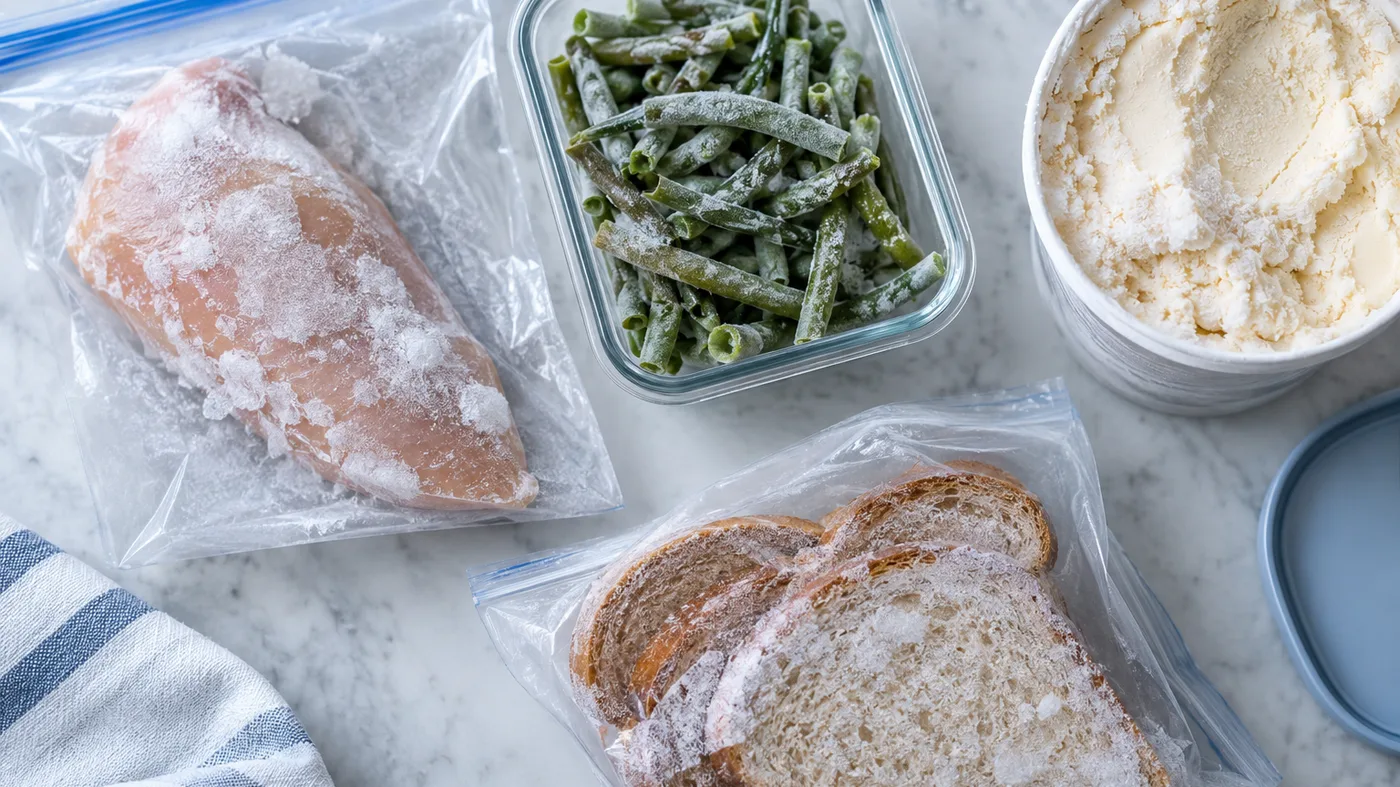
Look for surface drying rather than one universal color. Frost inside a package can accompany moisture movement, but loose ice crystals alone do not prove that food is unsafe or that it thawed. Use the package condition and temperature history with the visual check.
| Food | Typical freezer-burn signs | What the signs mean |
|---|---|---|
| Meat, poultry, and fish | White, gray, tan, or brown dry patches; tough or leathery edges | Exposed areas lost moisture. USDA says the dry portions can be trimmed. |
| Vegetables and fruit | Shriveled pieces, pale dry spots, clumped frost, softer texture after thawing | Texture and flavor may be weaker, especially in exposed pieces. |
| Bread and baked goods | Dry edges, hard spots, frost inside a loose bag | The surface lost moisture and may taste stale after thawing. |
| Ice cream | Coarse crystals, a dry or foamy top, less creamy texture | The emulsion and ice-crystal structure have deteriorated. |
| Soups and sauces | A dried exposed surface or ice buildup above the food | Too much headspace or a loose seal allowed moisture movement. |
Do not use smell or appearance as proof of safety after a thawing event. USDA explains that pathogenic bacteria may not change the taste, smell, or appearance of food. If the temperature history fails the safety rule, discard the food even when it looks normal. Never taste a questionable item to decide whether it is safe.
How can you use freezer-burned food?
First confirm that the food stayed safely frozen. Then decide whether the damaged portion is small enough to remove or mild enough to work around. USDA advises cutting away freezer-burned areas before or after cooking. Heavy damage is a quality reason to discard the food, even when it is technically safe.
| Food type | When it is worth saving | Practical use |
|---|---|---|
| Chicken, beef, pork, or fish | Only a limited surface area is dry and the remaining food has an acceptable flavor after safe thawing. | Trim the dry patch. Use the rest in soup, stew, curry, sauce, or another moist preparation. Cook to the correct safe internal temperature. |
| Frozen vegetables | The pieces are only slightly shriveled or frosty. | Add them directly to soup, sauce, casserole, or a blended dish where crisp texture is not expected. |
| Frozen fruit | The fruit is dry or soft but has no unsafe thawing history. | Use it in cooked sauce, oatmeal, smoothies, or baking rather than serving it for firm texture. |
| Bread | Only the edges are dry and the flavor is still acceptable. | Toast it or use it for crumbs, strata, stuffing, or another recipe that adds moisture. |
| Cooked meals | The meal has a small exposed dry area and was cooled, frozen, thawed, and reheated safely. | Remove the driest portion and reheat with sauce or a small amount of liquid. |
| Ice cream | The container stayed continuously frozen and only the top has surface crystals. | It is a personal quality decision. If the whole tub is coarse or stale tasting, discard it rather than trying to restore the texture. |
Moist cooking can make a slightly dry ingredient more pleasant, but it cannot remove oxidized flavor from the rest of the package. A strongly stale or rancid taste is a quality reason to stop using it. There is no reliable seasoning, brine, or cooking method that returns severely damaged food to its original texture.
For frozen meat that has not been thawed, follow the separate guide to cooking frozen meat safely. For cooked portions, the guide to reheating leftovers properly covers even heating and temperature checks.
When should freezer-burned food be discarded?
Freezer burn is not the reason to discard food after unsafe thawing. Time and temperature are. According to FoodSafety.gov's power-outage chart, frozen food that still contains ice crystals or is 40 degrees F or below can generally be refrozen. Perishable food held above 40 degrees F for more than 2 hours should be discarded.
Discard the food when any of these applies
- The storage history is unknown after a power failure, unplugged freezer, or door left open.
- Perishable food was above 40 degrees F for more than 2 hours.
- Raw meat or poultry juices leaked onto another food that will not be cooked safely.
- The package is torn and the food may have been contaminated by dirty surfaces or other foods.
- Mold, slime, or an unusual odor appears after thawing. These signs are separate from freezer burn.
- The damage is so extensive that the food is leathery, stale, or unpleasant throughout.
If an outage or partial thaw is the concern, check each package separately. A full freezer can stay cold longer than a half-full one, but elapsed time alone does not replace a thermometer or the ice-crystal check. FoodSafety.gov also gives food-specific decisions because bread, hard cheese, vegetables, meat, and ice cream do not all receive the same advice.
How do you prevent freezer burn?
Keep air away from the food and hold the freezer at 0 degrees F or below. The USDA packaging guidance recommends tight wrapping and thick freezer-grade materials. Thin supermarket wrap lets air pass through, so meat or poultry kept longer than a month or two should be overwrapped with airtight heavy-duty foil or freezer wrap.
- Use freezer-grade packaging. Choose heavy freezer bags, heavy plastic wrap, freezer paper, foil, or rigid containers made for freezing.
- Remove excess air. Press air from bags without crushing the food. Wrap irregular pieces closely before placing them in a second protective layer.
- Match the container to the portion. Too much empty space exposes more food to air. Liquids still need appropriate headspace for expansion.
- Freeze practical portions. Smaller, flatter packages freeze faster and let you thaw only what the meal needs.
- Label the package. Add the food name and freezing date so older food gets used while its quality is better.
- Keep the temperature steady. Use a freezer thermometer, close the door promptly, and avoid repeated partial thawing.
The National Center for Home Food Preservation packaging guide also recommends moisture-vapor-resistant materials and labels that include the product, packaging date, and amount. For a complete workflow from cooling through thawing, use the guide to freezing leftover food safely.
Food-specific packaging matters too. Cooked chicken benefits from small meal-size portions, rice should be cooled promptly before freezing, and bread needs a close barrier against dry freezer air. See the guides to freezing cooked chicken, freezing cooked rice, and freezing bread for those methods.
Frequently asked questions
Can freezer-burned food make you sick?
Freezer burn itself does not make food unsafe. It is surface drying caused by air exposure. Safety still depends on how the food was handled before freezing and whether it stayed continuously frozen. Discard perishable food if it was above 40 degrees F for more than 2 hours or if its thawing history is unknown.
Is freezer-burned chicken safe to eat?
Freezer-burned chicken can be safe if it was safe when frozen and remained continuously frozen. Trim dry white or gray patches if the damage is limited, thaw it safely, and cook it to the USDA safe minimum temperature. Discard it if the package leaked, raw juices contaminated other food, or its temperature history is unsafe.
How long does it take food to get freezer burn?
There is no fixed time. Freezer burn can develop sooner when packaging admits air, the package is loose or torn, or the freezer temperature fluctuates. Storage charts give best-quality windows, not a timer that makes continuously frozen food unsafe.
Can thawed freezer-burned food be refrozen?
FoodSafety.gov says frozen food can generally be refrozen if it still contains ice crystals or is 40 degrees F or below, although quality may decline. Perishable food held above 40 degrees F for more than 2 hours should be discarded. Ice cream and frozen yogurt should be discarded after thawing.
Sources
- USDA FSIS: What is freezer burn?
- USDA FSIS: Freezing and Food Safety
- FoodSafety.gov: Food Safety During a Power Outage
- FoodSafety.gov: Cold Food Storage Chart
- National Center for Home Food Preservation: Packaging and Labeling Foods
- Penn State Extension: Signs of Food Spoilage
The decision in one sentence
Freezer burn changes quality, not safety: use the food when it stayed safely frozen and the remaining flavor and texture are acceptable, but discard it when the time-temperature history or contamination risk is unsafe.