Quick Answer
The safe storage window for cooked chicken depends on temperature, handling, and how quickly it was refrigerated. Keep it at 40°F (4°C) or colder, follow the specific time limits below, and discard it sooner if its storage history is uncertain.
Practical note
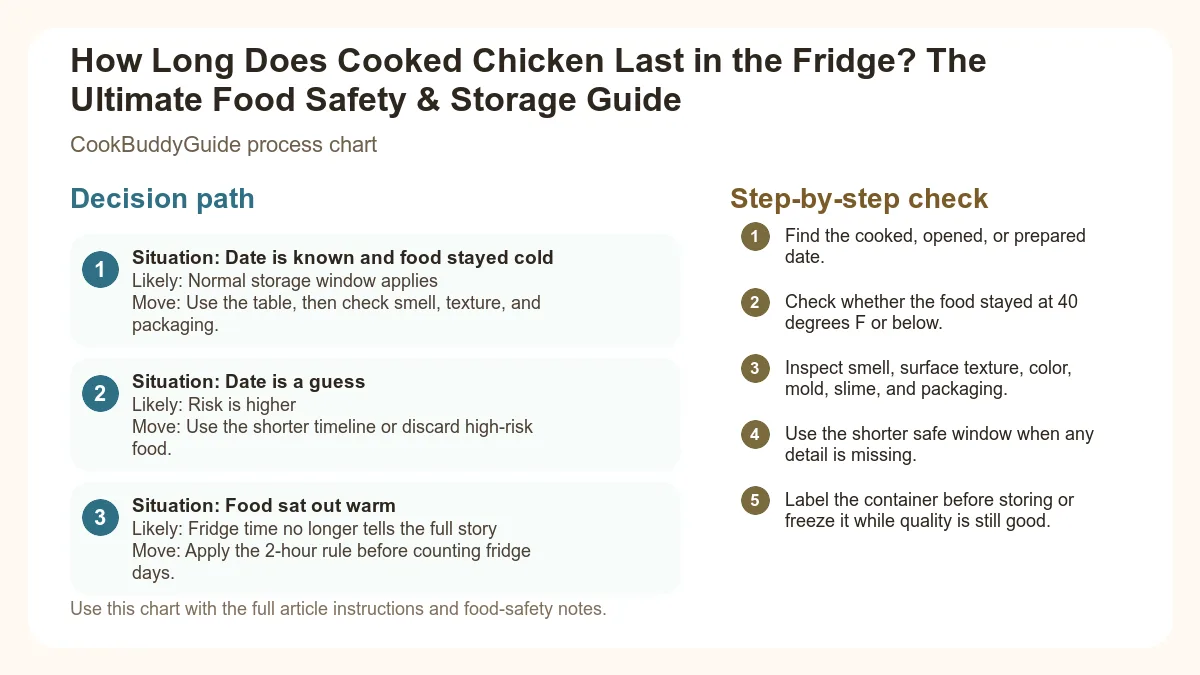
For cooked chicken storage, the home-kitchen check is not only the number of days. We look at the start date, fridge temperature, container seal, serving time, and spoilage signs. If one of those facts is missing, the safer move is to use the shorter window.
Decision table
| Situation | Likely cause or meaning | Best move |
|---|---|---|
| Date is known and food stayed cold | Normal storage window applies | Use the table, then check smell, texture, and packaging. |
| Date is a guess | Risk is higher | Use the shorter timeline or discard high-risk food. |
| Food sat out warm | Fridge time no longer tells the full story | Apply the 2-hour rule before counting fridge days. |
Step-by-step fix
- Find the cooked, opened, or prepared date.
- Check whether the food stayed at 40 degrees F or below.
- Inspect smell, surface texture, color, mold, slime, and packaging.
- Use the shorter safe window when any detail is missing.
- Label the container before storing or freeze it while quality is still good.
Common mistakes
- Counting fridge days from the day you noticed the container instead of the day it was made.
- Ignoring time spent on the counter, in a lunch bag, or on a serving table.
- Trusting smell alone when the date or temperature history is unknown.
- Putting warm food into a deep container that cools slowly.
Related topic hubs
How Long Does Cooked Chicken Last in the Fridge? A Practical Food Safety & Storage Guide
Table of Contents
- The Golden Rule: USDA Guidelines for Cooked Chicken
- Factors That Impact Cooked Chicken Storage Life
- The Store-Bought Rotisserie Chicken Exception
- The 2-Hour Rule: The Critical Cooling Window
- Best Containers for Cooked Chicken Storage
- How to Tell if Cooked Chicken Has Gone Bad
- Freezer Extension: How to Store Chicken for 4+ Months
- Safe Reheating Practices to Prevent Food Poisoning
- Common Meal Prep Mistakes with Cooked Chicken
The Golden Rule: USDA Guidelines for Cooked Chicken
When it comes to leftover chicken, the USDA (United States Department of Agriculture) is the ultimate authority. According to the USDA chicken storage guidelines, cooked chicken should be consumed within three to four days when kept refrigerated at 40 degrees Fahrenheit or below. This window is shorter than many people realize, often leading to the "Sunday prep, Friday lunch" mistake that can lead to Salmonella or other bacterial infections.
The 3 to 4 Day Window Explained
Why the 'Sniff Test' Isn't Enough
Factors That Impact Cooked Chicken Storage Life
Whole Pieces vs. Shredded Chicken
Plain vs. Sauced and Marinated Chicken
The Impact of Cooking Methods (Roasted vs. Fried)
Fried chicken is a unique beast. The crispy skin acts as a moisture trap. While it tastes delicious on night one, that trapped moisture migrates into the breading by night two, creating a soggy environment that bacteria love. Roasted chicken, with its rendered fat and tighter skin, generally holds its texture better in cooked chicken storage. If you are storing fried chicken, consider placing a paper towel at the bottom of the container to wick away excess moisture.
Pro-Tip: The "Prep-Ahead" Shredded Chicken
- Step 1: Poach or roast your chicken until it reaches an Internal Temperature of 165°F.
- Step 2: Let it rest for 10 minutes (do not shred yet!).
- Step 3: Place the whole pieces in a shallow glass container.
- Step 4: Cover tightly and refrigerate.
- Step 5: Shred only the portion you need for your meal right before reheating. This keeps the meat juicy and prevents premature oxidation.
The Store-Bought Rotisserie Chicken Exception
We’ve all grabbed a rotisserie chicken on a busy Tuesday. It’s the ultimate life-saver. However, store-bought birds come with their own set of rules. Because they are often kept in "hot cases" for hours, their journey to your fridge is different than a bird you cooked yourself.
From the Hot Case to Your Fridge
The biggest mistake people make is leaving the chicken in that plastic dome container in the fridge. Those containers are designed for display, not for long-term cooked chicken storage. They trap steam, which leads to a slimy texture and faster spoilage. As soon as you get home, if you aren't eating it immediately, you need to intervene. If you're looking for ways to use it up quickly, check out these leftover rotisserie chicken recipes.
How to Process a Rotisserie Chicken for Maximum Shelf Life
The 2-Hour Rule: The Critical Cooling Window
This is where most home cooks fail. According to the safe food handling practices outlined by the FDA, perishable foods should never be left out at room temperature for more than two hours. If the ambient temperature is above 90°F (like at a summer BBQ), that window shrinks to just one hour.
The Danger Zone (40°F - 140°F)
Bacteria thrive in the temperature range between 40°F and 140°F. In this zone, populations can double every 20 minutes. If you leave your chicken on the counter to "cool down" for three hours before putting it away, you’ve already given the bacteria a massive head start. Even if you refrigerate it afterward, the toxins some bacteria produce are heat-stable and won't be destroyed by reheating.
The Shallow Container Method for Faster Cooling
Best Containers for Cooked Chicken Storage
Glass vs. Plastic: Which is Safer?
The Paper Towel Trick for Moisture Control
How to Tell if Cooked Chicken Has Gone Bad
Sometimes the calendar fails us. Maybe your fridge was left ajar, or perhaps you forgot exactly when you cooked that bird. In these cases, you need to use your senses—but use them wisely. As mentioned in the storing leftover roast chicken guide, there are three main indicators of spoilage.
The Visual Inspection: Color and Mold
Freshly cooked chicken should be white or brown (depending on the cut and cooking method). If you see any hint of grey, green, or even a dull yellow tint, toss it immediately. Mold is an obvious sign, but remember that by the time mold is visible on the surface, the "roots" of the mold have likely penetrated deep into the meat. Do not just cut off the moldy bit; the whole piece is compromised.
Texture Changes: The 'Slimy' Factor
This is the most reliable physical indicator. If you touch the chicken and it feels slimy, "tacky," or excessively slippery, it’s gone bad. This slime is actually a biofilm created by bacterial colonies. Fresh chicken should feel moist but firm. If it leaves a residue on your fingers that feels like soap or gel, it is no longer safe to eat.
The Scent Profile of Spoiled Poultry
Freezer Extension: How to Store Chicken for 4+ Months
If you realize you aren't going to finish that chicken within the 4-day window, the freezer is your best friend. Cooked chicken can last 4 to 6 months in the freezer while maintaining good quality, though it remains safe to eat indefinitely if kept at 0°F.
Preventing Freezer Burn
Freezer burn isn't a safety issue, but it ruins the texture and flavor of the meat. To prevent it, you need to eliminate air. Use a double-wrapping technique: wrap the chicken tightly in heavy-duty aluminum foil or plastic wrap, then place it inside a high-quality freezer bag. Squeeze out every bit of air before zipping it shut. If you do a lot of meal prep, a vacuum sealer is a worthwhile investment that can extend the quality for up to a year.
Thawing Safely: The Three Approved Methods
Never thaw cooked chicken on the counter. The outer layer will reach the Danger Zone while the center is still frozen. The three safe methods are:
- The Refrigerator: The gold standard. Requires 24 hours but keeps the meat at a safe temperature.
- Cold Water: Place the sealed bag in a bowl of cold water, changing the water every 30 minutes.
- Microwave: Only use this if you plan to eat the chicken immediately, as it can start the cooking process and create hot spots where bacteria can thrive.
Safe Reheating Practices to Prevent Food Poisoning
Reheating is the final hurdle in the food safety marathon. You can't just warm it up until it's "hot enough to eat." You need to kill any bacteria that might have started to grow during storage.
The 165°F Internal Temperature Rule
Every time you reheat leftover chicken, it must reach an Internal Temperature of 165 degrees Fahrenheit. Use a digital meat thermometer to check. Don't guess. The middle of the thickest piece needs to hit that number to ensure total safety.
Reheating Multiple Times: Is it Safe?
While the USDA says it is technically safe to reheat leftovers multiple times as long as they reach 165°F each time, Avoid it. Each cooling and reheating cycle degrades the texture, dries out the meat, and provides a window for bacterial growth. My rule in the CookBuddyGuide kitchen is: Reheat only what you are going to eat right now.
How to Reheat Without Drying Out the Meat
The biggest complaint with leftover chicken is that it becomes "rubbery." To avoid this, add a splash of chicken broth, water, or even a little butter to the container before reheating. This creates steam that keeps the meat moist. If using a microwave, cover the dish with a damp paper towel and use 50% power to ensure even heating without "blasting" the exterior.
The Perfect Reheat: Skillet Method
- Step 1: Slice the cold chicken into even strips.
- Step 2: Heat a non-stick skillet over medium heat with 1 tablespoon of broth or water.
- Step 3: Add the chicken and cover with a lid for 2 minutes to let the steam penetrate.
- Step 4: Remove the lid and toss until the liquid has evaporated and the chicken reaches 165°F.
- Step 5: Serve immediately for the best texture.
Common Meal Prep Mistakes with Cooked Chicken
Overcrowding the Fridge
Ignoring Fridge Temperature Calibration
Do you actually know how cold your fridge is? The dial that says "1 through 7" is not a thermometer. Consider buying a cheap secondary refrigerator thermometer. Place it in the center of the fridge. If it reads above 40°F, your chicken (and everything else) is at risk. Keep mine at 37°F to allow for a small buffer when the door is opened frequently.
Frequently Asked Questions
A: While you might be fine, it is not recommended. The risk of foodborne illness increases significantly after day 4. It’s better to be safe and toss it or freeze it by day 3.
A: Yes! Never store chicken in the fridge door, as the temperature fluctuates every time you open it. Store it on the bottom shelf, which is usually the coldest part of the appliance.
A: Yes, as long as it has been stored properly. However, the quality will be better if you freeze it on day 1 or 2.
Conclusion: Stay Safe and Eat Well
Managing cooked chicken storage doesn't have to be a guessing game. By following the 3-to-4-day USDA rule, respecting the 2-hour cooling window, and using the right Airtight Containers, you can enjoy your leftovers with total peace of mind. Remember, when in doubt, the freezer is your best friend for extending that shelf life.