Quick Answer
The safe storage window for soup depends on temperature, handling, and how quickly it was refrigerated. Keep it at 40°F (4°C) or colder, follow the specific time limits below, and discard it sooner if its storage history is uncertain.
Practical note
For soup storage, the home-kitchen check is not only the number of days. We look at the start date, fridge temperature, container seal, serving time, and spoilage signs. If one of those facts is missing, the safer move is to use the shorter window.
Decision table
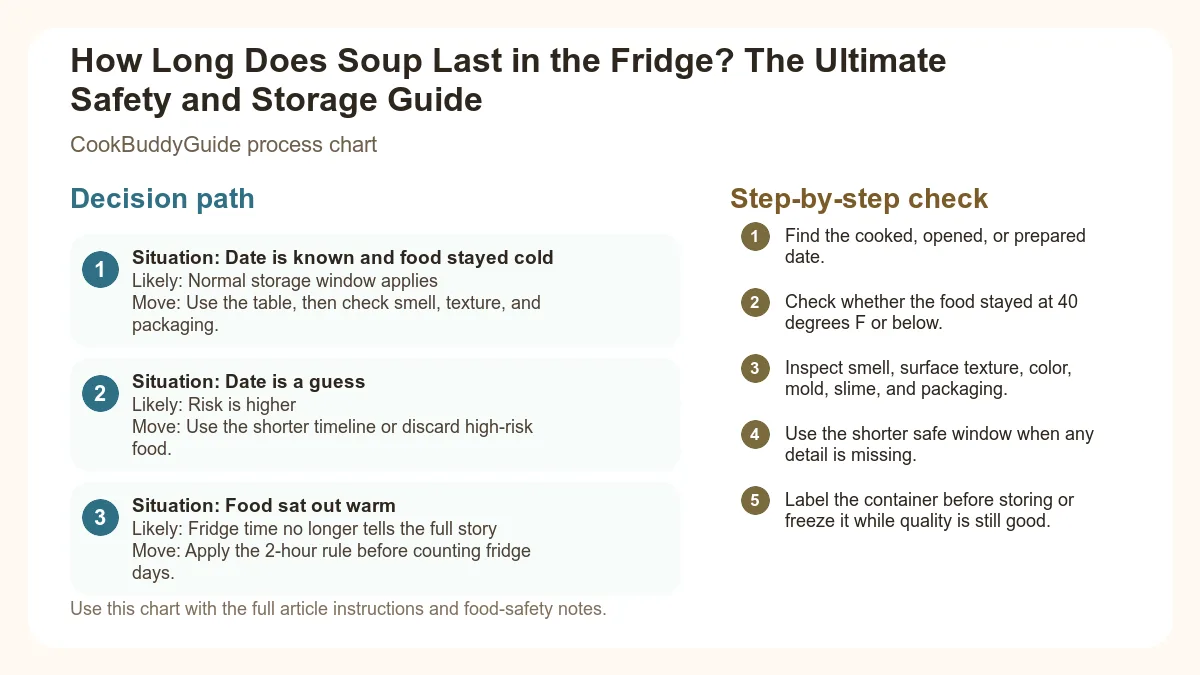
| Situation | Likely cause or meaning | Best move |
|---|---|---|
| Date is known and food stayed cold | Normal storage window applies | Use the table, then check smell, texture, and packaging. |
| Date is a guess | Risk is higher | Use the shorter timeline or discard high-risk food. |
| Food sat out warm | Fridge time no longer tells the full story | Apply the 2-hour rule before counting fridge days. |
Step-by-step fix
- Find the cooked, opened, or prepared date.
- Check whether the food stayed at 40 degrees F or below.
- Inspect smell, surface texture, color, mold, slime, and packaging.
- Use the shorter safe window when any detail is missing.
- Label the container before storing or freeze it while quality is still good.
Common mistakes
- Counting fridge days from the day you noticed the container instead of the day it was made.
- Ignoring time spent on the counter, in a lunch bag, or on a serving table.
- Trusting smell alone when the date or temperature history is unknown.
- Putting warm food into a deep container that cools slowly.
Related topic hubs
In This Guide:
- The Quick Answer: The 3-to-4 Day Window
- Storage Breakdown by Soup Type
- The Science of Cooling: Preventing the Danger Zone
- Choosing the Best Storage Containers
- Freezing Soup for Long-Term Preservation
- Safe Reheating Methods for Maximum Flavor
- How to Tell if Your Soup Has Gone Bad
- Frequently Asked Questions
The Quick Answer: The 3-to-4 Day Window
If you’re looking for the short, safe answer: most homemade soups last between 3 to 4 days in the refrigerator. This timeframe aligns with the USDA guidelines for leftover safety, which state that cooked perishable food should be consumed or moved to long-term storage within this window.
How Long Does Soup Last in the Fridge? Breakdown by Type
Clear Broths and Stock-Based Soups
Shelf Life: 3–4 Days
Creamy and Dairy-Based Soups
Hearty Bean, Lentil, and Grain Soups
Shelf Life: 3–5 Days
Beans and lentils are incredibly hardy. Interestingly, these often taste better on day two or three as the flavors meld. However, be aware that grains like rice or pasta will continue to absorb liquid while in the fridge. What was a soup on Sunday might become a thick stew by Tuesday. If you’re using beginner friendly instant pot recipes for your bean soups, remember that the high-pressure environment doesn't extend the shelf life once the lid is opened.
Seafood Soups and Chowders
Shelf Life: 1–2 Days Max
Pro-Tip: The "Chili Exception"
The Science of Cooling: Preventing the "Danger Zone"
The most dangerous mistake you can make with soup happens before it even touches the fridge. Food safety experts refer to the temperature range between 40°F and 140°F as the "Danger Zone." In this range, bacteria can double in number every 20 minutes.
The Two-Stage Cooling Method
You should never take a boiling pot of soup and put it directly into the refrigerator. Why? Because a large mass of hot liquid will raise the internal refrigerator temperature, potentially putting your milk, eggs, and other perishable food at risk of spoiling. Instead, use the two-stage method:
- Stage 1: Cool the soup from 140°F to 70°F within two hours.
- Stage 2: Cool it from 70°F to 40°F within an additional four hours.
The Ice Bath Shortcut
If you've made a massive batch of liquid gold bone broth, it can take hours to cool on the counter. To speed this up, Use the practical technique of cooling down a large pot: fill your sink with ice and a little water, then set the pot inside. Stir the soup frequently; this moves the heat from the center to the edges, cooling it in a fraction of the time.
Choosing the Best Storage Containers
Your choice of vessel is the second line of defense in your soup storage guide. To prevent cross-contamination and odors, you need airtight containers.
- Glass Jars and Pyrex: This is my gold standard. Glass is non-porous, meaning it won't absorb the smell of garlic or onions. Mason jars are excellent for individual portions, but leave space at the top (headspace) if you plan to freeze them.
- BPA-Free Plastic: Lightweight and convenient for meal prep, but plastic can warp over time and often stains from tomato-based soups. If using plastic, ensure the seal is still tight.
- Silicone Bags: These are excellent for saving space. You can lay them flat in the fridge or freezer. They are a favorite for those following make-ahead crockpot freezer meals.
Freezing Soup: Tips for Long-Term Preservation
If you realize you won't finish that chicken noodle soup within 4 days, the freezer is your best friend. Most soups will last 3 to 6 months in the freezer before freezer burn begins to affect the taste.
What Freezes Well (and What Doesn't)
According to freezing different types of soup research, texture is the biggest hurdle.
- Freeze: Broths, bean soups, chili, and meat-heavy stews.
- Avoid Freezing: Soups with heavy cream (they curdle), potatoes (they turn mealy), or delicate noodles (they turn to mush).
The "Souper Cube" and Portioning
I stopped freezing soup in large gallon tubs years ago. It’s impossible to defrost just what you need. Instead, follow best practices for freezing soup by using silicone molds or muffin tins to freeze individual 1-cup portions. Once frozen solid, pop them into a freezer bag. This makes weekday lunches a breeze.
Safe Reheating Methods for Maximum Flavor
Reheating is about more than just making the soup hot; it's about kitchen hygiene. You must reach the "magic number" to ensure any bacteria that may have developed are destroyed.
The Reheating Checklist
- Target Temperature: Use a food thermometer to ensure the soup reaches 165°F. This is the safe food handling and reheating standard.
- Stirring: Whether in the microwave or on the stove, stir every 60 seconds to eliminate cold spots where bacteria can hide.
- Liquid Revival: Bean and grain soups often thicken into a paste. Add 1/4 cup of water or broth per bowl to bring it back to its original consistency.
- Only Reheat Once: Each time you heat and cool soup, the quality drops and the risk of contamination rises. Only reheat the portion you plan to eat.
How to Tell if Your Soup Has Gone Bad
Sometimes we lose track of the days. If you're staring at a container and wondering, "How long has this been here?", use your senses. However, remember that some dangerous bacteria, like Staphylococcus aureus, don't always produce a smell or change the look of the food.
The Senses Test
- The Smell: If it smells "sour," "funky," or "yeasty," it's gone. This is especially true for broth-based soups which should smell clean and savory.
- The Sight: Look for any "fizzy" bubbles on the surface (a sign of fermentation) or fuzzy mold. Slimy vegetables are also a major red flag.
- The Texture: If a broth that was once clear is now cloudy and "goopy," bacteria have likely taken over.
The Golden Rule: When in doubt, throw it out. No bowl of soup is worth the risk of 24 hours of food poisoning symptoms.
Frequently Asked Questions
No. While boiling kills active bacteria, some bacteria (like Bacillus cereus) produce heat-stable toxins that cannot be destroyed by cooking. If it's been in the "Danger Zone" for more than 2 hours, discard it.
Once a can is opened, the clock starts. Treat it exactly like homemade soup—move it to an airtight container and eat it within 3 to 4 days.
As soup sits, chemical reactions continue to happen. Aromatics like onions and garlic break down and disperse, and proteins continue to release savory amino acids. This is why many chefs recommend making soup 24 hours before serving!
Final Thoughts from the CookBuddy Kitchen
Mastering how long does soup last in fridge is a fundamental skill for any home cook. By respecting the 3-to-4 day window, using proper cooling techniques, and choosing the right containers, you can enjoy your favorite comfort foods without the stress of spoilage. Soup is truly the gift that keeps on giving—as long as you treat it with the care it deserves.
Now that you know how to store your soup safely, why not start a new batch? Check out our beginner friendly instant pot recipes to get a head start on your next meal prep Sunday. Happy (and safe) cooking!