
Quick Answer
This guide explains how to store fresh herbs so they last for weeks. From the mason jar method to freezing, discover the best ways to keep herbs fresh and stop wasting money.
Practical note
For How to Store Fresh Herbs, this guide centers on Cilantro, Parsley, Mint. Those are the checkpoints we would use first in a normal home kitchen before making a bigger change.
Decision table
| Situation | Likely cause or meaning | Best move |
|---|---|---|
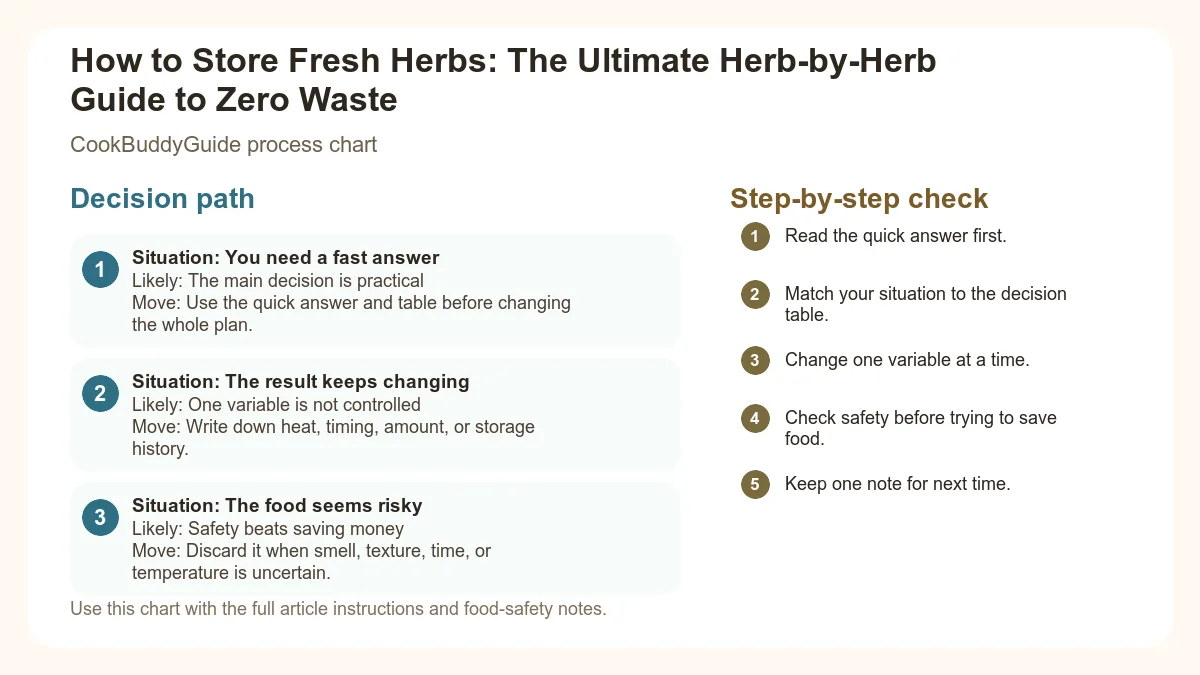
| You need a fast answer | The main decision is practical | Use the quick answer and table before changing the whole plan. |
| The result keeps changing | One variable is not controlled | Write down heat, timing, amount, or storage history. |
| The food seems risky | Safety beats saving money | Discard it when smell, texture, time, or temperature is uncertain. |
Step-by-step fix
- Read the quick answer first.
- Match your situation to the decision table.
- Change one variable at a time.
- Check safety before trying to save food.
- Keep one note for next time.
Common mistakes
- Skipping the quick answer and changing too much at once.
- Treating quality problems and safety problems the same way.
- Not writing down the detail that caused the repeat problem.
Related topic hubs
Table of Contents
- The Science of Herb Longevity: Why They Wilt
- Soft vs. Hardy: Identifying Your Herb Type
- The Mason Jar Method: Best for Soft Herbs
- The Paper Towel Wrap: Best for Hardy Herbs
- The Basil Exception: Why Your Basil Turns Black
- Long-Term Preservation: Freezing and Drying
- Quick-Reference Herb Storage Chart
- Common Mistakes and How to Fix Wilted Herbs
The Science of Herb Longevity: Why They Wilt
Respiration and Ethylene Gas
The Role of Moisture Control
This is where most home cooks fail. Herbs are a delicate balance of hydration. Too little moisture and the cells lose turgor pressure, leading to wilting. Too much moisture, especially sitting directly on the leaves, encourages the growth of bacteria and mold. Oxidation also plays a role; when leaves are bruised or overly wet, they react with oxygen and begin to break down. To keep herbs fresh, we must provide humidity to the stems while keeping the leaves relatively dry.
Temperature Sensitivity
While we often think of the refrigerator as the ultimate preservative, it’s actually a hostile environment for certain plants. Most culinary herbs thrive in cool, but not freezing, temperatures. However, tropical herbs (like basil) suffer from "chilling injury" in the fridge, which disrupts their photosynthesis remnants and turns the leaves black almost instantly. Understanding which herbs are cold-hardy and which are cold-sensitive is the first step toward zero waste.
Soft vs. Hardy: Identifying Your Herb Type
Soft Herbs (Tender Stems)
Soft herbs have tender, green, edible stems. They are high in moisture and very delicate. This category includes:
- Cilantro: Perhaps the most notorious for wilting.
- Parsley: Both flat-leaf and curly varieties.
- Mint: Which loves water but can easily rot.
- Dill: Very thin fronds that dry out quickly.
- Tarragon: Highly aromatic and very sensitive to heat.
Hardy Herbs (Woody Stems)
Hardy herbs have woody stems and tougher, often needle-like or leathery leaves. They generally grow in Mediterranean climates and are built to withstand more stress. This category includes:
- Rosemary: The sturdiest of the bunch.
- Thyme: Small leaves but very resilient.
- Sage: Fuzzy leaves that actually dislike excess surface moisture.
- Oregano: Tough stems that can handle the cold.
- Chives: While they look soft, they actually behave more like hardy herbs in storage.
The Mason Jar Method: Best for Soft Herbs
If you want your cilantro and parsley to last for weeks, you must treat them like a bouquet of flowers. This is often called the "bouquet technique," and storing herbs in mason jars is the most effective way to implement it. According to scientific testing on herb storage, this method consistently outperforms all others for tender herbs.
A Practical Soft Herb Storage Technique
- Trim the Stems: Use sharp kitchen shears to trim the bottom half-inch of the stems at a 45-degree angle. This increases the surface area for water uptake.
- Clean the Base: Remove any lower leaves that would sit below the water line. Leaves in water will rot, creating bacteria that kills the whole bunch.
- The Water Bath: Fill a clean mason jar with about 1-2 inches of cold water. Place the herbs in the jar.
- The Plastic Bag "Tent": This is the secret step. Loosely cover the top of the herbs with a plastic bag (the one from the grocery store is fine). This creates a high-humidity microclimate while still allowing for some air exchange. Secure it with a rubber band around the jar if you want to be extra precise.
- Refrigerate: Place the jar in the fridge, preferably on a shelf rather than in the back where it might freeze.
Testing Notes: In my side-by-side tests, cilantro stored in a grocery bag lasted 4 days before turning yellow. Cilantro stored using this mason jar method lasted 22 days. The key is to change the water every 2-3 days. If the water looks cloudy, change it immediately!
The Paper Towel Wrap: Best for Hardy Herbs
Hardy herbs like rosemary and thyme don't need to sit in a pool of water. In fact, doing so often leads to mold. Instead, they need a controlled, humid environment. This is where the damp paper towel method shines. This technique prevents the leaves from drying out while keeping them away from standing water.
The Damp Wrap Method for Woody Herbs
- Dampen, Don't Soak: Take a paper towel and run it under the tap. Wring it out thoroughly until it is just barely damp to the touch.
- The Wrap: Lay the herbs in a single layer on the towel and roll them up loosely like a cigar.
- The Container: Place the roll into an airtight container or a reusable silicone bag. If using a plastic bag, press out as much air as possible before sealing.
- Storage: Store this in the crisper drawer of your refrigerator storage.
The Basil Exception: Why Your Basil Turns Black
Basil is the "problem child" of the herb world. It is incredibly sensitive to cold. If you put basil in the fridge, the leaves will turn black and slimy within 24 hours. This is because the cold temperature causes the cell walls to collapse, leading to rapid oxidation. To keep this herb alive, you have to treat it differently than any other.
According to America's Test Kitchen's research on the best way to store basil, the countertop is your only friend here.
The Countertop Basil Bouquet
- Trim and Jar: Trim the stems and place them in a jar of room-temperature water.
- Location Matters: Place the jar on your kitchen counter. Avoid direct sunlight, which can "cook" the leaves and cause yellowing. A shaded corner is best.
- The Darkness Trick: If your kitchen is very bright, loosely drape a paper bag over the top. This mimics the darkness they prefer for longevity once cut.
- Do NOT Refrigerate: I cannot stress this enough. Keep it away from the fridge!
Long-Term Preservation: Freezing and Drying
The Herb Oil Cube Method
Flash Freezing
For herbs like chives or dill, where you want to keep the individual pieces separate, use the flash-freeze method. Spread chopped herbs in a single layer on a parchment-lined sheet pan. Freeze for 1 hour, then scrape them into a freezer-safe bag. They won't clump together, allowing you to shake out exactly what you need for a garnish.
Quick-Reference Herb Storage Chart
Use this chart as your go-to guide for every grocery trip. Consider printing this out and taping it to the inside of your pantry door!
| Herb | Type | Storage Method | Location | Shelf Life |
|---|---|---|---|---|
| Cilantro | Soft | Jar with water + Bag tent | Refrigerator | 3 Weeks |
| Parsley | Soft | Jar with water + Bag tent | Refrigerator | 3 Weeks |
| Basil | Soft | Jar with water (No cover) | Countertop | 1 Week |
| Mint | Soft | Jar with water + Bag tent | Refrigerator | 2 Weeks |
| Dill | Soft | Damp paper towel wrap | Refrigerator | 10 Days |
| Rosemary | Hardy | Damp paper towel wrap | Refrigerator | 4 Weeks |
| Thyme | Hardy | Damp paper towel wrap | Refrigerator | 3 Weeks |
| Sage | Hardy | Damp paper towel wrap | Refrigerator | 2 Weeks |
| Chives | Hardy-ish | Dry paper towel wrap | Refrigerator | 10 Days |
| Oregano | Hardy | Damp paper towel wrap | Refrigerator | 2 Weeks |
For more detailed breakdowns on specific varieties, you can check out this guide on how to keep fresh herbs lasting longer from the Food Network experts.
Common Mistakes and How to Fix Wilted Herbs
The Ice Water Shock Treatment
Washing Before vs. After Storage
The "One Bad Leaf" Rule
Ethylene gas is contagious. If one leaf in your bunch starts to turn slimy or black, it will release gases that kill the rest of the bunch. Every time you pull your herbs out of the fridge, do a quick "triage." Remove any yellowing or soft leaves immediately. This simple 30-second habit can extend the life of the remaining bunch by several days.
Frequently Asked Questions
A: Absolutely. Any vessel that holds the stems upright in water will work. Choose mason jars because they are sturdy and less likely to tip over in a crowded fridge.
A: Generally, no. Excess moisture is the enemy of storage. Only wash them if they are visibly covered in dirt, and if you do, ensure they are completely dry before wrapping or jarring them.
A: Your paper towel likely dried out. Check the wrap once a week; if it feels dry to the touch, give it a quick spritz of water to maintain the humidity.
Final Thoughts on Reducing Food Waste
Learning how to store fresh herbs is one of the most impactful skills you can develop to reduce food waste and save money. It takes less than five minutes when you get home from the store, but it pays off in flavor and freshness for weeks. Remember: soft herbs love a "bouquet" in the fridge, hardy herbs love a "damp wrap," and basil wants to stay on the counter. By following these simple rules, you’ll always have the perfect fresh garnish ready to go, no matter how busy your week gets. Happy cooking!