Quick Answer
Both canned and frozen vegetables can be nutritious, affordable choices. Frozen vegetables usually retain a firmer texture, while canned vegetables are ready to eat; compare added sodium, sauces, cost, storage space, and the dish you are making.
Practical note
For Canned vs Frozen Vegetables, this guide centers on Don't Thaw, High Heat, The Sear. Those are the checkpoints we would use first in a normal home kitchen before making a bigger change.
Decision table
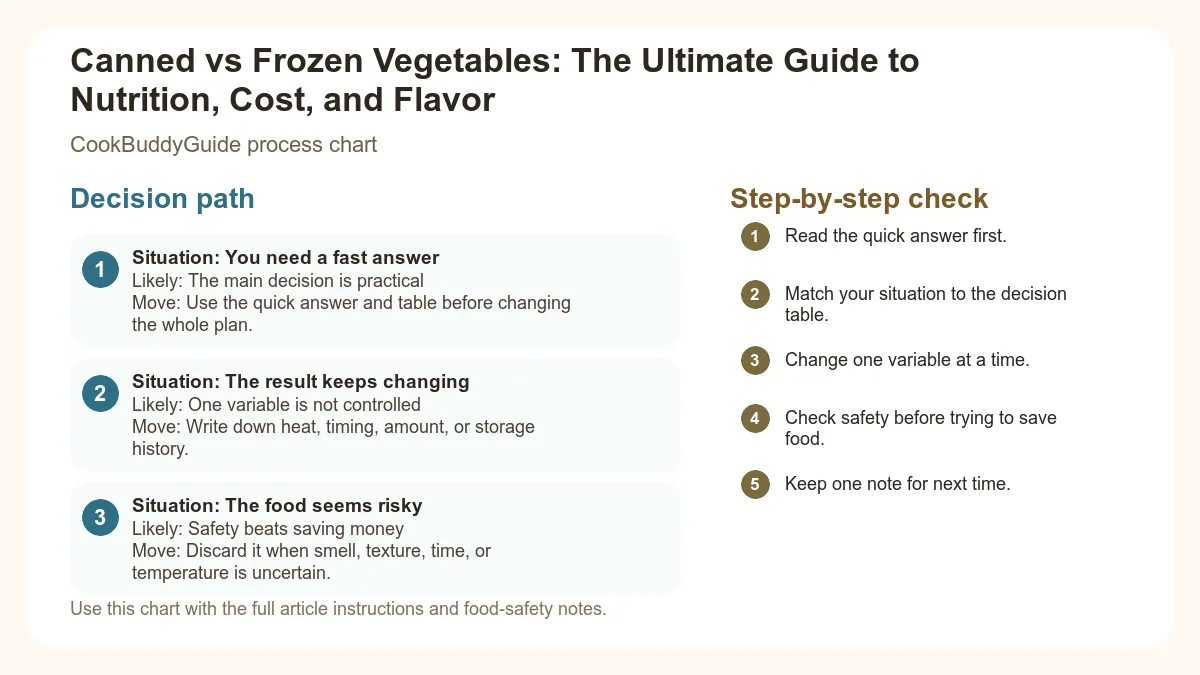
| Situation | Likely cause or meaning | Best move |
|---|---|---|
| You need a fast answer | The main decision is practical | Use the quick answer and table before changing the whole plan. |
| The result keeps changing | One variable is not controlled | Write down heat, timing, amount, or storage history. |
| The food seems risky | Safety beats saving money | Discard it when smell, texture, time, or temperature is uncertain. |
Step-by-step fix
- Read the quick answer first.
- Match your situation to the decision table.
- Change one variable at a time.
- Check safety before trying to save food.
- Keep one note for next time.
Common mistakes
- Skipping the quick answer and changing too much at once.
- Treating quality problems and safety problems the same way.
- Not writing down the detail that caused the repeat problem.
Related topic hubs
You open your crisper drawer on a Thursday night only to find a bag of spinach that has turned into a green, translucent puddle of sadness. We’ve all been there. There is a specific kind of guilt that comes with throwing away "fresh" produce—a feeling that we’ve failed at being healthy, failed our grocery budget, and failed the environment. For years, the culinary world has hammered home the mantra that "fresh is best," leaving home cooks feeling like they are settling for second-best when they reach for a bag of frozen peas or a can of corn.
Table of Contents
- The Science of Nutrition: Fresh vs Canned vs Frozen
- The Practicality Factor: Cost, Convenience, and Waste
- Navigating the Sodium and Additive Trap
- Texture and Taste: A Cook’s Guide to Application
- A Practical Verdict: Vegetable-by-Vegetable Comparison
- Kitchen Tips for Cooking with Frozen and Canned Veggies
- Conclusion: Building a Sustainable Kitchen Strategy
The Science of Nutrition: Fresh vs Canned vs Frozen
When we talk about fresh vs canned vs frozen nutrition, we have to talk about timing. The moment a vegetable is harvested, its nutrient clock starts ticking. Enzymes begin to break down vitamins, and respiration consumes the sugars that provide flavor.
How Freezing Locks in Nutrients at the Source
Most frozen vegetables undergo a process called flash-freezing. Within hours of being picked at their peak ripeness, vegetables are transported to a nearby facility, briefly submerged in boiling water or steam (a process known as blanching vegetables), and then frozen at extremely low temperatures. This process halts enzymatic activity that causes decay.
Because of this, frozen vegetables often have a higher nutrient density than "fresh" produce that has spent five days in a truck and another three days on a shelf. According to research on how freezing preserves nutrients at peak, the levels of Vitamin A and carotenoids in frozen options are often identical to, or even higher than, their fresh counterparts.
The Impact of Heat: What Happens During Canning?
Canning is a different beast. It involves high-heat processing to ensure the product is commercially sterile. This heat can cause a decline in water-soluble vitamins, specifically Vitamin C and various B vitamins like ascorbic acid. However, it’s not all bad news. The high heat used in canning and retort packaging (those flexible pouches you see in aisles now) can actually increase the bioavailability of certain nutrients.
For example, the lycopene in tomatoes—a powerful antioxidant—is much more easily absorbed by your body after it has been heated during the canning process. This is why nutritional value of canned goods is often misunderstood; while some vitamins take a hit, others become more potent.
The "Fresh" Paradox: Nutrient Degradation During Transport
The Practicality Factor: Cost, Convenience, and Waste
As a home cook, your time and your wallet are just as important as your vitamin intake. This is where canned vs frozen vegetables truly shine. If you are trying to master budget friendly dinner recipes, the freezer aisle is your best friend.
Price Per Serving Breakdown
During a recent price audit at my local grocery store, I compared organic fresh broccoli to conventional frozen florets. The fresh broccoli was $2.99/lb, but after trimming the woody stalks (which account for nearly 40% of the weight), the "usable" price jumped to nearly $5.00/lb. The frozen florets, already trimmed and ready to go, were $1.89 for a 12oz bag. That is a massive difference when feeding a family of four.
Shelf Life and Food Waste Reduction
Food waste reduction is perhaps the strongest argument for the non-fresh categories. The average American family throws away nearly 30% of the groceries they buy. Frozen vegetables allow you to use exactly what you need—a handful of peas for a carbonara, a cup of corn for a chowder—while the rest stays preserved. Canned goods, with their 2-5 year shelf life, act as a "safety net" for those nights when you haven't been to the store in a week.
Prep Time: The Hidden Value of Pre-Cut Veggies
We often forget to factor in the "labor cost" of cooking. A frozen stir fry mix or a pre-diced frozen mirepoix (onions, carrots, and celery) can save 15-20 minutes of knife work. For busy parents, steam-in-bag veggies are a literal lifesaver, taking a side dish from a chore to a 4-minute microwave task.
Navigating the Sodium and Additive Trap
The primary criticism of canned vegetables is their sodium content. Manufacturers use salt not just for flavor, but as a preservative to maintain the texture of the vegetable over long periods of storage.
The "Drain and Rinse" Rule
Reading Labels: BPA and Sugars
When shopping for canned goods, look for BPA-free cans. Bisphenol A is a chemical used in the lining of some cans that has raised health concerns. Most major brands have phased this out, but it’s always worth checking the label. Additionally, be wary of "sauced" frozen vegetables. While plain frozen green beans are great, the ones in "butter sauce" often contain hidden sugars and emulsifiers that negate the health benefits.
Texture and Taste: A Cook’s Guide to Application
When Frozen Wins
In 90% of my recipes, frozen peas vs fresh isn't even a contest. Fresh peas are starchy and lose their sweetness within hours of harvest. Frozen peas are sweet, vibrant, and have a perfect "pop." They are ideal for stir-frys, smoothies (yes, frozen cauliflower in a smoothie is a great thickener!), and quick steaming. For more on this, check out these best uses for frozen vegetables.
When Canned Wins
Technique Spotlight: The Searing Secret for Frozen Veggies
The biggest mistake people make with frozen vegetables is steaming them until they are limp. To get a "fresh" snap and charred flavor, follow this method:
- Don't Thaw: Take your veggies (corn, green beans, or broccoli) straight from the freezer to the pan.
- High Heat: Get a cast-iron or heavy stainless steel skillet very hot with 1 tablespoon of high-smoke-point oil (like avocado oil).
- The Sear: Drop the frozen veggies in a single layer. Do not crowd the pan! Let them sit undisturbed for 3 minutes. The high heat will evaporate the ice crystals instantly rather than letting them melt into a puddle.
- The Finish: Toss quickly, add a pinch of salt and a squeeze of lemon juice, and remove from heat immediately.
A Practical Verdict: Vegetable-by-Vegetable Comparison
| Vegetable | Best Form | Why? |
|---|---|---|
| Peas | Frozen | Superior sweetness and color compared to fresh or canned. |
| Tomatoes | Canned | Higher lycopene and better flavor than "winter" fresh tomatoes. |
| Spinach | Frozen | Incredible value; one block equals 3-4 large fresh bunches. |
| Corn | Frozen/Canned | Frozen for crunch; canned for soups and creamed corn. |
| Broccoli | Fresh | Frozen broccoli can get watery; fresh is better for roasting. |
| Green Beans | Fresh/Frozen | Frozen "haricots verts" are a fantastic pantry staple. |
Kitchen Tips for Cooking with Frozen and Canned Veggies
If you find that your canned or frozen veggies taste "dull," it’s likely an issue of acidity and seasoning rather than the vegetable itself. Because these items have been processed, they often need a little "brightness" to wake them up.
Seasoning Hacks
The "Pantry-Pull" Minestrone
This recipe uses all three forms of vegetables to create a nutrient-dense, incredibly cheap meal. It’s a staple for my crockpot freezer meals rotation.
- 1 can (28 oz) crushed tomatoes (Canned)
- 1 can (15 oz) kidney beans, rinsed (Canned)
- 2 cups frozen mixed vegetables (corn, carrots, peas) (Frozen)
- 1 cup fresh zucchini, chopped (Fresh)
- 4 cups vegetable broth
- 1 tsp dried oregano + 2 cloves minced garlic
Instructions: Sauté the garlic and fresh zucchini in a pot for 3 minutes. Add the broth, tomatoes, and beans. Bring to a simmer. In the last 5 minutes of cooking, stir in the frozen vegetables and oregano. Season with salt, pepper, and a squeeze of lemon. The frozen veggies will stay bright and crisp while the canned tomatoes provide a rich base.
Conclusion: Building a Sustainable Kitchen Strategy
The debate of canned vs frozen vegetables shouldn't be about choosing a winner. Instead, it’s about building a hybrid pantry that works for your life. Use fresh vegetables for salads and roasting where texture is the star. Use frozen vegetables for your daily smoothies, stir-frys, and side dishes to lock in nutrients and save money. Keep canned vegetables as your reliable backup for hearty soups, stews, and sauces.
By embracing all three forms, you reduce food waste, lower your grocery bill, and ensure that your family is getting a wide variety of nutrients regardless of the season. Remember, the most "nutritious" vegetable is the one that actually makes it onto your fork. Stop feeling guilty about the cans in your pantry—they are some of the smartest tools a home cook has.
A: Technically, yes, because they have been blanched and frozen. However, they are "minimally processed" and do not contain the additives, sugars, or unhealthy fats typically associated with ultra-processed foods.
A: Yes! The key is to toss them in oil while frozen and roast at a very high temperature (425°F/220°C). Do not thaw them first, or they will become soggy. They won't be quite as crisp as fresh, but they are still delicious.
A: It is safe, but it often contains high amounts of sodium and starches. For the best flavor and health profile, it is generally recommended to drain and rinse the vegetables unless the recipe specifically calls for the liquid (like in a chickpea curry or certain soups).