Quick Answer
Yes, you can freeze sour cream, but it usually separates and becomes grainy after thawing. Freeze it in small portions, thaw it in the refrigerator, stir well, and use it in cooked dishes or baking rather than as a smooth topping or dip.
Practical note
Portioning matters more than trying to restore the original texture. Small dollops can go straight into soup, stroganoff, or sauce, where heat and mixing hide the separation better than a cold dip will.
Decision table
| Situation | Likely cause or meaning | Best move |
|---|---|---|
| You need it for soup or baking | Texture changes will be less noticeable | Freeze in recipe-size portions. |
| You need a dip or topping | Thawed sour cream may look grainy | Use fresh sour cream instead. |
| It is already near spoilage | Freezing will not restore freshness | Discard it rather than freezing it. |
Step-by-step fix
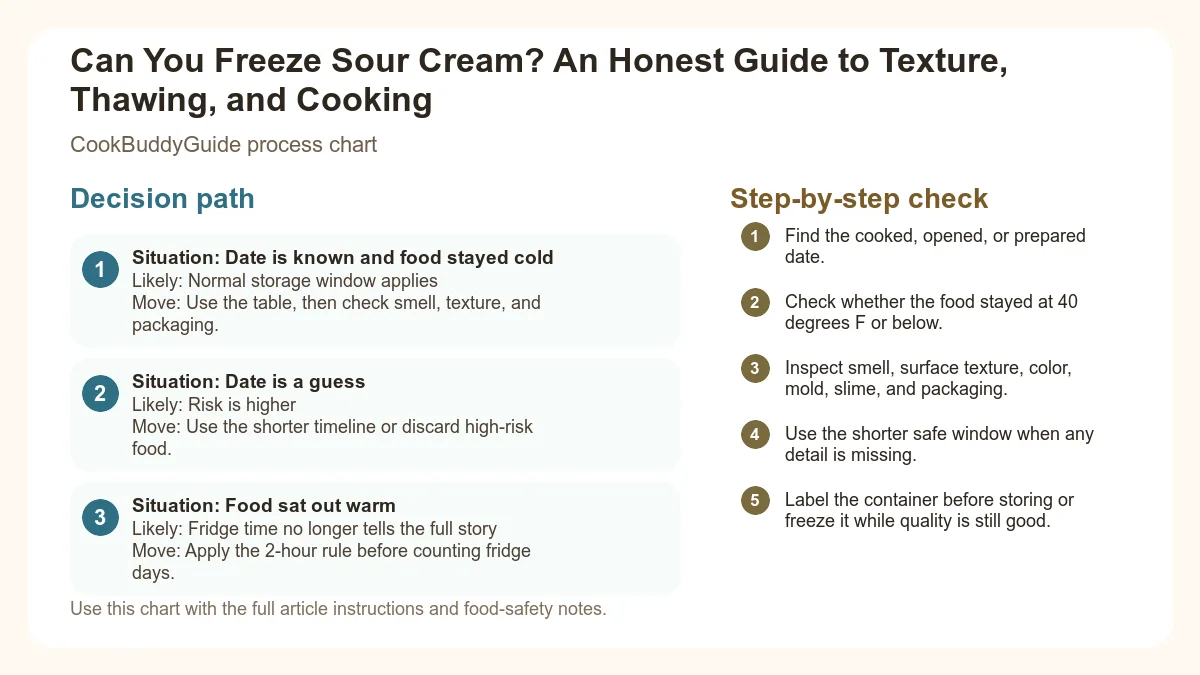
- Check that the sour cream is still fresh.
- Stir it, then divide it into small airtight portions.
- Leave a little expansion space and label the container.
- Thaw overnight in the refrigerator.
- Stir or whisk well and use it in a cooked recipe.
Common mistakes
- Expecting thawed sour cream to stay perfectly smooth.
- Freezing a full container when recipes use only a spoonful.
- Thawing on the counter instead of in the refrigerator.
- Freezing sour cream that already smells sour or shows mold.
Related topic hubs
Table of Contents
- The Short Answer: Can You Freeze Sour Cream?
- The Science of the Squeeze: What Happens at a Molecular Level?
- The Texture Test: What Thawed Sour Cream Actually Looks Like
- Where Frozen Sour Cream Shines (Best Applications)
- The 'No-Go' Zone: When to Avoid Using Frozen Sour Cream
- How to Freeze Sour Cream: 3 Reliable Methods
- How to Properly Thaw and 'Revive' Your Sour Cream
- Shelf Life and Food Safety
- Fresh Alternatives to Freezing
The Short Answer: Can You Freeze Sour Cream?
The 'Yes, But' Reality
When You Should (and Shouldn't) Freeze It
Deciding whether to freeze your leftovers depends entirely on your future menu. Here is the CookBuddyGuide "Rule of Thumb" for dairy preservation:
- Freeze it if: You plan to use it in a cake, muffin batter, thick soup, or a baked casserole. In these instances, the texture change is masked by other ingredients or corrected by heat.
- Toss it (or use it fresh) if: You want a smooth garnish, a taco topping, or a cold dressing. The grainy consistency will be front-and-center, ruining the mouthfeel of your dish.
The Science of the Squeeze: What Happens at a Molecular Level?
Understanding Emulsification
To understand why freezing sour cream is so disruptive, we have to look at its DNA. Sour cream is an emulsion—a stable mixture of fat globules suspended in water. This stability is maintained by milk proteins (caseins) that act as natural emulsifiers, keeping the fat and water from separating. During the production process, lactic acid bacteria are added to cream, which thickens the mixture and gives it that signature tang.
The Role of Fat Globules and Ice Crystals
When you place sour cream in the freezer, the moisture content (water) begins to form ice crystals. As these crystals grow, they act like tiny needles, puncturing the delicate membranes of the fat globules and the protein network holding everything together. This is a well-documented impact of freezing on dairy products with high water content.
Why Syneresis (Separation) Occurs
When the cream thaws, the damaged protein structure can no longer hold the water in place. This leads to syneresis—the technical term for when liquid wheys out of a gel or emulsion. This is why thawed sour cream looks like it has "broken." The fat clumps together while the water pools around it. Furthermore, the fat content plays a huge role here; full-fat sour cream (about 18% milkfat) tends to hold up slightly better than low-fat or fat-free versions, which have more water and fewer structural fats to cushion the freezing process.
The Texture Test: What Thawed Sour Cream Actually Looks Like
Visual Expectations: The Grainy Reality
In my recent 14-day freeze test, I took a standard brand of full-fat sour cream and froze it in an airtight container. After thawing it in the refrigerator, the appearance was jarring. Instead of a uniform, glossy cream, it looked like fine-curd cottage cheese swimming in a thin yellowish liquid. Even after whisking it vigorously for two minutes, the grainy consistency remained. The tiny clumps of protein and fat are physically altered; they don't just "melt" back together at room temperature.
Taste vs. Texture: Does the Flavor Change?
Where Frozen Sour Cream Shines (Best Applications)
Don't let the grainy look scare you away from saving your dairy! There are several ways to use thawed sour cream where it is best used in cooked dishes. When the cream is integrated into a batter or simmered in a sauce, the physical separation becomes irrelevant.
Baking: The Secret to Moist Cakes and Muffins
Cooked Sauces and Soups
Pro-Tip: The Sour Cream Marinade
Why it works: The lactic acid in sour cream is a gentle tenderizer for chicken or pork. Since the cream is wiped off or cooked away before serving, the texture doesn't matter!
- 1 cup thawed sour cream
- 2 cloves minced garlic
- 1 tbsp lemon juice
- 1 tsp smoked paprika
Instructions: Whisk the ingredients together. Coat 1lb of chicken breasts and refrigerate for 4-24 hours. The enzymes break down the protein fibers, resulting in incredibly juicy meat.
The 'No-Go' Zone: When to Avoid Using Frozen Sour Cream
Dips and Dressings
Taco Toppings and Baked Potato Dollops
A dollop of sour cream should be thick and hold its shape. Thawed sour cream tends to "weep" liquid as it sits on hot food, creating a puddle on your plate. It lacks the structural integrity to stand up as a garnish. For these applications, a fresh sour cream substitute like Greek yogurt is a much better choice than frozen-then-thawed dairy.
How to Freeze Sour Cream: 3 Reliable Methods
To prevent freezer burn and maintain as much quality as possible, you need to follow a specific process. Simply tossing the plastic tub in the freezer is the "lazy way" and often leads to the worst results.
1. The Ice Cube Tray Method (Best for Portions)
- Clean an ice cube tray thoroughly.
- Spoon the sour cream into the wells, tapping the tray on the counter to remove air bubbles.
- Flash-freeze for 4 hours until solid.
- Pop the cubes out and transfer them to a heavy-duty freezer bag. Squeeze out all the air before sealing.
2. The Silicone Bag Method (Best for Space)
Using a high-quality airtight container or silicone bag is essential. Choose silicone bags because you can flatten them out, which saves freezer space and allows the cream to thaw faster later on. Ensure you label the bag with the date and the exact quantity (e.g., "1 Cup Sour Cream - Oct 12").
3. The Original Container Method
If you must freeze it in the original tub, make sure it is at least 75% full. If there is too much "headspace" (empty air) in the container, the moisture will evaporate and turn into ice crystals on the surface, leading to freezer burn. To combat this, place a piece of plastic wrap directly on the surface of the cream before snapping the lid shut.
How to Properly Thaw and 'Revive' Your Sour Cream
The Refrigerator Thaw (The Only Safe Way)
Never, under any circumstances, thaw sour cream on the kitchen counter. Dairy products are highly susceptible to bacterial growth between 40°F and 140°F. Always move your frozen cream to the refrigerator 24 hours before you plan to use it. This slow thaw helps keep the moisture content as stable as possible.
The Whisk and Cornstarch Trick
Once thawed, you’ll see the dreaded separation. To "revive" it for cooking, follow this technique I developed after many failed stroganoffs:
The "Rescue" Emulsion Technique
Goal: To stabilize thawed sour cream for use in hot sauces or casseroles.
- Pour the thawed cream and all its liquid into a small bowl.
- Use a balloon whisk to beat the mixture for 60 seconds.
- Add 1 teaspoon of cornstarch per cup of sour cream.
- Whisk again until the starch is fully incorporated. The starch molecules will grab onto the excess water and prevent the sauce from breaking when heat is applied.
Using an Immersion Blender
Shelf Life and Food Safety
How Long Does Frozen Sour Cream Last?
While the freezer stops bacterial growth, it doesn't stop quality degradation. For the best results, use your frozen sour cream within 2 to 3 months. Beyond that, the risk of freezer burn increases, and the cream may take on the odors of other foods in your freezer (like that bag of onions from last year).
Signs of Spoilage: When to Toss It
When you thaw the cream, give it the "Senses Test":
- Smell: It should smell tangy and fresh. If it smells musty, yeasty, or like old gym socks, toss it.
- Color: Sour cream should be white or off-white. Any yellowing or pinkish hues indicate bacterial spoilage.
- Mold: If you see any fuzzy spots, do not try to scrape them off. The root system of mold in soft dairy products like sour cream can penetrate deep into the container.
The 'One-Thaw Rule'
Can you refreeze sour cream? Absolutely not. Every time you freeze and thaw dairy, the protein structure breaks down further and the risk of bacterial contamination increases. Once it’s thawed, use it or lose it.
Fresh Alternatives to Freezing
Sometimes, the best way to handle extra sour cream isn't the freezer at all. If you only have a small amount left, consider these home kitchen secrets for extending dairy storage.
The 'Upside Down' Trick
Greek Yogurt Substitutions
If you find yourself constantly throwing out sour cream, consider switching to plain Greek yogurt. It has a similar fat content and acidity, but it tends to have a slightly longer shelf life and freezes with similar results. Plus, it's a more versatile sour cream substitute for healthy cooking.
Small-Batch DIY Sour Cream
Instead of buying a giant tub, you can make exactly what you need. Mix 1 cup of heavy cream with 1 teaspoon of lemon juice or white vinegar. Let it sit at room temperature for 30 minutes, and you have a quick, fresh sour cream that won't result in food waste.
Frequently Asked Questions
A: You can, but it’s not ideal. The plastic is thin and allows for air exchange, which leads to freezer burn. It’s better to transfer it to a freezer-safe bag or wrap the tub in foil.
A: Most lactic acid bacteria survive freezing, but their activity is paused. They won't "die," but the structural changes to the cream are more significant than the change in bacterial count.
A: A slight yellowish tint in the liquid (whey) is normal. However, if the solid cream itself has turned yellow or has a "crusty" appearance, it has likely suffered from severe freezer burn or oxidation and should be discarded.
Final Thoughts from the Kitchen
Save those leftover tubs for your next batch of muffins, stir them into your Sunday night stroganoff, or hide them in a cheesy casserole. Just keep the fresh, cold tubs for your taco Tuesdays. Managing food waste is all about knowing the strengths and weaknesses of your ingredients—and now, you're an expert on the frozen fate of sour cream.
Happy Cooking!