Quick Answer
This guide explains if eggs are safe after expiration date, how to use the float test, and practical tips for maximum shelf life.
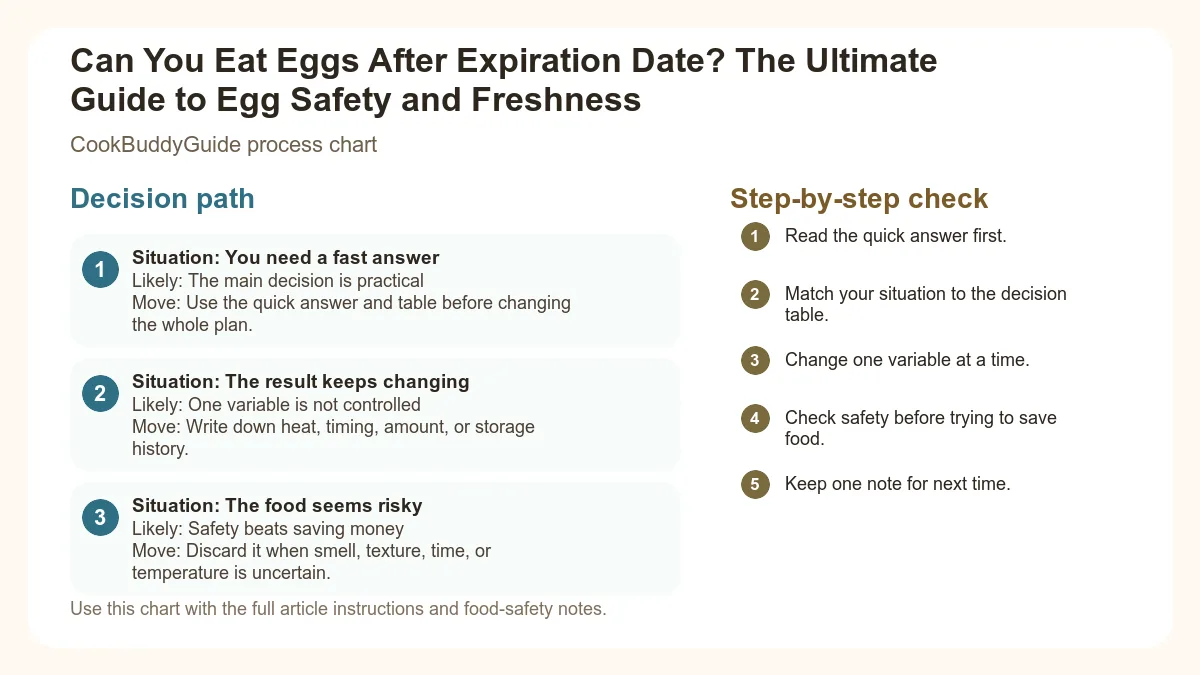
Practical note
For Can You Eat Eggs After Expiration Date? Guide to Egg Safety and Freshness, this guide centers on Moisture Loss and the Air Cell, Thinning Albumen, The Vitelline Membrane. Those are the checkpoints we would use first in a normal home kitchen before making a bigger change.
Decision table
| Situation | Likely cause or meaning | Best move |
|---|---|---|
| You need a fast answer | The main decision is practical | Use the quick answer and table before changing the whole plan. |
| The result keeps changing | One variable is not controlled | Write down heat, timing, amount, or storage history. |
| The food seems risky | Safety beats saving money | Discard it when smell, texture, time, or temperature is uncertain. |
Step-by-step fix
- Read the quick answer first.
- Match your situation to the decision table.
- Change one variable at a time.
- Check safety before trying to save food.
- Keep one note for next time.
Common mistakes
- Skipping the quick answer and changing too much at once.
- Treating quality problems and safety problems the same way.
- Not writing down the detail that caused the repeat problem.
Related topic hubs
The short answer is a resounding yes: in most cases, eggs are perfectly safe to eat for several weeks beyond the date stamped on the carton. However, safety and quality are two different things. While an older egg might not make you sick, it might result in a flat omelet or a messy poached egg. This guide will share practical freshness checks for determining egg freshness, explain the science of why eggs age, and help you stop wasting perfectly good food based on a confusing "sell-by" date.
Table of Contents
Decoding the Carton: Sell-By vs. Best-By vs. Use-By
One of the biggest frustrations for home cooks is the lack of consistency in food labeling. When you look at an egg carton, you might see a "Sell-By," "Best-By," or "EXP" date. It’s important to understand that these are primarily quality indicators, not hard deadlines for safety.
What "Sell-By" Actually Means
The "Sell-By" date is a guide for the retailer, not the consumer. According to USDA food safety guidelines, this date tells the store how long they should display the eggs for sale. It is usually set no more than 30 days after the eggs were packed. Even if the sell-by date passes while the eggs are on your fridge shelf, they are usually still fresh enough for your morning scramble.
The "Best-By" Date and Peak Quality
The "Best-By" or "Best if Used By" date is the manufacturer's estimate of how long the eggs will maintain peak flavor and texture. After this date, the egg white (Albumen) might become thinner, and the runny yolks might not stand as tall, but they aren't necessarily "bad."
The Julian Date: The Secret to True Freshness
How Long Do Eggs Actually Last Past the Date?
If you're wondering are eggs safe after expiration date, the general rule of thumb used by food safety experts is 3 to 5 weeks from the day you put them in your refrigerator. This timeframe holds true even if the "Sell-By" date passes during that time.
Store-Bought vs. Farm-Fresh Eggs
There is a significant difference between the eggs you buy at the supermarket and those you get from a neighbor's coop. In the United States, commercial eggs are washed and sanitized to remove bacteria like Salmonella enteritidis. This process also removes the "bloom" or "cuticle," a natural protective coating. This is why commercial eggs must be refrigerated. Farm-fresh, unwashed eggs still have this cuticle, which allows them to sit on the counter for several weeks in many parts of the world. However, once you wash an egg or refrigerate it, it must stay refrigerated to prevent condensation, which can pull bacteria through the porous shell.
The Science of Egg Aging: What Happens Inside the Shell?
To understand why an old egg behaves differently than a fresh one, we have to look at the biology of the egg. An egg is not a sealed vault; the shell contains thousands of tiny pores that allow for gas exchange.
- Moisture Loss and the Air Cell: As an egg sits, moisture and carbon dioxide escape through the shell. This causes the air cell at the large end of the egg to expand. This is the scientific basis for the "float test" we’ll discuss later.
- Thinning Albumen: The egg white (Albumen) has a naturally high pH that increases as the egg ages. This causes the protein structures to break down, turning the thick, cloudy white into a thin, watery liquid.
- The Vitelline Membrane: This is the clear casing that holds the yolk together. As the egg ages, water moves from the white into the yolk, stretching and weakening the vitelline membrane. This is why older yolks break so easily the moment they hit the pan.
How to Tell if Eggs are Safe: 4 Reliable Freshness Tests
The Definitive Egg Freshness Protocol
1. The Water Float Test: Fill a bowl with cold water and gently drop the egg in.
- Sinks and lays flat: Very fresh.
- Sinks but stands on one end: Getting older, but perfectly safe and great for boiling.
- Floats: The air cell has grown significantly. While not a guarantee of spoilage, it means the egg is old. Always perform a "sniff test" on floaters.
2. The Sniff Test: This is the most reliable indicator of safety. Crack the egg into a separate small bowl. A fresh egg has almost no smell. A spoiled egg will have an unmistakable, pungent sulfur smell. If you smell anything "off," discard it immediately.
3. Visual Inspection: Look at the shell. Is it slimy or powdery? This could indicate mold. Once cracked, look at the white. Is it pink, green, or iridescent? These are signs of Pseudomonas bacteria growth. Throw it away.
4. The Slosh Test: Hold the egg to your ear and shake it. If you hear a sloshing sound, it means the air cell is large and the egg is old. It’s not a safety test, but a quick way to gauge age without water.
For a deeper dive into the mechanics of these tests, you can check out this guide on the egg float test.
Proper Refrigerator Storage to Extend Shelf Life
The door is the warmest part of the fridge and is subject to constant temperature fluctuations every time you open it. To maximize shelf life, follow these rules:
- The Back of the Fridge Rule: Store eggs on the middle or bottom shelf toward the back, where the temperature is most stable.
- Keep the Original Carton: The egg carton isn't just for transport. It protects the eggs from breaking and, more importantly, prevents the porous shell from absorbing strong odors from other foods like onions or garlicky leftovers.
- Pointy Side Down: Storing eggs with the large end (where the air cell is) up helps keep the yolk centered and keeps the air cell away from the yolk, potentially extending freshness by a few days.
For more detailed advice, the American Egg Board provides excellent proper egg storage tips.
Cooking with Older Eggs: Best Uses and Practical Tips
Just because an egg is a few weeks old doesn't mean it's useless. In fact, for certain recipes, an older egg is actually superior to a fresh-from-the-chicken egg.
The Secret to Perfect Hard-Boiled Eggs
Baking and Scrambling
Older eggs are perfectly fine for baking cakes, cookies, or making scrambled eggs. Since the whites are thinner, they actually incorporate into batters more easily. If you are making a high protein meal like a large frittata, using older eggs is a great way to reduce food waste without sacrificing flavor.
When to Use Only Fresh Eggs
There are two times when you should only use the freshest eggs possible:
- Poaching: You need the thick albumen of a fresh egg to hold its shape in the simmering water. An old egg will just create a "spiderweb" of whites in the pot.
- Frying (Sunny Side Up): If you want a beautiful, perky yolk that sits high on the white, freshness is key.
The Risks: Salmonella and Foodborne Illness
While we’ve established that can you eat eggs after expiration date is usually a "yes," we must address the real risk: Salmonella enteritidis. This bacteria can exist on the shell or inside the egg itself. According to the FDA egg safety recommendations, thousands of cases of food poisoning occur annually due to contaminated eggs.
Crucial Safety Notes:
- Cooking Temperature: Cooking eggs until the yolks and whites are firm, or to an internal temperature of 160°F (71°C), kills Salmonella.
- Pasteurization: If you are making a recipe that calls for raw eggs (like Caesar dressing or traditional chocolate mousse), always buy eggs that have undergone pasteurization.
- Vulnerable Populations: The elderly, pregnant women, young children, and those with compromised immune systems should avoid eating older eggs and should always ensure their eggs are fully cooked.
Quick-Reference Safety Guide: The "Should I Eat It?" Table
Use this table as a quick reference when you're in a rush during your easy breakfast meal prep sessions.
| Scenario | Float Test Result | Safety Verdict | Recommended Use |
|---|---|---|---|
| Before "Best-By" Date | Sinks to bottom | Safe | Poaching, Frying, Any use |
| 1-2 Weeks Past Date | Sinks, stands upright | Safe | Hard-boiled, Baking, Scrambling |
| 3-5 Weeks Past Date | Hovers or tilts upward | Likely Safe* | Baking, Hard-boiled (Check smell!) |
| Any Date | Floats high on surface | Caution | Perform Sniff Test; discard if odor exists |
| Any Date | Cracked shell or slime | UNSAFE | Discard immediately |
*Always perform a sniff test after cracking the egg into a separate bowl.
Conclusion: Reducing Food Waste Safely
In the end, the question of whether are eggs safe after expiration date comes down to a combination of proper storage and trusting your own senses. The food industry uses conservative dating to ensure you have the best possible experience with their product, but those dates are not law. By understanding the Julian date, maintaining a steady refrigerator temperature, and using the float and sniff tests, you can confidently use eggs weeks past their printed expiration.
I’ve saved hundreds of dollars over the years simply by not tossing eggs that were perfectly good for baking or boiling. The next time you see a date that has passed, don't panic. Grab a bowl of water, trust your nose, and remember that a slightly older egg is often the secret to the easiest-peeling hard-boiled egg you've ever made.
What’s your favorite way to use up a carton of eggs that’s nearing its limit? Do you have a "secret" omelet recipe or a favorite cake? Let us know in the comments below!
Frequently Asked Questions
A: Yes! Do not freeze them in the shell. Crack them into a bowl, whisk gently with a pinch of salt or sugar (to prevent graininess), and freeze in an airtight container for up to a year.
A: No. Whether the shell is white, brown, or blue, the shelf life and nutritional content remain the same. The color is purely determined by the breed of the hen.
A: Yolk color is determined by the hen's diet, not freshness. Hens that eat corn or soy produce paler yolks, while those that eat greens or marigold petals produce deep orange yolks.