Quick Answer
Choose an electric pressure cooker when speed and active pressure cooking matter; choose a slow cooker for long, gentle cooking with minimal attention. Both handle soups and braises well, but evaporation, texture, and recipe timing are not interchangeable.
Practical note
For Instant Pot vs. Slow Cooker, this guide centers on instant pot vs slow cooker, pressure cooker vs crockpot, programmable settings. Those are the checkpoints we would use first in a normal home kitchen before making a bigger change.
Decision table
| Situation | Likely cause or meaning | Best move |
|---|---|---|
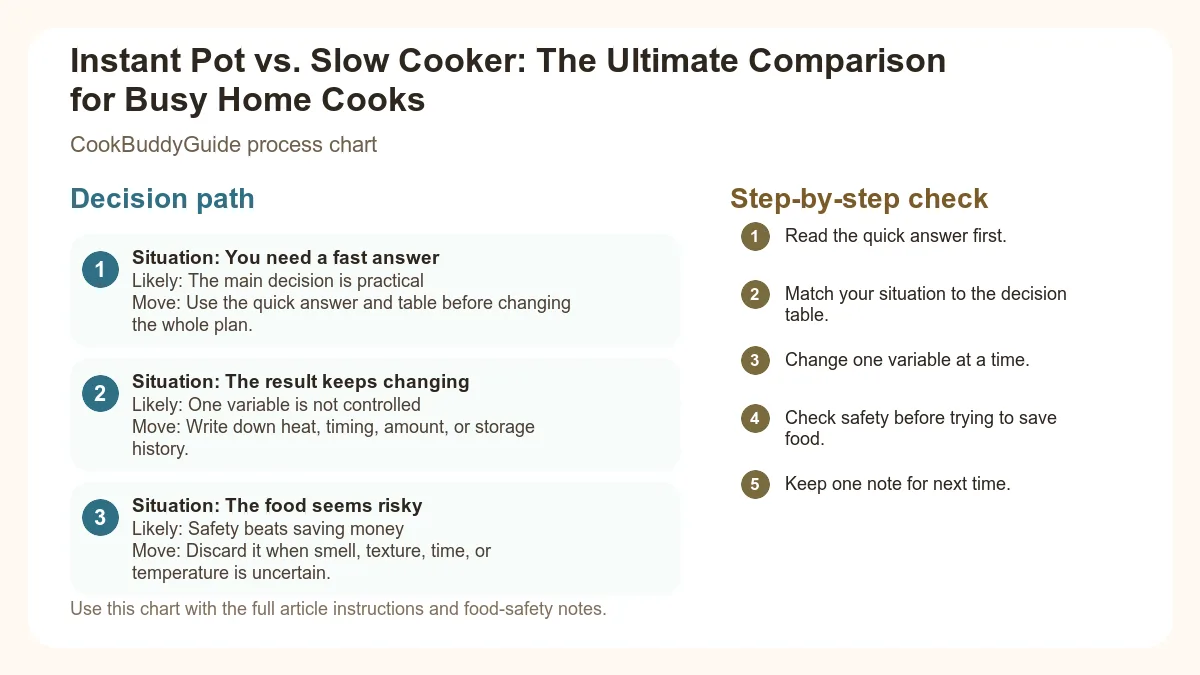
| You need a fast answer | The main decision is practical | Use the quick answer and table before changing the whole plan. |
| The result keeps changing | One variable is not controlled | Write down heat, timing, amount, or storage history. |
| The food seems risky | Safety beats saving money | Discard it when smell, texture, time, or temperature is uncertain. |
Step-by-step fix
- Read the quick answer first.
- Match your situation to the decision table.
- Change one variable at a time.
- Check safety before trying to save food.
- Keep one note for next time.
Common mistakes
- Skipping the quick answer and changing too much at once.
- Treating quality problems and safety problems the same way.
- Not writing down the detail that caused the repeat problem.
Related topic hubs
It’s 5:45 PM. You just walked through the door after a grueling commute, the kids are asking what’s for dinner, and you realize the chicken is still sitting in the freezer, rock-solid. In one corner of your kitchen sits the Instant Pot, a high-tech multi-cooker glowing with digital promises of speed. In the other corner is your trusty slow cooker, the low-and-slow workhorse that has been a staple of American kitchens for decades. Which one is the true hero of the weeknight meal?
Table of Contents
- The Science of Heat and Pressure
- Cook Time and Convenience: Speed vs. Strategy
- Versatility: One-Pot Wonder vs. Specialized Tool
- Flavor and Texture: A Side-by-Side Comparison
- Ease of Use, Safety, and Cleanup
- Cost and Durability: Which is the Better Investment?
- The Verdict: Which One Should You Choose?
How They Work: The Science of Heat and Pressure
To understand the differences between these appliances, we first have to look at the physics happening inside the pot. While both are designed to produce one-pot meals and tender results, they achieve this through diametrically opposed methods.
The Instant Pot: Atmospheric Pressure and Boiling Points
An Instant Pot is a multi-cooker that functions primarily as an electric pressure cooker. When you lock the lid and set the steam release valve to "sealing," the liquid inside begins to boil, creating steam. Because the steam cannot escape, the internal pressure rises. This increased pressure raises the boiling point of water from 212°F (100°C) to roughly 240°F-250°F.
The Slow Cooker: Low, Consistent Heat and Moisture Retention
The crockpot (a brand name that has become synonymous with the slow cooker) works on a much simpler principle. It consists of a ceramic crock nestled inside a metal housing containing heating elements. It maintains a low, steady temperature—usually between 190°F and 210°F—over many hours.
This gentle heat is excellent for braising meat. Because the temperature never reaches a vigorous boil, the muscle fibers in meat don’t contract as violently as they might on a stovetop. This results in that "fall-off-the-bone" texture we associate with traditional pot roasts. However, because the temperatures stay low, the Maillard reaction is minimal unless you sear the meat in a separate pan first. For more on how these temperatures interact with food safety, refer to the slow cooker food safety guidelines regarding the "danger zone."
Cook Time and Convenience: Speed vs. Strategy
When we talk about instant pot vs slow cooker, the most obvious differentiator is time. But "time" is a tricky concept in the kitchen. There is active time, passive time, and hidden time.
The "Last Minute" Savior: Instant Pot Timelines
The "Morning Prep" Hero: Slow Cooker Timelines
The slow cooker is the ultimate set and forget tool. Its convenience lies in the fact that it does the work while you are at the office or sleeping. A pork shoulder that takes 60 minutes in an Instant Pot will take 8 to 10 hours on "Low" in a slow cooker. The convenience here isn't speed; it's the meal planning strategy. There is a psychological comfort in walking into a house that already smells like dinner. For the busiest families, crockpot freezer meals are the gold standard for efficiency.
Comparison: The 3-Pound Pot Roast
The Instant Pot Method: Sauté the meat using the sauté function, add 1 cup of broth, and cook on High Pressure for 60 minutes with a 15-minute natural release. Result: Deeply infused flavor, firm but tender meat.
The Slow Cooker Method: Place meat in the ceramic crock with 1/2 cup of broth and vegetables. Cook on Low for 8 hours. Result: Exceptionally soft meat that shreds with a fork, very soft vegetables.
Versatility: One-Pot Wonder vs. Specialized Tool
If you have limited cabinet space, versatility is everything. This is where the pressure cooker vs crockpot debate usually leans heavily in one direction.
The Instant Pot’s 7-in-1 Capabilities
The Instant Pot isn't just a pressure cooker. Most models include programmable settings for:
- Pressure Cooking
- Slow Cooking (though with caveats, which I'll discuss later)
- Rice Cooking
- Steaming
- Yogurt Making
- Sautéing (The real helpful shortcut!)
- Warming
The Slow Cooker’s Singular Focus
A traditional slow cooker does one thing, but it does it very well. It provides a consistent, low-heat environment. While some modern slow cookers have added bells and whistles, they generally lack the ability to sear or boil. This means if you want a flavorful stew, you usually have to dirty a skillet on the stove first. However, the simplicity of a slow cooker is a benefit for many. With just a "Low," "High," and "Warm" dial, there is almost no learning curve.
Flavor and Texture: A Side-by-Side Comparison
The "Dilution" Problem
Ingredient Integrity
According to research on retaining nutrients during cooking, the shorter cooking time of the Instant Pot can actually preserve more heat-sensitive vitamins compared to the long exposure of a slow cooker.
Ease of Use, Safety, and Cleanup
Learning Curves and the Steam Release Valve
Safety Features
Modern electric pressure cookers are incredibly safe, with dozens of sensors to prevent the lid from opening under pressure. Gone are the days of the "exploding" stovetop models. Slow cookers are also very safe, though leaving an appliance on for 10 hours while you’re out of the house does give some users pause. Both are generally safer than leaving a pot on a gas stove.
The Cleanup Factor
- Instant Pot: The inner pot is usually stainless steel, which is dishwasher safe and great for scrubbing. However, the silicone sealing ring tends to absorb odors (like garlic or cumin). Keep two rings: one for savory and one for sweet (yogurt/cheesecake).
- Slow Cooker: The ceramic crock is heavy and can be prone to cracking if subjected to extreme temperature changes (don't put a cold crock into a preheated base). However, it is generally very easy to clean, and many people use plastic liners for zero-scrub cleanup.
Cost and Durability: Which Is the Better Investment?
When comparing the pressure cooker vs crockpot in terms of price, the slow cooker usually wins on the low end. You can find a basic, reliable slow cooker for $30-$50. An Instant Pot or similar multi-cooker typically starts around $80 and can go up to $200 for models with air fryer lids or WiFi connectivity.
In terms of longevity, the slow cooker has an edge. Because they use simple heating elements and often mechanical dials, they can last for decades. I still have my mother’s Crockpot from the 90s! The Instant Pot is a complex piece of electronics with a digital motherboard. Like a computer, it is more susceptible to electronic failure over time. However, replacement parts like sealing rings and stainless steel pots are widely available and affordable.
The Verdict: Which One Should You Choose?
After years of side-by-side testing, here is my definitive advice for the busy home cook.
Choose the Instant Pot if...
- You often forget to defrost meat or plan dinner in advance.
- You want to minimize dishes by using the sauté function.
- You enjoy making a variety of foods like yogurt, hard-boiled eggs, and rice.
- You prefer a more "hands-on" cooking experience with faster results.
Choose the Slow Cooker if...
- You have a "set it and forget it" lifestyle and want dinner ready the second you walk in the door.
- You find digital buttons and pressure valves intimidating.
- You primarily make stews, pot roasts, and chilis where "low and slow" texture is preferred.
- You are on a tighter budget and want an appliance that will last for decades.
Can You Have Both?
A: Yes, but you must add at least 1 cup of thin liquid (water or broth) and reduce the cooking time by about 70%. Also, remember that liquid won't evaporate, so use less than the slow cooker recipe calls for.
A: Often, it is more tender because the pressure forces moisture into the fibers. However, it can sometimes feel "drier" if you don't allow for a natural pressure release, which lets the juices redistribute.
A: Surprisingly, no. Because it cooks so much faster, it often uses less total energy than a slow cooker running for 8 hours.
Ultimately, the instant pot vs slow cooker debate isn't about which tool is "better"—it's about which tool fits your life. If you’re a morning person who likes to prep early, stick with the crockpot. If you’re a 6 PM "what's for dinner?" person, the Instant Pot will change your life. Happy cooking!