Quick Answer
Yes, you can freeze cream cheese, but the texture may change after thawing. Freeze it while fresh in an airtight, labeled container, and thaw perishable foods in the refrigerator before using them in the ways described below.
Practical note
For Can You Freeze Cream Cheese? A Practical Guide to Freezing, Thawing, and Cooking, the home-kitchen check is not only the number of days. We look at the start date, fridge temperature, container seal, serving time, and spoilage signs. If one of those facts is missing, the safer move is to use the shorter window.
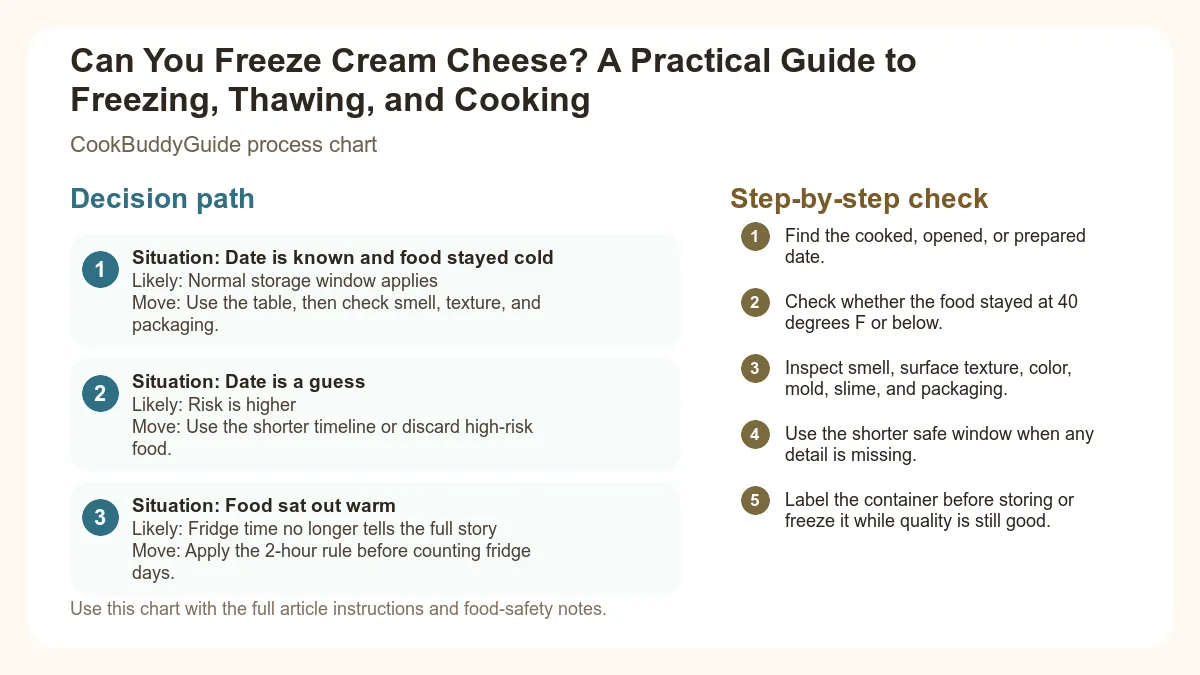
Decision table
| Situation | Likely cause or meaning | Best move |
|---|---|---|
| Date is known and food stayed cold | Normal storage window applies | Use the table, then check smell, texture, and packaging. |
| Date is a guess | Risk is higher | Use the shorter timeline or discard high-risk food. |
| Food sat out warm | Fridge time no longer tells the full story | Apply the 2-hour rule before counting fridge days. |
Step-by-step fix
- Find the cooked, opened, or prepared date.
- Check whether the food stayed at 40 degrees F or below.
- Inspect smell, surface texture, color, mold, slime, and packaging.
- Use the shorter safe window when any detail is missing.
- Label the container before storing or freeze it while quality is still good.
Common mistakes
- Counting fridge days from the day you noticed the container instead of the day it was made.
- Ignoring time spent on the counter, in a lunch bag, or on a serving table.
- Trusting smell alone when the date or temperature history is unknown.
- Putting warm food into a deep container that cools slowly.
Related topic hubs
You’re standing in front of the dairy aisle, and there’s a massive sale on 8-ounce blocks of Philadelphia Cream Cheese. You want to stock up—after all, the holidays are coming, or maybe you're planning a massive brunch—but then the hesitation hits. You live in a household that can only go through so much schmear in a week. You wonder: can you freeze cream cheese without ruining that iconic, velvety texture?
- Can You Freeze Cream Cheese? The Short Answer
- 3 Best Methods for Freezing Cream Cheese
- How Long Does It Last in the Freezer?
- The Best Ways to Thaw Frozen Cream Cheese
- How to Fix Grainy or Crumbly Thawed Cream Cheese
- Best Uses for Previously Frozen Cream Cheese
- When NOT to Use Frozen Cream Cheese
- Freezing Cream Cheese Frosting, Dips, and Poppers
Can You Freeze Cream Cheese? The Short Answer
Yes, you can absolutely freeze cream cheese, but it comes with a significant caveat: the texture will change permanently. While freezing cream cheese is perfectly safe from a food safety perspective, the physical structure of the cheese undergoes a transformation that makes it less than ideal for certain uses.
What Happens to Cream Cheese When It Freezes?
When you put a block of cream cheese in the freezer, the water content inside the cheese turns into ice crystals. Because cream cheese has a high moisture content (usually around 55%), these crystals are substantial. When the cheese eventually thaws, those ice crystals melt, but the water doesn't naturally move back into the fat solids. This results in a thawed cream cheese that is crumbly, grainy, and prone to separation.
The Science of Dairy Emulsion and Separation
To understand why this happens, we have to look at the dairy emulsion. Cream cheese is essentially an emulsion of milk fat, water, and protein. These components are held together in a delicate balance. Freezing acts as a mechanical disruptor. As the ice crystals expand, they break the protein bonds that keep the fat and water suspended together. According to experts on texture changes in cream cheese, this separation is what creates that "sandy" or grainy texture that many home cooks find off-putting.
How to Freeze Cream Cheese: 3 Best Methods
If you’ve decided that the texture change is a fair trade-off for saving money or reducing waste, you need to do it right. Exposure to air is the enemy of any frozen dairy product, as it leads to freezer burn and the absorption of "off" smells from your freezer (nobody wants onion-scented cheesecake).
Method 1: Freezing Unopened Foil-Wrapped Blocks
This is the easiest and most effective method. If the block is still in its original, vacuum-sealed foil, you already have a great first layer of protection. However, don't just toss the cardboard box in the freezer.
- Remove the foil-wrapped block from the cardboard box.
- Place the foil-wrapped block inside a heavy duty freezer bag.
Method 2: Freezing Opened Leftovers
A half-used block needs tighter wrapping than an unopened package. Portion it before freezing when you only need small amounts for breakfast meal prep or baking.
- Wrap the leftover portion tightly in plastic wrap, ensuring there are no exposed edges.
- Wrap it a second time in a layer of aluminum foil.
- Place the bundle into an airtight container or a freezer bag. Label it with the date and the exact weight or measurement (e.g., "4 oz - Oct 12").
Method 3: Freezing Whipped Cream Cheese
Pro-Tip: Portioning for Future Recipes
How Long Does Cream Cheese Last in the Freezer?
While the USDA notes that freezing cheese for food safety is effective indefinitely at 0°F, the quality of cream cheese declines the longer it sits.
Signs of Spoilage and Freezer Burn
- Yellowing: If the edges of the cheese have turned a dark yellow or translucent color, it likely has freezer burn.
- Off Smells: Upon thawing, cream cheese should smell tangy and fresh. If it smells sour, musty, or like the "inside of a freezer," discard it.
- Sliminess: While thawed cream cheese will be watery, it should not feel slimy or slippery to the touch.
The Best Ways to Thaw Frozen Cream Cheese
How you thaw your cream cheese is just as important as how you freeze it. Speed is rarely your friend when it comes to defrosting dairy.
The Refrigerator Method (Recommended)
This is the gold standard. Move the cream cheese from the freezer to the fridge at least 24 hours before you plan to use it. This slow transition helps the cheese maintain as much of its original structure as possible. According to guides on the best ways to thaw cheese, the refrigerator method is the safest way to prevent bacterial growth while minimizing the "shock" to the dairy emulsion.
The Cold Water Bath (The Quick Fix)
If you're in a rush, place the sealed freezer bag in a bowl of cold tap water. Change the water every 30 minutes. An 8-ounce block will usually thaw in about 2 to 3 hours using this method. Do not use warm or hot water, as this can cause the outer layers of the cheese to reach unsafe temperatures while the center remains frozen.
Why You Should Never Thaw on the Counter
Food Safety first. Leaving dairy out at room temperature for more than two hours (or one hour if your kitchen is over 90°F) puts you in the "Danger Zone" for bacterial growth. Always thaw in the fridge or under cold water.
How to Fix Grainy or Crumbly Thawed Cream Cheese
You’ve thawed your cheese, and it looks like a mess of watery curds. Don't panic! You can re-emulsify the fats and liquids to restore some of that smoothness. While it will never be exactly like a fresh block, these steps will make it usable for most recipes.
The "Smooth-Again" Technique
- Drain the excess: If there is a large amount of separated water (whey) in the bag, you can pour a tiny bit off, but try to keep most of it, as that moisture is needed for the texture.
- The Heat Method: Place the thawed cream cheese in a microwave-safe bowl. Microwave on medium power in 15-second intervals.
- Whisk Vigorously: After each interval, use a stiff whisk or a handheld mixer to beat the cheese. The heat softens the fat, allowing it to bond back with the liquid.
- The Food Processor Trick: If whisking by hand isn't working, toss the cheese into a food processor or blender. The high-speed blades are often much more effective at breaking down those stubborn grains than a hand whisk.
- Add a Splash: If the cheese still feels too crumbly, add 1 teaspoon of heavy cream or whole milk. The additional fat and liquid act as a bridge to help the emulsion reform.
Best Uses for Previously Frozen Cream Cheese
Once you’ve thawed and whisked your cream cheese, it’s time to put it to work. Because the texture has been compromised, it is best used in recipes where it will be melted or thoroughly incorporated with other ingredients. As noted by the Food Network's guide on cooking with thawed cream cheese, soft cheeses are ideal for applications where they provide flavor and richness rather than structural integrity.
Baked Goods and Desserts
Frozen cream cheese is a fantastic addition to batters. Since it will be beaten with sugar and eggs, the graininess disappears entirely.
- Pound Cakes: It adds a wonderful tang and moisture.
- Brownies: Use it for a cream cheese swirl; the heat of the oven will smooth everything out.
- Cookies: Soft-batch cream cheese cookies are a great way to use up 4 ounces of thawed cheese.
Savory Casseroles and Pasta Sauces
Hot Dips and Appetizers
Thawed cream cheese is the secret weapon for a great Buffalo Chicken Dip or a hot spinach dip. Since the dip is served warm and bubbly, no one will ever know the cream cheese started out grainy in the bag.
When NOT to Use Frozen Cream Cheese
Despite our best efforts to fix the texture, there are some situations where only fresh cream cheese will do. Philadelphia Cream Cheese manufacturers themselves suggest that freezing is discouraged for spreading due to these very changes.
The Bagel Test
If you plan to spread the cream cheese directly onto a bagel, toast, or crackers, do not use frozen cheese. The mouthfeel will be gritty and unpleasant. It lacks the "cling" and silkiness of fresh dairy.
No-Bake Cheesecakes and Frostings
In a no-bake cheesecake, the cream cheese provides the structural integrity. Frozen cheese is often too watery and weak to hold the shape, leading to a dessert that sags or collapses. Similarly, for a silky smooth cream cheese frosting, frozen cheese is a risky choice. Even with a food processor, it can remain slightly "speckled" in appearance, which isn't what you want for a polished cake.
Freezing Cream Cheese Products
What if the cream cheese is already part of a dish? The rules change slightly because other ingredients (like sugar, flour, or fat) can act as stabilizers.
Yes! Because cream cheese frosting contains a high amount of sugar and butter, it freezes much better than plain cream cheese. The sugar helps stabilize the emulsion. Store it in an airtight container for up to 3 months. Thaw in the fridge and give it a quick whip with a mixer before using.
Hot dips (like buffalo chicken or artichoke) freeze beautifully. Cold dips (like a veggie dip with sour cream) may separate and become watery. If you freeze a cold dip, be prepared to stir it vigorously after thawing.
Absolutely. In fact, freezing them before frying or baking helps the cheese stay inside the pepper rather than oozing out immediately. This is a classic kitchen hack for party prep.
Conclusion: To Freeze or Not to Freeze?
So, can you freeze cream cheese? The answer is a resounding "Yes," provided you have a plan for it. If you’re a savvy shopper who loves a good deal, don't be afraid to stock up and use your freezer. Just remember my "Golden Rule of Frozen Dairy": Freeze for cooking, buy fresh for spreading.
By using a heavy duty freezer bag, allowing for a slow thaw in the refrigerator, and using a whisk or food processor to re-emulsify the cheese, you can significantly extend the shelf life of this kitchen staple without sacrificing flavor. Whether you're adding it to a creamy pasta sauce or incorporating it into your next batch of breakfast meal prep ideas, frozen cream cheese is a versatile tool for any busy home cook.
Next time you see that sale, grab a few extra blocks. Your future self—and your grocery budget—will thank you!