Quick Answer
Cooked chicken can remain slightly pink and still be safe, but color is not a reliable doneness test. Check the thickest part with a clean food thermometer; poultry should reach 165 F, and chicken below that temperature should go back on the heat.
Practical note
Bone-in chicken, smoked chicken, and previously frozen poultry can stay pink even after reaching a safe temperature. Insert the thermometer into the thickest meat without touching bone, because bone can distort the reading.
Decision table
| Situation | Likely cause or meaning | Best move |
|---|---|---|
| Chicken is pink but reads 165 F | Color may come from bone, freezing, or cooking method | It is safe by temperature; rest and serve. |
| Chicken is pink and below 165 F | It is not fully cooked | Return it to heat and recheck the thickest part. |
| No thermometer is available | Color and juices cannot confirm safety | Continue cooking and verify with a thermometer before serving. |
Step-by-step fix
- Wash your hands and use a clean instant-read thermometer.
- Insert it into the thickest part of the meat without touching bone.
- Check more than one spot on large or uneven pieces.
- Return chicken below 165 F to the heat.
- Clean the thermometer probe after checking raw or undercooked poultry.
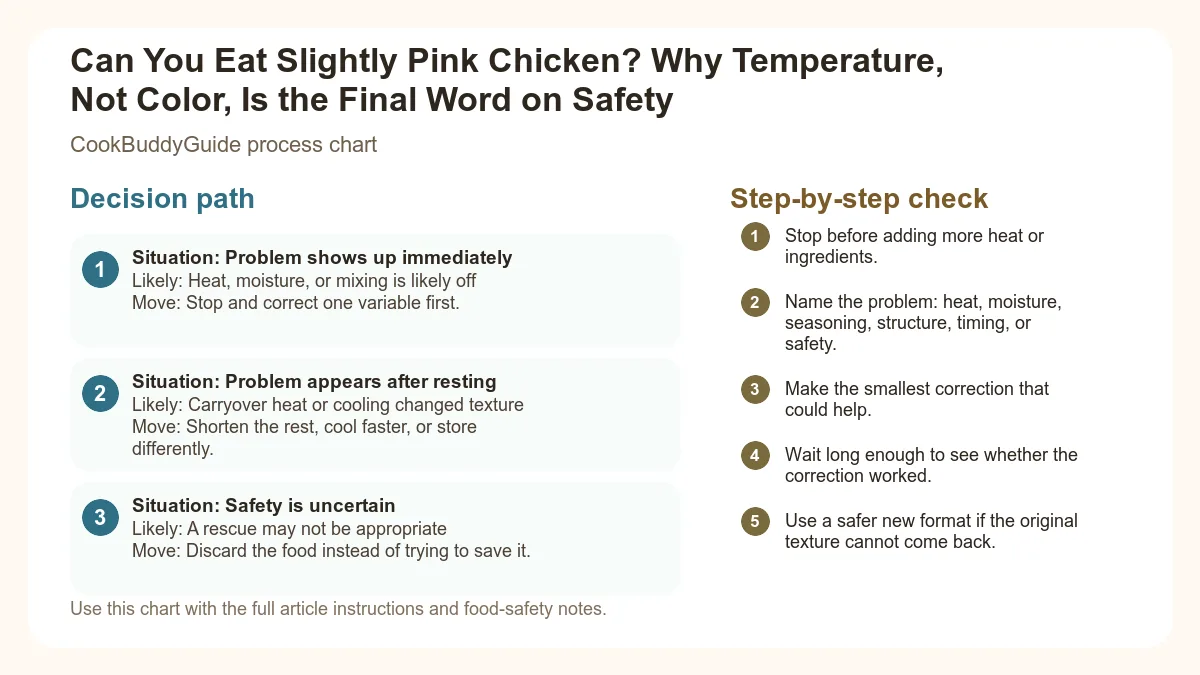
Common mistakes
- Judging safety by pink color or clear juices alone.
- Touching the thermometer probe to bone.
- Checking only the thinnest part of an uneven piece.
- Using the same unwashed utensil for raw and cooked chicken.
Related topic hubs
Table of Contents
- The Great Chicken Panic: Why Color Isn't the Best Safety Indicator
- The Science of Pink: Why Safe Chicken Stays Rosy
- The 165°F Rule: Your Definitive Safety Standard
- How to Use a Meat Thermometer Like a Pro
- When Pink is a Red Flag: Identifying Undercooked Chicken
- Cooking Methods That Naturally Cause Pinkness
- Health Risks: What Happens if You Actually Eat Raw Chicken?
- CookBuddy Tips for Perfectly Done Chicken Every Time
The Great Chicken Panic: Why Color Isn't the Best Safety Indicator
The Psychological Fear of Pink Poultry
But here is the reality: modern food science has evolved. The USDA food safety guidelines state clearly that poultry can show a pinkish tinge even when it has reached a safe internal temperature. This psychological hurdle is something every home cook needs to overcome to achieve juicy, restaurant-quality results.
Why the 'Clear Juices' Rule is Outdated
The Science of Pink: Why Safe Chicken Stays Rosy
The Role of Myoglobin in Poultry Muscle
To understand why your chicken looks pink, we have to talk about myoglobin. This is a protein found in muscle tissue that stores oxygen. When it’s exposed to heat, it typically turns tan or white. However, myoglobin is remarkably stable. In some cases, it doesn’t fully denature (change shape) even at high temperatures, leaving a pinkish hue in the meat. This is especially common in dark meat vs white meat, as thighs and legs contain significantly more myoglobin to fuel the bird's movement.
Bone Marrow Leaching in Young Chickens
Most of the chicken we buy at the grocery store today comes from "broilers," which are young birds (usually 6 to 8 weeks old). Their bones are still quite porous and haven't fully calcified. During the cooking process, the bone marrow—which is deep red—can seep through the soft bone structure and stain the surrounding meat. This is why chicken stays pink most often right against the bone. Even if you cook that drumstick to 180°F, that purple-pink stain may remain. It is perfectly safe to eat, though it can be visually off-putting.
The Effect of Oven Gases and pH Levels
The 165°F Rule: Your Definitive Safety Standard
Why 165°F is the Magic Number
When it comes to food safety, the USDA Food Safety and Inspection Service has designated 165 degrees Fahrenheit as the "North Star." At this temperature, pathogens like Salmonella and Campylobacter are destroyed instantly. It is the point of Poultry Pasteurization that ensures no foodborne illness will occur. If your thermometer reads 165°F, you can ignore the pink color entirely—the meat is safe.
The Relationship Between Time and Temperature
USDA Guidelines vs. Culinary Preferences
The "Safety First" Roasted Thigh Technique
Ingredients: 4 bone-in, skin-on chicken thighs, 2 tbsp olive oil, 1 tsp kosher salt, 1/2 tsp smoked paprika.
Method:
- Preheat your oven to 425°F. Pat the chicken completely dry with paper towels—this prevents steaming and encourages browning.
- Rub the thighs with oil and spices.
- Place on a wire rack over a baking sheet. This allows hot air to circulate around the bone, reducing the "bone marrow leaching" effect.
- Roast until your instant-read thermometer hits 175°F in the thickest part (avoiding the bone).
- Do not panic if you see pink near the joint! If the temp is 175°F, it is safe and delicious.
How to Use a Meat Thermometer Like a Pro
Finding the 'Thickest Part' of the Bird
Avoiding the Bone: Why Placement Matters
Bones conduct heat differently than meat. If your thermometer tip touches the bone, you will likely get a much higher reading than the actual temperature of the meat, leading you to pull the chicken out while the flesh is still undercooked. Always pull the probe back slightly if you feel it hit something hard. Similarly, don't let the probe touch the metal pan, as this will give you a false reading of the oven temperature rather than the internal temperature of the poultry.
Digital vs. Analog: Choosing the Right Tool
When Pink is a Red Flag: Identifying Undercooked Chicken
Texture Cues: Rubbery vs. Tender
While color can be deceptive, texture rarely is. Safe, cooked chicken—even if it’s slightly pink—should have a distinct "flake" to it. It should feel firm but tender. Raw poultry texture, on the other hand, is rubbery, bouncy, and resilient. If you press down on the meat and it feels like a wet sponge or a rubber band that won't break, it is likely undercooked. This is common when using quick chicken breast recipes where the heat might be too high, searing the outside while leaving the middle raw.
The 'Glossy' Look of Raw Meat
Look at the surface of the meat. Cooked chicken has a matte finish. Truly undercooked or raw chicken has a translucent, shiny, or "glossy" appearance. It looks wet in a way that isn't just juice—it looks like it hasn't been transformed by heat yet. If the meat looks like it’s glowing or has a "slimy" sheen, put it back in the oven immediately. This is a sign that the proteins haven't coagulated.
Cold Spots and Uneven Cooking
Cooking Methods That Naturally Cause Pinkness
The 'Smoke Ring' in BBQ Chicken
The Impact of Brining and Curing
Brining your chicken in a salt solution (especially one containing nitrates or nitrites) can preserve the pink color of the meat even after extensive cooking. This is the same principle that makes ham pink. If you’ve marinated your chicken in a heavy salt brine or used certain spice rubs with high mineral content, don't be surprised if the meat retains a rosy glow. This is very common in smoked meats and commercially processed poultry.
Grilling and the Hemoglobin Reaction
High-heat grilling can sometimes "lock in" the color of the hemoglobin in the meat before it has a chance to turn brown. This is especially true if you are grilling over charcoal. The intense, direct heat causes the proteins on the outside to seize, while the interior undergoes a slower chemical change that can leave a pinkish hue. As long as you are using your thermometer, the color from the grill is nothing to fear.
The "No-Panic" Air Fryer Chicken Breast
Air fryers are notorious for creating "pink-looking" chicken because they cook so fast with circulating air. Here is how to do it right.
Instructions:
- Season 2 chicken breasts (6oz each) with your favorite rub.
- Place in the air fryer basket at 375°F.
- Flip halfway through. At the 12-minute mark, check the temp.
- Pull the chicken when it hits 162°F. The carryover cooking will bring it to 165°F during the rest.
- Check out my Air Fryer Chicken Recipes for Beginners for more detailed timing charts.
Health Risks: What Happens if You Actually Eat Raw Chicken?
Salmonella and Campylobacter: The Main Culprits
While we’ve established that can you eat slightly pink chicken (if it's 165°F), we must respect the risks of truly raw poultry. Chicken is a primary carrier of Salmonella and Campylobacter. These bacteria live in the intestinal tracts of birds and can easily contaminate the meat during processing. This is why cross-contamination in the kitchen—like using the same cutting board for chicken and salad—is actually more dangerous than a slightly pink bone in a cooked thigh.
Symptoms to Watch For
What to Do if You Suspect Food Poisoning
If symptoms are mild, stay hydrated with electrolytes. However, for vulnerable populations—children, the elderly, or those with compromised immune systems—food poisoning can be life-threatening. If you can't keep liquids down or have a high fever, seek medical attention. The best medicine is prevention: use that thermometer every single time.
CookBuddy Tips for Perfectly Done Chicken Every Time
The Importance of Carryover Cooking
One of the biggest "aha!" moments for my students is learning about carryover cooking. When you remove meat from a heat source, the residual heat on the outside continues to travel inward. A chicken breast will typically rise about 5°F while resting. If you wait until the thermometer says 165°F to pull it out of the oven, it will likely end up at 170°F—which is where the meat starts to get dry and chalky. Pull at 160°F and let it rest!
Letting Your Meat Rest
Never slice into chicken the second it comes off the heat. Resting for 5 to 10 minutes allows the muscle fibers to relax and reabsorb the juices. If you cut it too soon, all that moisture (and any residual pink myoglobin) will pour out onto the board, leaving the meat dry. Resting also helps the internal temperature equalize, ensuring that any slightly undercooked spots in the center reach the safety threshold.
Buying Quality Poultry: Does Organic Matter?
Frequently Asked Questions
A: Only if the internal temperature has reached 165°F. Color is not a reliable indicator. Use a thermometer to be certain.
A: This is usually bone marrow leaching, common in young chickens. It is safe to eat if the meat is fully cooked.
A: You can, but it will ruin the texture. It's better to return the meat to the oven or pan for a few minutes until the temperature is verified.
The Final Word on Pink Chicken
At the end of the day, your kitchen should be a place of joy, not fear. The answer to can you eat slightly pink chicken is a resounding "yes," provided you have done your due diligence with an instant-read thermometer. By understanding the science of myoglobin, the reality of bone marrow leaching, and the 165°F safety standard, you can stop overcooking your dinner out of caution.
Trust the tools, not your eyes. Next time you see a little blush in your roasted chicken, check the temp. If it’s 165°F, pick up your fork and enjoy one of the juiciest meals you’ve ever made. Happy cooking!