Quick Answer
When using leftover bread, choose the idea by amount, texture, and how soon the ingredient needs to be used. Small amounts work best in sauces, toppings, scrambles, bowls, or fillings, while larger amounts are better for soups, casseroles, meal prep, or freezer portions.
Practical note
For using leftover bread, the most useful home checks are temperature, measuring, resting time, and visible texture. Those details tell you more than guessing, especially before adding extra flour, liquid, heat, or leavening.
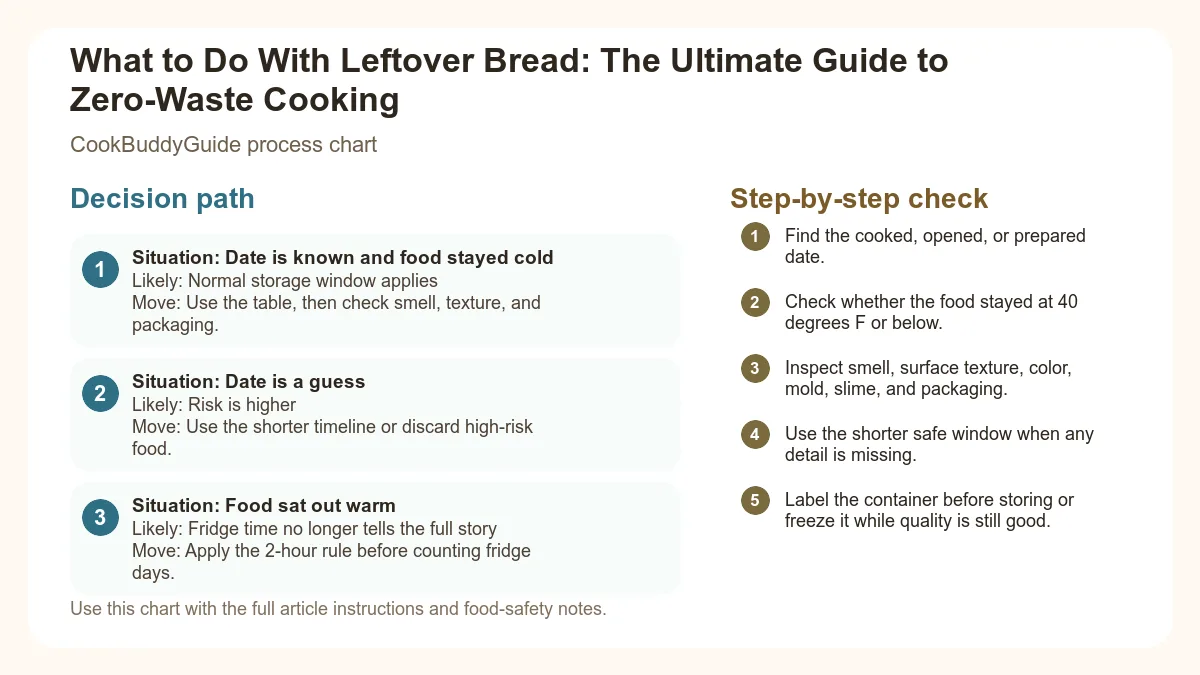
Decision table
| Situation | Likely cause or meaning | Best move |
|---|---|---|
| Date is known and food stayed cold | Normal storage window applies | Use the table, then check smell, texture, and packaging. |
| Date is a guess | Risk is higher | Use the shorter timeline or discard high-risk food. |
| Food sat out warm | Fridge time no longer tells the full story | Apply the 2-hour rule before counting fridge days. |
Step-by-step fix
- Find the cooked, opened, or prepared date.
- Check whether the food stayed at 40 degrees F or below.
- Inspect smell, surface texture, color, mold, slime, and packaging.
- Use the shorter safe window when any detail is missing.
- Label the container before storing or freeze it while quality is still good.
Common mistakes
- Counting fridge days from the day you noticed the container instead of the day it was made.
- Ignoring time spent on the counter, in a lunch bag, or on a serving table.
- Trusting smell alone when the date or temperature history is unknown.
- Putting warm food into a deep container that cools slowly.
Related topic hubs
- The Science of Stale: Why Leftover Bread is a Goldmine
- Essential Storage Tips to Keep Bread Usable Longer
- 1. Homemade Croutons: The Easiest Solution
- 2. Classic Bread Pudding: A Practical Comfort
- 3. Panzanella Salad: A Tuscan Summer Staple
- 4. French Toast: Beyond the Basic Breakfast
- 5. Savory Strata: The Make-Ahead Hero
- 6. Ribollita: The Hearty Italian Soup
- 7. DIY Breadcrumbs: A Pantry Essential
- Matching the Bread to the Recipe
- Frequently Asked Questions
The Science of Stale: Why Leftover Bread is a Culinary Goldmine
Understanding Retrogradation: Why Bread Goes Stale
Most people assume bread goes stale because it loses moisture. While dehydration plays a role, the real culprit is a process called retrogradation. When bread is baked, the starch molecules in the flour absorb water and become "gelatinized," giving the bread its soft, fluffy texture. As the bread cools and sits, those starch molecules slowly begin to recrystallize, pushing the water out of the starch granules and into the surrounding spaces. This is why day-old bread feels firm and brittle even if it hasn't completely dried out.
Stale vs. Moldy: When to Save It and When to Toss It
Safety is paramount. Stale bread is safe; moldy bread is not. If you see fuzzy spots of green, blue, or white, the entire loaf must go. Mold is like an iceberg; by the time you see the "bloom" on the surface, the microscopic hyphae (roots) have likely permeated the porous interior of the bread. However, if the bread is simply hard or dry, it’s a candidate for food preservation and transformation.
The Economic Impact of Bread Waste
Bread is one of the most wasted food items globally. According to the USDA, Americans throw away millions of tons of food annually, and bakery products are a significant portion of that. By mastering a few stale bread recipes, you aren't just becoming a better cook; you're actively participating in tips to reduce food waste. It’s a win for your wallet and the planet. During my time managing a high-volume bistro, we never threw away a single end-piece of sourdough bread; every scrap was turned into croutons or breadcrumbs, saving the restaurant thousands in food costs over the year.
Essential Storage Tips to Keep Bread Usable Longer
The Paper vs. Plastic Debate
How you store your bread determines how it stales. Crusty bread, like a baguette or sourdough bread, should be kept in a paper bag. Paper allows the bread to "breathe," maintaining the crispness of the crust. If you put a crusty loaf in plastic, the trapped moisture will soften the crust, leading to a rubbery texture and faster mold growth. Conversely, soft sandwich breads benefit from plastic to prevent them from turning into crackers overnight.
Why the Refrigerator is Your Bread's Worst Enemy
The Proper Way to Freeze and Thaw Bread
To freeze bread properly, consider slicing it first. Double-wrap the loaf (or slices) in plastic wrap, then place it in a heavy-duty freezer bag. This prevents freezer burn. When you're ready to use it, you can toast slices directly from the freezer. If you have a whole loaf that has gone slightly too hard, you can use the "water-and-oven trick." Lightly run the loaf under a cold tap to dampen the crust, then bake it at 350°F (175°C) for 6-10 minutes. The steam created inside the loaf will temporarily reverse the retrogradation, making it soft again. For more details on this, check out this guide on how to revive stale bread.
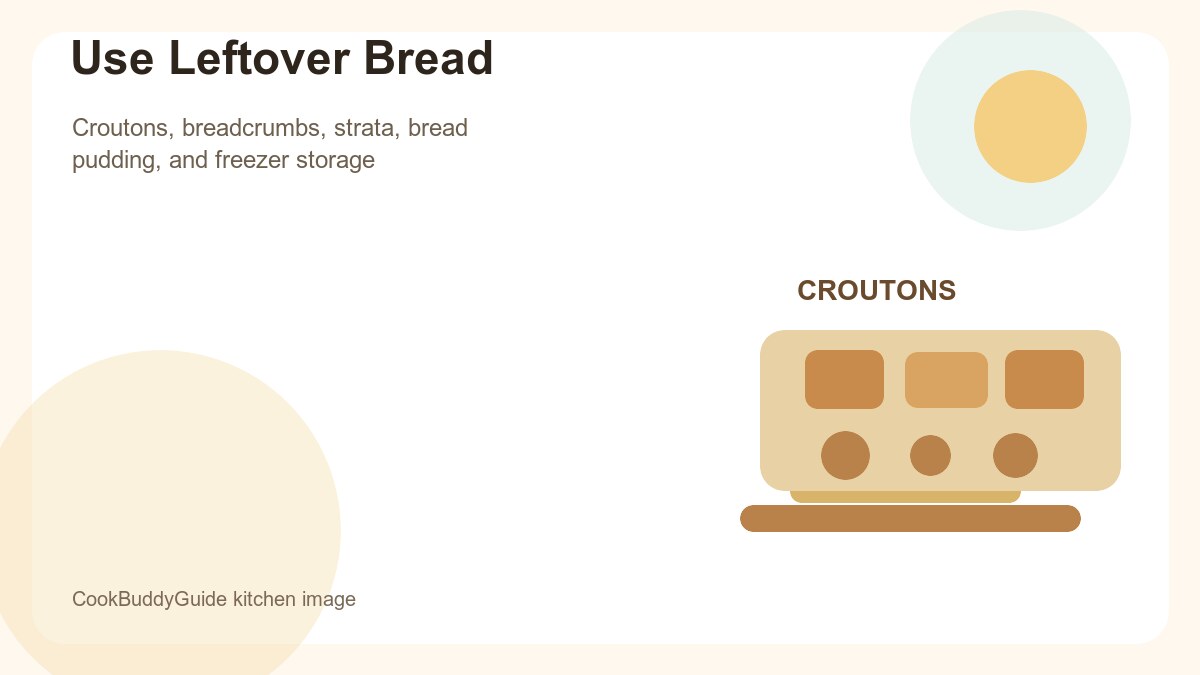
1. Homemade Croutons: The Easiest Leftover Bread Solution
Once you make your own croutons, you will never buy the bagged version again. Store-bought croutons are often rock-hard and excessively salty. Homemade versions are shatteringly crisp on the outside and slightly chewy in the center.
A Practical Garlic & Herb Croutons
Best bread for this: Sourdough, ciabatta, or a rustic baguette.
- 4 cups of bread cubes (1-inch pieces)
- 3 tbsp extra virgin olive oil
- 1 tsp garlic powder
- 1 tsp dried Italian herbs
- 1/2 tsp sea salt
Pro-Tip: The secret to even seasoning is to toss the bread in the oil before adding the dry spices. If you add spices to dry bread, they just fall to the bottom of the bowl. The oil acts as the glue.
- Preheat your oven to 375°F (190°C).
- In a large bowl, toss the bread cubes with oil until every piece is glistening.
- Sprinkle with seasonings and toss again.
- Spread in a single layer on a rimmed baking sheet. Common mistake: Crowding the pan. If the cubes are touching, they will steam instead of crisping.
- Bake for 12-15 minutes, tossing halfway through, until golden brown.
2. Classic Bread Pudding: A Practical Comfort Dessert
Why Brioche and Challah Reign Supreme
While you can use any bread, enriched breads like brioche, challah, or even leftover croissants make the best bread pudding. Their high butter and egg content create a melt-in-your-mouth texture. If you're using a leaner French bread, you may want to use heavy cream instead of whole milk to compensate for the lack of fat.
Testing note: Letting the bread soak in the custard for at least 30 minutes (or up to 2 hours) is non-negotiable. This ensures the liquid reaches the very center of the stale cubes, preventing dry pockets. To achieve a crispy top with a soft center, bake the pudding in a water bath (bain-marie) and sprinkle a little granulated sugar on top during the last 10 minutes of baking.
3. Panzanella Salad: A Tuscan Summer Staple
Panzanella is not a "salad with croutons." It is a bread salad where the bread is the main character. This dish was historically created by Tuscan farmers to use up rock-hard, unsalted bread. It relies on the juices from ripe tomatoes to rehydrate the crusty bread.
Authentic Tuscan Panzanella
The Secret Technique: Salting the tomatoes first. This draws out the flavorful juices, which combine with the olive oil and vinegar to create a natural dressing that the bread will drink up.
- 6 cups cubed stale Italian bread (hearty, rustic loaves)
- 2 lbs ripe tomatoes, chopped
- 1/2 red onion, thinly sliced
- 1/2 cup extra virgin olive oil
- 2 tbsp red wine vinegar
- Large handful of fresh basil, torn
- Place chopped tomatoes in a colander over a bowl. Sprinkle with salt and let sit for 15 minutes.
- Whisk the collected tomato juice with the oil and vinegar.
- Combine bread, tomatoes, onions, and the dressing in a large bowl.
- Let it sit for at least 30 minutes. The bread should be moist but not mushy.
For the definitive guide on this technique, see this classic Italian panzanella salad recipe.
4. French Toast: Beyond the Basic Breakfast
French toast is perhaps the most famous use for day-old bread. In France, it’s called pain perdu, which literally translates to "lost bread." You are "finding" the bread again by soaking it in a sweet egg mixture.
The Thick-Cut Rule
If you use thin, pre-sliced sandwich bread, you’ll likely end up with the "soggy middle syndrome." For the best texture, slice your French bread or brioche at least 1 inch thick. This allows the outside to caramelize in the pan while the inside sets into a light, souffle-like texture. If you're looking for more morning inspiration, check out our Breakfast Meal Prep Ideas.
Savory Twist: Don't limit yourself to maple syrup. Try a savory French toast by omitting the sugar and vanilla, and adding parmesan cheese, chives, and a pinch of smoked paprika to the custard. Serve it with a fried egg on top for a sophisticated brunch.
5. Savory Strata: The Make-Ahead Brunch Hero
A strata is essentially a savory bread pudding or a bread-based casserole. It is the ultimate "clean out the fridge" meal. Because it requires a long soak—usually overnight—it’s the perfect choice for busy mornings.
6. Ribollita: The Hearty Italian 'Reboiled' Soup
Ribollita is a famous Tuscan bean and kale soup that is thickened with leftover bread. The name means "reboiled," referring to the fact that it was often made by reheating leftover minestrone and adding scraps of bread to stretch the meal further. This is a fantastic example of cheap meals under 5 dollars that taste like a million bucks.
Hearty Ribollita
The Role of Bread: In this soup, the bread doesn't just sit in the liquid; it dissolves slightly to create a thick, porridge-like consistency that is incredibly satisfying.
- 1 bunch Lacinato kale (Dino kale), chopped
- 2 cans Cannellini beans (one mashed, one whole)
- 1 parmesan rind (essential for umami)
- 3 cups cubed stale crusty bread
- Aromatics: Onion, carrot, celery, garlic
- Sauté aromatics in olive oil until soft.
- Add kale, beans, and 6 cups of vegetable broth. Add the parmesan rind.
- Simmer for 30 minutes.
- Stir in the bread cubes and cook for another 5-10 minutes until the soup thickens significantly. Remove the rind before serving.
7. DIY Breadcrumbs: A Pantry Essential
If your bread is so far gone that you could use it as a hammer, it’s time for breadcrumbs. Homemade breadcrumbs have a much better flavor and texture than the dusty, store-bought canisters.
Fine vs. Panko-Style Crumbs
For fine crumbs, Use a food processor. For a coarser, "panko-style" crumb, Choose using the large holes of a box grater. If the bread still has some moisture, I bake the crumbs at 300°F (150°C) for 10 minutes to completely dry them out. This prevents them from molding in storage. You can find more detailed techniques on how to make your own breadcrumbs at The Kitchn.
Storage Tip: Store your homemade breadcrumbs in the freezer. Because they contain natural oils from the bread (especially if it’s a high-quality loaf), they can go rancid at room temperature over time. Freezing keeps them fresh for up to 6 months.
Matching the Bread to the Recipe
| Bread Type | Best Application | Why It Works |
|---|---|---|
| Sourdough / Artisanal | Croutons, Panzanella, Ribollita | Strong structure; doesn't disintegrate in liquid. |
| Brioche / Challah | Bread Pudding, French Toast | High fat content creates a rich, tender crumb. |
| Baguette / French Bread | Croutons, DIY Breadcrumbs | High crust-to-crumb ratio leads to maximum crunch. |
| Rye / Pumpernickel | Savory Strata, Croutons | Strong flavor profile pairs well with meats/onions. |
| Buns (Burger/Hot Dog) | Bread Pudding, Breadcrumbs | Soft texture blends easily into custards. |
Frequently Asked Questions
No. As a rule of food safety, if mold is visible on a porous food like bread, the microscopic roots have already spread throughout the loaf. It is safer to toss it and start fresh.
Depending on the recipe, bread can be used anywhere from 1 to 5 days after it has gone stale, provided it is kept dry and mold-free. For breadcrumbs, even older bread is fine as long as it's completely dehydrated.
Absolutely! Gluten-free bread actually tends to go stale faster than wheat bread, making it a perfect candidate for croutons and French toast. Just be aware that it may absorb liquid slightly differently, so keep an eye on your soaking times.
Conclusion: Turning Waste into Wonder
Learning what to do with leftover bread is more than just a kitchen hack; it’s a mindset shift. When we stop viewing food through the lens of its expiration date and start viewing it through the lens of its texture and potential, we become more creative, efficient, and sustainable cooks. Whether you’re tossing cubes of sourdough bread into a hot pan for croutons or layering baguette slices into a savory strata, you are honoring the craft that went into baking that loaf in the first place.
For more ways to save money and eat better, don't miss our guide on Cheap Meals Under $5 and other zero-waste tips here at CookBuddyGuide.com.