Quick Answer
Gas responds quickly and works with any cookware, while electric and induction surfaces are easier to clean and can heat more efficiently. The better choice depends on ventilation, energy cost, cookware compatibility, and how much immediate heat control matters to you.
Practical note
For Gas vs Electric Stove Cooking, this guide centers on Upfront Costs, Installation, Operating Costs. Those are the checkpoints we would use first in a normal home kitchen before making a bigger change.
Decision table
| Situation | Likely cause or meaning | Best move |
|---|---|---|
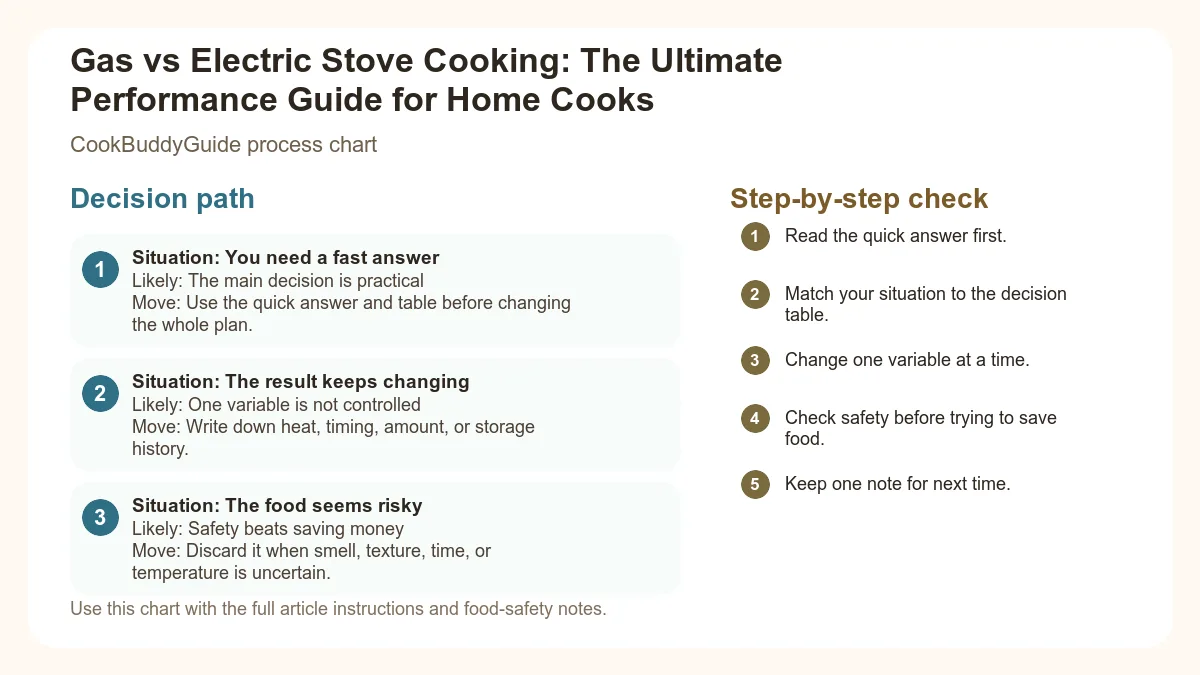
| You need a fast answer | The main decision is practical | Use the quick answer and table before changing the whole plan. |
| The result keeps changing | One variable is not controlled | Write down heat, timing, amount, or storage history. |
| The food seems risky | Safety beats saving money | Discard it when smell, texture, time, or temperature is uncertain. |
Step-by-step fix
- Read the quick answer first.
- Match your situation to the decision table.
- Change one variable at a time.
- Check safety before trying to save food.
- Keep one note for next time.
Common mistakes
- Skipping the quick answer and changing too much at once.
- Treating quality problems and safety problems the same way.
- Not writing down the detail that caused the repeat problem.
Related topic hubs
It’s 6:15 PM on a Tuesday. You’ve got a pan of onions hitting the oil, a pot of water struggling to reach a boil for pasta, and a piece of salmon waiting for that perfect, crispy sear. Suddenly, you realize the onions are browning too fast. You twist the dial, but the heat doesn't budge. If you’re on an electric range, you’re likely sliding the pan to a cold burner in a panic. If you’re on gas, the flame vanishes instantly, and the sizzle subsides. This split-second difference is at the heart of the gas vs electric stove cooking debate.
Table of Contents
Heat Control and Responsiveness: The Pro's Choice?
The Instant Gratification of Gas Flames
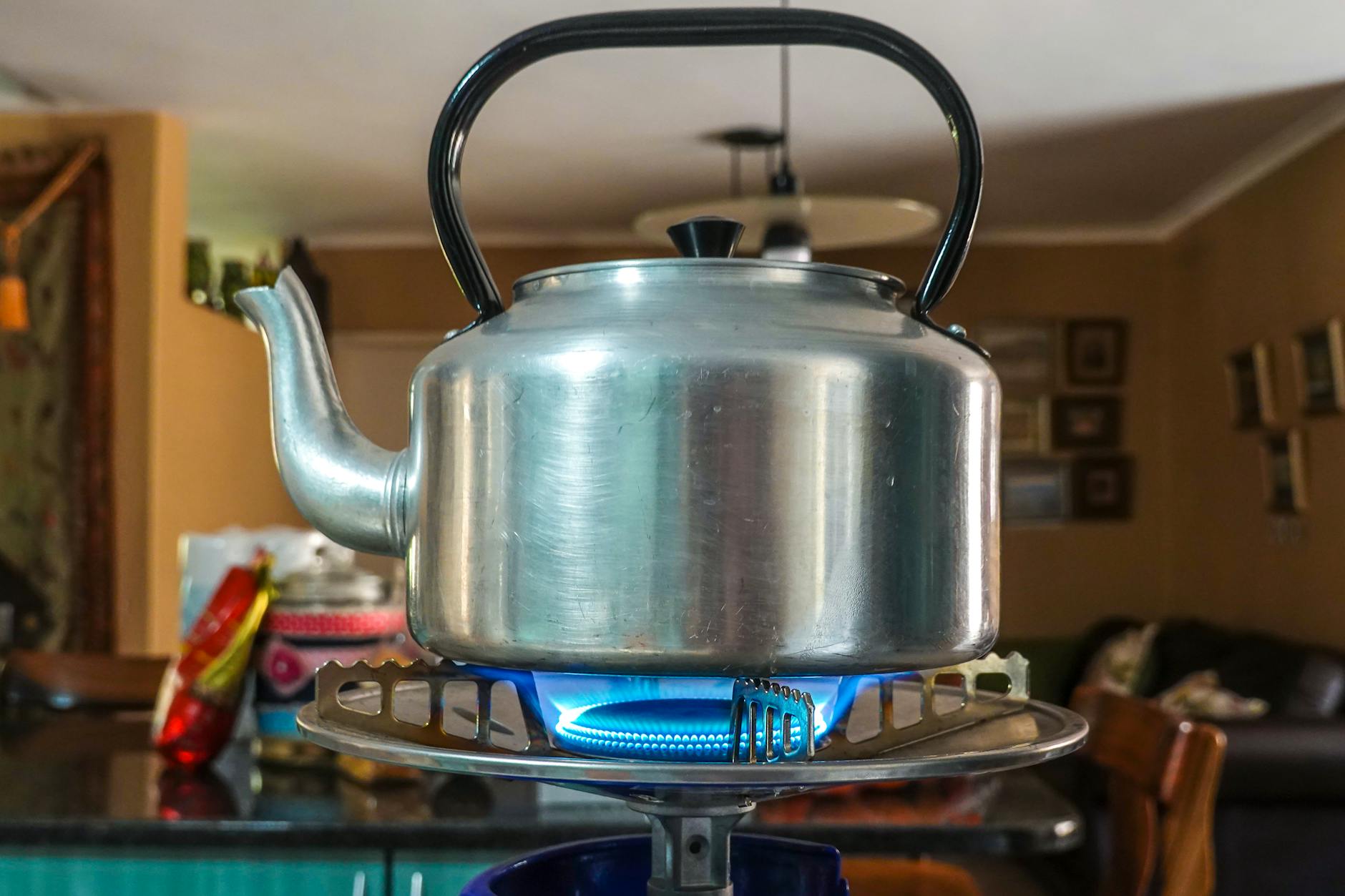
Gas burners provide immediate heat. The moment you click the igniter, you have 100% of your requested energy. More importantly, when you turn the dial down, the heat stops hitting the pan instantly. This responsiveness and heat control is why gas is often favored for delicate tasks like making a caramel or sautéing garlic, where five seconds of residual heat can mean the difference between golden brown and bitter black.
The Thermal Lag of Electric Coils
Pro Tip: The "Two-Burner" Technique for Electric Cooks
If you are stuck with an electric stove and need to drop heat quickly (for example, when making a delicate one-pot pasta), always pre-heat a second burner to "low" while your main burner is on "high." When it’s time to simmer, move the pot to the low burner immediately. This bypasses the 2-minute cool-down lag of the primary element.
Cooking Performance: Searing, Simmering, and Boiling
When we evaluate gas vs electric stove cooking, we have to look at the raw numbers. Gas power is measured in BTU (British Thermal Units), while electric power is measured in Watts. A standard home gas burner usually outputs between 9,000 and 12,000 BTUs, while high-end "power burners" can reach 18,000 to 20,000 BTUs.
The Boiling Test: Which Reaches 212°F Faster?
There is a persistent myth that gas is faster. However, in head-to-head testing, electric often wins the boiling water speed race. Why? Because gas flames are inefficient; much of the heat escapes around the sides of the pot, heating your kitchen rather than your water. An electric radiant heat element or a glass top stove transfers energy more directly to the bottom of the cookware. According to research on boiling and searing efficiency, a high-wattage electric burner can often boil a gallon of water 2-3 minutes faster than a standard gas burner.
High-Heat Searing and Wok Cooking
Where gas truly shines is cookware compatibility and specialized techniques. If you love wok cooking, gas is the undisputed king. A wok requires heat to crawl up the sides of the metal, which only an open flame can provide. Furthermore, gas allows you to use warped pans or cast iron skillets that might not sit perfectly flat. Electric ranges require a flat-bottomed pan to ensure even heat distribution; any air gap between the pan and the glass top creates a "cold spot."
Precision Control: The Simmer Struggle
Baking Performance: The Oven Factor
While the cooktop is where the action happens, the oven is where the science of gas or electric stove which is better gets really interesting. Most professional bakers will tell you they prefer an electric oven, and there’s a very specific reason: moisture.
Dry Heat vs. Moist Heat
Natural gas is a hydrocarbon. When it burns, it releases water vapor as a byproduct. This creates a "moist heat" environment inside a gas oven. While this sounds good, it’s actually a disadvantage for many tasks. Moist heat can prevent the crust of a loaf of bread from becoming truly crispy and can interfere with the browning of a roast chicken. Electric ovens, conversely, provide a very "dry heat," which is ideal for dehydration and achieving that perfect golden-brown finish.
Temperature Consistency
Electric heating elements can be controlled with extreme precision via a thermostat. Gas ovens tend to have wider temperature swings, as the burner has to kick on and off to maintain the heat. This is why baking and oven performance data usually favors electric ranges for delicate pastries and soufflés. If you have the budget, the "Dual-Fuel" range—which features gas burners on top and an electric oven below—is the gold standard for serious home cooks.
Testing Note: The Oven Thermometer Rule
Cost Analysis: Purchase vs. Long-Term Operation
When deciding between gas vs electric stove cooking, you have to look at three distinct costs: the appliance, the installation, and the monthly utility bill.
- Upfront Costs: Generally, basic electric coil ranges are the cheapest to buy. Smooth-top electric and standard gas ranges are comparable in price, usually ranging from $600 to $1,500.
- Installation: This is the "hidden" cost. If your kitchen isn't already piped for natural gas, adding a line can cost $500 to $2,000 depending on your home's layout. Conversely, an electric range requires a heavy-duty 240V outlet.
- Operating Costs: This varies wildly by region. In the Northeast, where electricity rates are high, gas is often cheaper to run. In the South or Northwest, where hydroelectric or nuclear power keeps electric rates low, an electric range might be more economical.
Energy Efficiency and Carbon Footprint
From a purely technical standpoint, electric stoves are more energy-efficient. About 75-80% of the energy used by an electric element goes directly into the pan. With gas, only about 30-40% of the energy reaches the food; the rest escapes into the room. This not only increases your carbon footprint but also forces your air conditioner to work harder in the summer. However, gas is often viewed as more "reliable" in areas prone to power outages, as you can usually light the burners with a match even when the grid is down.
Safety and Indoor Air Quality
In recent years, the conversation around gas vs electric stove cooking has shifted toward health. This is an area where electric ranges have a clear advantage. When you burn gas in an enclosed space, it releases nitrogen dioxide (NO2), carbon monoxide, and fine particulate matter.
The Importance of Kitchen Ventilation
If you choose gas, a high-quality, high-CFM range hood is not optional—it is a health necessity. Studies linked by indoor air quality concerns suggest that gas stoves can contribute to respiratory issues, particularly in children, if not properly vented to the outside. Many older homes simply recirculate air through a charcoal filter, which does nothing to remove harmful gases.
Physical Safety and Fire Hazards
Electric stoves carry their own risks. A glass top stove stays hot long after the element is turned off, and because there is no visible flame, it’s easy to accidentally touch the surface or leave a plastic cutting board on a hot zone. Most modern electric ranges include "residual heat" indicator lights to mitigate this. Gas stoves, while having a visible flame, carry the risk of gas leaks or the flame being blown out by a draft, leading to gas buildup in the kitchen.
The Cleanup: Grates vs. Glass
Ask any busy parent which is better, and they will likely point to the electric glass top stove. The ability to simply wipe down a flat surface after dinner is a massive time-saver. However, there are nuances to cleaning and maintenance differences that you should know before you buy.
The Nightmare of Gas Grates
The Smooth-Top Challenge
Pro Tip: The 5-Minute Deep Clean
For a glass top stove: Sprinkle baking soda over the cool surface, spritz with water until it's a paste, and lay a warm, damp towel over it for 15 minutes. The residue will wipe right off. For gas: Place your burner caps in a sealed bag with 1/4 cup of ammonia overnight. The fumes (do this in a ventilated area!) will dissolve the grease without any scrubbing required.
The Verdict: Which Should You Choose?
Choose Gas If...
- You are a "tactile" cook who needs visual feedback from a flame.
- You use a wok frequently or prefer heavy cast-iron cookware.
- You live in an area with frequent power outages.
- You already have a gas line installed and a high-quality ventilation hood.
Choose Electric If...
- You are a serious baker who needs the dry, consistent heat of an electric oven.
- Cleanup is your primary pain point (the "one-wipe" appeal is real).
- You are concerned about indoor air quality and respiratory health.
- You want the fastest possible boiling times for pasta and grains.
The Summary Comparison
| Feature | Gas Stove | Electric Stove |
|---|---|---|
| Responsiveness | Instant | Slow (Thermal Lag) |
| Boiling Speed | Moderate | Fast |
| Baking Quality | Moist (Good for roasts) | Dry (Best for pastries) |
| Cleanup Ease | Difficult (Grates/Nooks) | Easy (Smooth surface) |
| Health/Safety | Emission concerns | Residual heat risks |
A Final Word on Induction
If you find yourself torn between the control of gas and the cleanliness of electric, there is a "third way": Induction cooking. Induction uses magnetism to heat the pan directly, offering even faster boiling speeds than electric and more precise control than gas, all while keeping the cooktop cool to the touch. While it requires magnetic cookware, it is rapidly becoming the preferred choice for modern home cooks who want the best of both worlds.
Ultimately, the best stove is the one that makes you feel confident in the kitchen. Whether you love the primal roar of a gas burner or the sleek, high-tech efficiency of an electric range, understanding these nuances will help you master your favorite recipes and enjoy the process of cooking for your family every single night.
A: Yes! Gas is incredibly versatile. From copper and aluminum to cast iron and stainless steel, the open flame will heat almost any material, even if the bottom of the pan isn't perfectly flat.
A: This is usually due to the "cycling" of the heating element or a pan that isn't making full contact with the burner. Ensure you are using a flat-bottomed pot that matches the size of the burner ring for maximum efficiency.
A: Some cities have implemented bans on gas hookups in new construction to meet climate goals, but there is no federal ban on existing gas stoves. Many cooks are voluntarily switching to induction for better air quality.