Quick Answer
This guide explains how to make rich brownies without eggs. Our practical guide to egg free brownies covers flax, aquafaba, and more for the perfect fudgy, chewy texture.
Practical note
For How to Make Fudgy Brownies Without Eggs, this guide centers on Pros, Cons, Ratio. Those are the checkpoints we would use first in a normal home kitchen before making a bigger change.
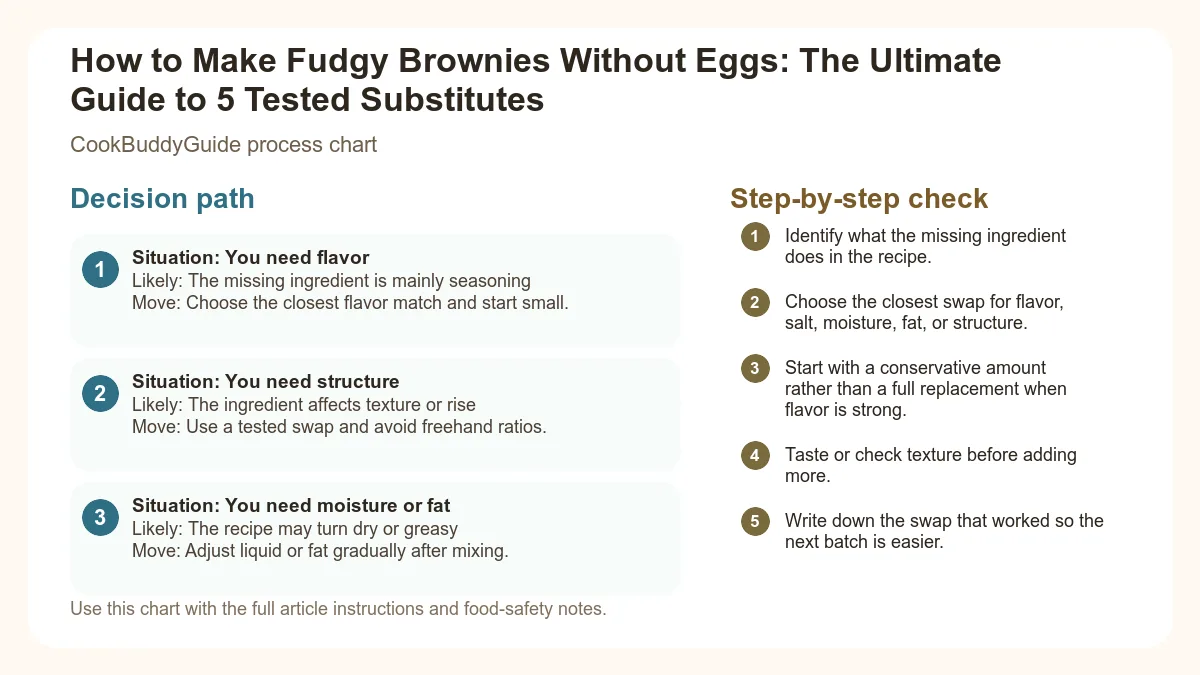
Decision table
| Situation | Likely cause or meaning | Best move |
|---|---|---|
| You need flavor | The missing ingredient is mainly seasoning | Choose the closest flavor match and start small. |
| You need structure | The ingredient affects texture or rise | Use a practical swap and avoid freehand ratios. |
| You need moisture or fat | The recipe may turn dry or greasy | Adjust liquid or fat gradually after mixing. |
Step-by-step fix
- Identify what the missing ingredient does in the recipe.
- Choose the closest swap for flavor, salt, moisture, fat, or structure.
- Start with a conservative amount rather than a full replacement when flavor is strong.
- Taste or check texture before adding more.
- Write down the swap that worked so the next batch is easier.
Common mistakes
- Replacing a strong ingredient 1:1 before tasting.
- Choosing a flavor match when the recipe actually needs structure.
- Forgetting that salty swaps can change the whole dish.
- Adding extra liquid before the batter, dough, or sauce has time to hydrate.
Related topic hubs
Table of Contents
The Science of Eggs in Brownies: Why They Matter
Binding: Holding the Structure Together
The proteins in egg whites coagulate as they heat, creating a firm binding agent that keeps your brownies from falling apart into a pile of crumbs when you slice them. Without this protein network, the gluten structure of the flour has to do all the heavy lifting. This is why many egg free brownies can feel "gummy" if the ratio of flour to moisture isn't perfectly balanced.
Leavening: Achieving the Perfect Lift
While we usually want brownies to be dense, we don't want them to be bricks. Eggs trap tiny air bubbles during the mixing process. As the heat of the oven hits the batter, these bubbles expand, providing a subtle lift. When we remove eggs, we often have to rely more heavily on the chemical reaction between baking powder vs baking soda to ensure the batter doesn't become too compressed.
Moisture and Fat: The Secret to Fudginess
The yolk is a powerhouse of fat and Lecithin. Lecithin is a natural emulsifier, which means it helps water and fat (like melted butter and sugar) stay bonded together in a smooth, creamy state. This emulsification is what creates that velvety mouthfeel. Without it, the fat can separate during baking, leading to an oily top and a dry bottom. Understanding this helped me realize that a successful substitute must provide both moisture and a way to bind fats.
Top 5 Egg Substitutes for Brownies: compared side by side
1. Flax Eggs: The Best for Chewy Texture
- Pros: Excellent binding, adds fiber, creates chewy edges.
- Cons: Tiny brown specks may be visible; slightly nutty flavor.
- Ratio: 1 flax egg = 1 large egg.
2. Aquafaba: The Secret to a Crinkle Top
If you live for that thin, papery crinkle top, chickpea brine (aquafaba) is your best friend. This liquid is packed with starches and proteins that mimic egg whites almost perfectly. When whisked vigorously with sugar, it helps trigger the Maillard reaction on the surface of the brownie, leading to that beautiful shiny crust. This guide to egg replacements explains why aquafaba is such a structural powerhouse in vegan baking.
- Pros: Best for "meringue-style" tops; neutral flavor.
- Cons: Requires extra whisking; can be too light if over-aerated.
- Ratio: 3 tablespoons = 1 large egg.
3. Unsweetened Applesauce: For Ultra-Moist Brownies
- Pros: Extremely moist; low fat; usually already in the pantry.
- Cons: Can make brownies "cakey" rather than fudgy if you use too much.
- Ratio: 1/4 cup = 1 large egg.
4. Mashed Banana: Natural Sweetness and Binding
- Pros: Great binding; adds natural sweetness.
- Cons: Strong banana flavor; can make brownies feel heavy.
- Ratio: 1/2 medium mashed banana = 1 large egg.
5. Silken Tofu: The Heavyweight for Fudgy Density
- Pros: Pure fudginess; no aftertaste; high protein.
- Cons: Requires a blender/food processor; can make brownies very "wet."
- Ratio: 1/4 cup blended tofu = 1 large egg.
A Practical Base Recipe for Egg-Free Brownies
The CookBuddy Egg-Free Fudgy Brownies
Yields: One 8x8 inch pan (16 brownies)
Ingredients:- 1/2 cup (115g) melted butter (or vegan butter alternative)
- 1 cup (200g) granulated sugar
- 1/4 cup (50g) packed light brown sugar
- 2 "eggs" worth of your chosen substitute (Consider flax eggs for this recipe)
- 1 tsp pure vanilla extract
- 1/2 cup (60g) Dutch-process cocoa powder (sifted)
- 1/2 cup (65g) all-purpose flour
- 1 tbsp cornstarch
- 1/2 tsp sea salt
- 3/4 cup dairy-free chocolate chips or chopped dark chocolate
- Preheat and Prep: Preheat your oven to 350°F (175°C). Line an 8x8 inch square baking pan with parchment paper, leaving an overhang on the sides for easy removal.
- The Butter-Sugar Emulsion: In a large bowl, whisk the hot melted butter with both sugars. Whisk vigorously for 2 minutes. This helps dissolve the sugar, which is key to a shiny top.
- Add Substitutes: Whisk in your chosen egg substitute and vanilla. If using flax eggs, ensure they have rested for 10 minutes first.
- Dry Ingredients: Gently fold in the Dutch-process cocoa, flour, cornstarch, and salt. Use a spatula and stop as soon as no white streaks remain. Over-mixing here will develop too much gluten and make the brownies tough.
- Fold in Chocolate: Stir in the chocolate chips.
- Bake: Pour the batter into the prepared pan and smooth the top. Bake for 25-30 minutes. (See "How to Tell When Done" below).
- Cool: This is the hardest part. Place the pan on a cooling rack and wait at least 2 hours before slicing.
The Importance of Dutch-Process Cocoa Powder
In egg free brownies, the type of cocoa you use matters immensely. Natural cocoa powder is acidic. Dutch-process cocoa has been treated with an alkalizing agent to neutralize that acidity. Because egg-free batters can be finicky with their baking powder vs baking soda reactions, using a neutral, high-fat Dutch-process cocoa ensures a consistent rise and a much deeper, fudgier chocolate flavor. It also gives the brownies that dark, deep bakery-style look.
Kitchen Tips for the Perfect Eggless Texture
Temperature Matters: Room Temp vs. Melted
Always use room temperature ingredients for your liquid substitutes (like applesauce or aquafaba). If you add cold applesauce to melted butter, the butter will immediately seize and clump, destroying your emulsification. If your substitute is cold, the batter will be grainy and the oil will likely leak out during baking.
The Cornstarch Secret for Better Binding
Why You Should Never Skip the Salt
Eggs provide a subtle richness that masks the bitterness of cocoa. Without them, the chocolate can sometimes taste "flat." A full half-teaspoon of sea salt is essential to brighten the chocolate notes and balance the sweetness of the substitutes (especially if using banana or applesauce).
How to Tell When Egg-Free Brownies Are Done
This is where most home cooks fail. Brownies without eggs do not behave like traditional brownies in the oven. Because they lack egg proteins, they don't "set" in the same way while hot.
The Toothpick Test vs. The Jiggle Test
Forget the "clean toothpick" rule. If a toothpick comes out clean from an egg-free brownie, you have overbaked it, and it will be dry. You want the toothpick to come out with "moist crumbs" attached. Additionally, give the pan a gentle nudge. The edges should be firm and slightly puffed, but the center should still have a very slight, slow jiggle (not a liquid slosh).
Carryover Cooking: Why Pulling Early is Essential
Brownies continue to cook for about 10 minutes after they leave the oven. This is called carryover cooking. Because egg-free batters are often more moisture-heavy, this phase is critical for the starches to fully hydrate and set. If they look 90% done, they are 100% ready to come out.
The Cooling Rule: Patience for the Perfect Slice
Troubleshooting Common Eggless Baking Mistakes
This usually happens because the emulsification broke. Either the ingredients were different temperatures, or the batter was over-mixed, causing the fat to separate. Next time, ensure your "egg" is at room temperature and whisk the sugar and butter more thoroughly at the start.
You likely used a substitute with too much moisture and not enough binding power (like thin applesauce). Try adding 1 tablespoon of flax meal or cornstarch to the dry ingredients next time to help hold the gluten structure together.
A gummy texture is often the result of underbaking or using too much liquid substitute. Make sure you measure your 1/4 cup of applesauce or tofu precisely—extra moisture in an egg-free recipe is much more damaging than in a traditional one.
Final Thoughts on Egg-Free Baking
Mastering brownies without eggs is a liberating experience for any home cook. It removes the barrier of a missing ingredient and opens up a world of textures that eggs simply can't provide. Whether you choose the structural reliability of a flax egg or the moisture of applesauce, the key is to respect the science of emulsification and the necessity of a long cooling period.