Quick Answer
Air Fryer French Fries works best when the food is spaced well, lightly coated, and checked before the final minutes. Use the timing in this guide as a starting point, then adjust for food size, basket crowding, and how crisp you want the result.
Practical note
For Air Fryer French Fries, basket crowding and food size usually change the result more than the brand of air fryer. Check early, shake or flip when needed, and record the timing that works for your basket.
Decision table
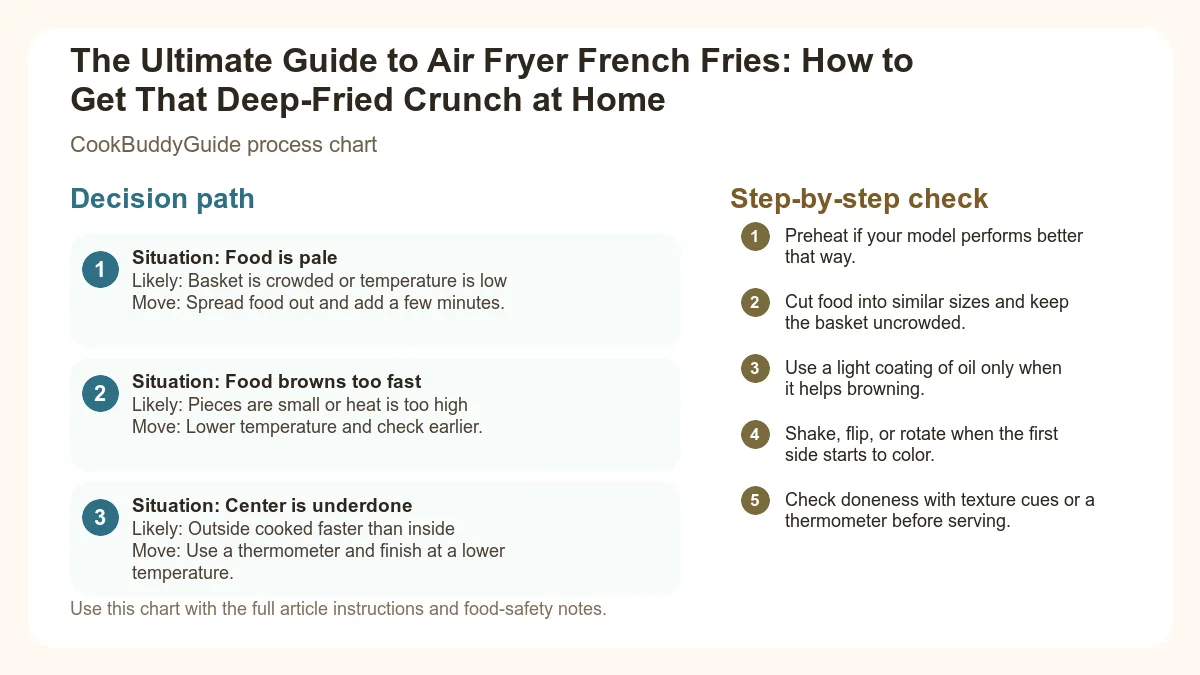
| Situation | Likely cause or meaning | Best move |
|---|---|---|
| Food is pale | Basket is crowded or temperature is low | Spread food out and add a few minutes. |
| Food browns too fast | Pieces are small or heat is too high | Lower temperature and check earlier. |
| Center is underdone | Outside cooked faster than inside | Use a thermometer and finish at a lower temperature. |
Step-by-step fix
- Preheat if your model performs better that way.
- Cut food into similar sizes and keep the basket uncrowded.
- Use a light coating of oil only when it helps browning.
- Shake, flip, or rotate when the first side starts to color.
- Check doneness with texture cues or a thermometer before serving.
Common mistakes
- Crowding the basket until food steams instead of browns.
- Using too much oil and making the surface heavy.
- Following time charts without checking piece size.
- Skipping a thermometer for foods where doneness matters.
Related topic hubs
Table of Contents
- Why Most Air Fryer Fries Fail
- The Science of the Potato: Choosing Your Spud
- The Preparation Secret: The Cold Water Soak
- The Oil Equation: Coating Without Soaking
- The Two-Stage Cooking Method
- Avoiding the Crowded Basket Syndrome
- Beyond Salt: Elevating Your Flavor Profile
- Fresh vs. Frozen: An Honest Comparison
- Troubleshooting Common Mistakes
Introduction: Why Most Air Fryer Fries Fail (and How We Fixed It)
The quest for the perfect healthy fry is the "Holy Grail" of modern home cooking. We all want that shattering crunch of a boardwalk fry without the vat of bubbling peanut oil and the lingering smell of a fast-food joint in our curtains. This is why the air fryer has become a staple; it offers a healthier alternative to deep frying by using convection heating to circulate hot air rapidly around the food.
The common complaint that air fryer fries are "dry" or "tough" usually stems from one of three errors: choosing the wrong potato, skipping the soak, or overcrowding. This guide will show you exactly how to avoid these pitfalls to achieve a golden brown, crispy exterior and a fluffy interior every single time.
The Science of the Potato: Choosing Your Spud
Before you even plug in your appliance, the success of your air fryer french fries is determined at the grocery store. Not all potatoes are created equal, and using the wrong variety is the fastest way to end up with a mediocre result.
Russet vs. Yukon Gold: The Starch Showdown
Yukon Gold potatoes are a decent runner-up. They have a naturally buttery flavor and a medium starch content. While they won't get quite as "shattering" on the outside as a Russet, they produce a beautiful golden brown color. However, if you use red potatoes or "new" potatoes, you will likely fail. These are waxy potatoes with high moisture and low starch; they are great for potato salad but will turn gummy in an air fryer.
Why Freshness Matters for Moisture Content
The Preparation Secret: The Cold Water Soak
Why Surface Starch is the Enemy of Crispiness
When you cut a potato, you release potato starch onto the surface. This starch is sticky. If you put it directly into the air fryer, that starch creates a tacky film that traps moisture inside the fry. Instead of frying, the potato steams. By removing excess surface starch, you allow the hot air to directly contact the potato's surface, leading to a much faster and more effective crunch.
Step-by-Step: The 30-Minute Soak Technique
- Cut the potatoes: Use a kitchen mandoline to ensure every fry is exactly 1/4 inch thick. Inconsistent sizes lead to inconsistent cooking.
- Submerge: Place the cut fries in a large bowl of ice-cold water.
- Wait: Let them sit for at least 30 minutes. If you’re prepping for a 6pm dinner, you can even do this in the morning and leave them in the fridge.
The Importance of Bone-Dry Potatoes
The Oil Equation: Coating Without Soaking
One of the biggest myths about air frying is that you don't need oil. While you use significantly less than deep frying, you still need some oil to conduct heat and create that crispy air fryer fries like deep fried texture.
Best Oils for High-Heat Air Frying
Do not use extra virgin olive oil for this. Its smoke point is too low, and it can leave a bitter taste when blasted at 400°F. Instead, reach for Avocado oil or Grapeseed oil. These have high smoke points and a neutral flavor profile that lets the potato shine.
The "Bowl Toss" vs. Spraying Method
The Ratio: Use exactly 1 tablespoon of oil per 1 pound of potatoes.
Place your bone-dry fries in a clean, dry bowl, drizzle the oil, and use your hands to massage it in. You want every single millimeter of the potato to have a thin, glistening coat of oil. This ensures the convection heating works efficiently on every surface.
The Two-Stage Cooking Method for Maximum Crunch
The CookBuddyGuide Perfect Fry Method
Ingredients: 2 Large Russet Potatoes, 1.5 tbsp Avocado Oil, 1 tsp Sea Salt.
- Stage 1 (The Soften): Set air fryer to 325°F. Cook for 15 minutes. This acts as a "par-cook," softening the interior without browning the outside. Shake the basket every 5 minutes.
- The Rest: Remove the basket and let the fries sit for 2 minutes. This allows the surface moisture to stabilize.
- Stage 2 (The Crisp): Crank the heat to 400°F. Cook for 5-8 minutes until golden brown. This is where the magic happens and the exterior shatters.
Avoiding the Crowded Basket Syndrome
It is 6pm, the kids are hungry, and you want to dump three pounds of potatoes into the basket at once. Don't do it. Airflow is the engine of the air fryer. If the air cannot circulate around each individual fry, you aren't frying; you are steaming.
Airflow: The Engine of the Air Fryer
The fan in your air fryer moves heat at high speeds. When you stack fries three inches deep, the air only hits the top and bottom layers. The middle stays soggy. You must avoid overcrowding the basket to ensure the convection heating can do its job.
Batch Cooking vs. Overloading
Consider cooking in batches. For a standard 5-quart air fryer, you should only cook about 1 to 1.5 pounds of potatoes at a time. The fries should be in a mostly single layer, though a slight overlap is okay if you are diligent about the "Shake and Rotate" schedule.
Pro Tip: To keep the first batch warm while the second batch cooks, place them on a wire rack in a 200°F oven. Do not put them in a covered bowl, or the steam will ruin the crunch you worked so hard for!
Beyond Salt: Elevating Your Flavor Profile
While salt and pepper are classics, the air fryer is a great vehicle for gourmet flavors. However, there is a "Golden Rule" for seasoning: Never salt before cooking. Salt draws out moisture. If you salt the raw potatoes, they will weep water in the air fryer and become limp. Always season the moment they come out of the heat while the oil is still tacky on the surface.
Gourmet Seasoning Blends to Try
- Garlic Parmesan: Toss hot fries with 1/2 tsp garlic powder and 2 tbsp finely grated (powder-like) Parmesan cheese.
- Smoked Paprika & Lime: A teaspoon of smoked paprika and a fresh squeeze of lime juice right before serving. This is a great healthy side dish for taco night.
- Truffle Herb: A drizzle of truffle oil and finely chopped fresh parsley.
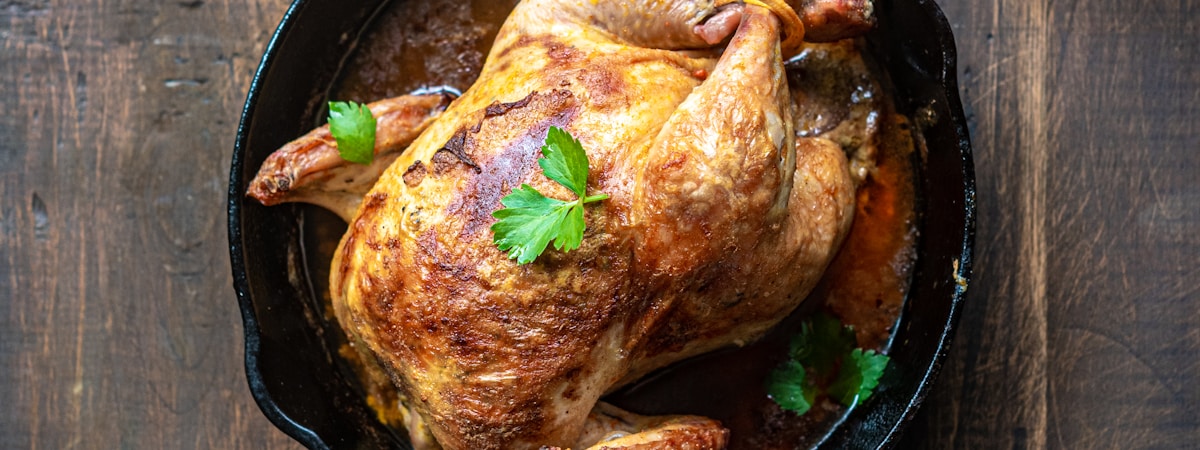
If you're looking for the perfect main course to pair these with, check out our easy air fryer chicken recipes. A crispy thigh and a side of these fries is a world-class meal made in under 30 minutes.
Fresh vs. Frozen: An Honest Comparison
When to Use Store-Bought Frozen Fries
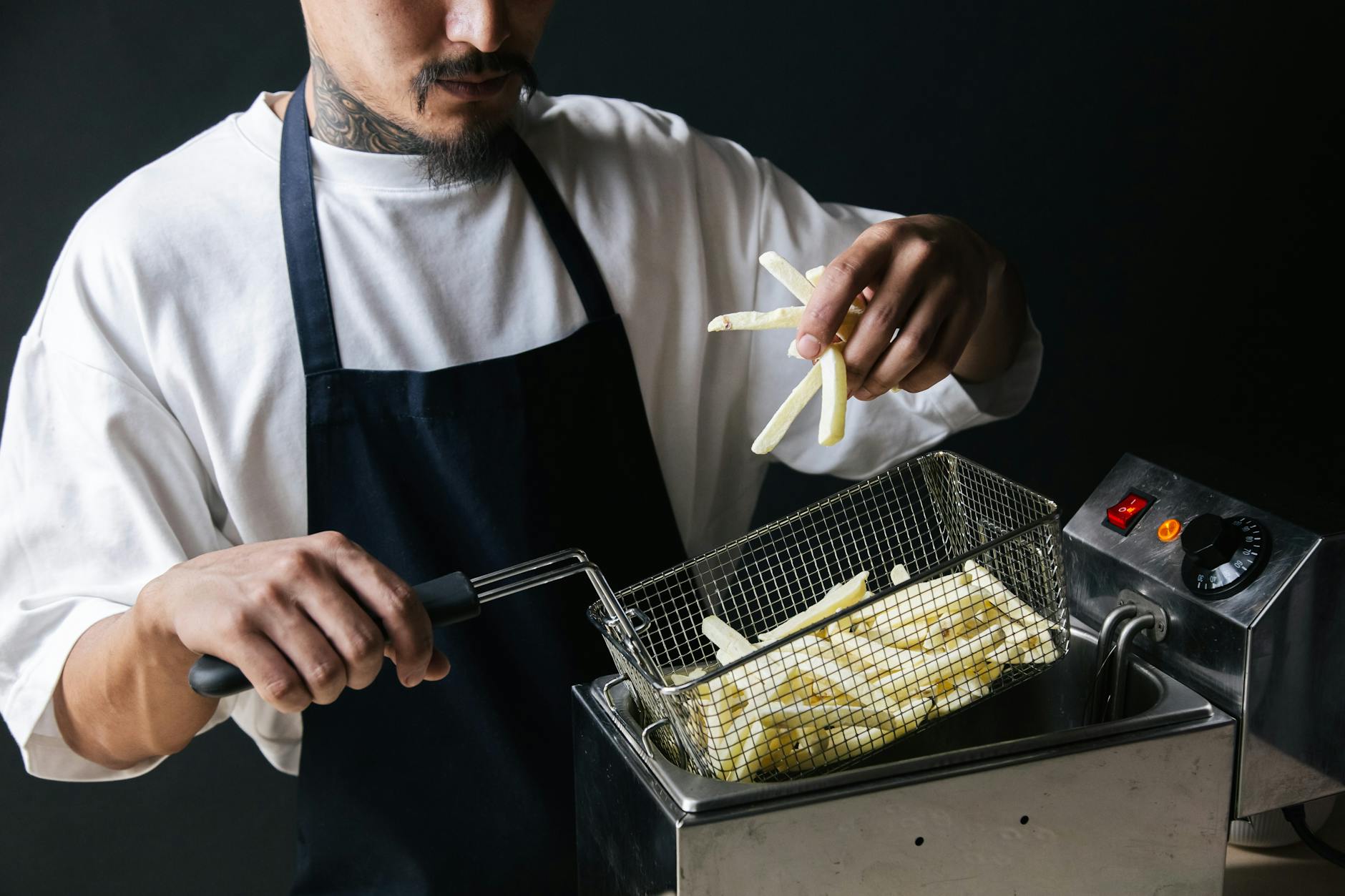
Frozen fries are actually "cheating" in a good way. Most brands like Ore-Ida or Alexia have already been blanching their potatoes in hot water or oil before freezing. This means the starch is already managed. To make frozen fries taste like restaurant quality, don't follow the bag instructions. Instead, preheat your air fryer for 5 minutes at 400°F, spray the frozen fries lightly with avocado oil, and cook for about 12-15 minutes, shaking every 4 minutes.
Troubleshooting Common Air Fryer Fry Mistakes
Usually, this is due to moisture. Either you didn't dry them enough after the soak, or you overcrowded the basket. Try reducing the batch size by half and see if the crunch returns.
This is a temperature issue. Your air fryer is likely running too hot. Use the two-stage method (starting at 325°F) to ensure the middle cooks through before the outside burns. Also, ensure you are using a kitchen mandoline for uniform thickness.
The Impact of Air Fryer Model Variations
Conclusion: Your Path to Fry Perfection
Making the perfect air fryer french fries isn't about luck; it's about physics. By choosing high-starch Russet potatoes, removing the surface starch through a cold-water soak, and using a two-stage temperature approach, you can create a healthy side dish that truly rivals the deep fryer. Stop settling for soggy potatoes. Tomorrow night, grab two Russets, give them a soak, and watch as your family asks which restaurant you ordered from. Happy cooking!