Quick Answer
This guide explains how to make brownies fudgy not cakey in this guide on flour ratios, egg counts, and baking secrets.
Practical note
For your brownies cakey, the most useful home checks are temperature, measuring, resting time, and visible texture. Those details tell you more than guessing, especially before adding extra flour, liquid, heat, or leavening.
Decision table
| Situation | Likely cause or meaning | Best move |
|---|---|---|
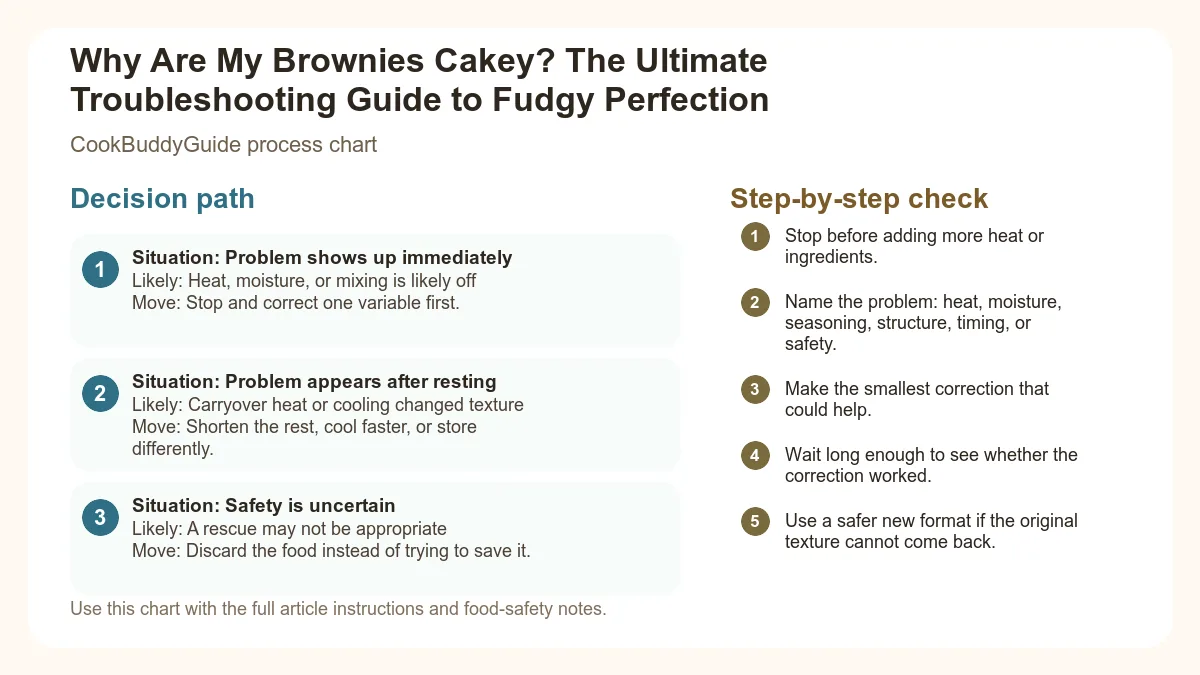
| Problem shows up immediately | Heat, moisture, or mixing is likely off | Stop and correct one variable first. |
| Problem appears after resting | Carryover heat or cooling changed texture | Shorten the rest, cool faster, or store differently. |
| Safety is uncertain | A rescue may not be appropriate | Discard the food instead of trying to save it. |
Step-by-step fix
- Stop before adding more heat or ingredients.
- Name the problem: heat, moisture, seasoning, structure, timing, or safety.
- Make the smallest correction that could help.
- Wait long enough to see whether the correction worked.
- Use a safer new format if the original texture cannot come back.
Common mistakes
- Adding several fixes at once and losing track of what helped.
- Using high heat to rush a texture problem.
- Trying to rescue food when safety is uncertain.
- Repeating the recipe without writing down the likely cause.
Related topic hubs
In This Guide:
- The Great Brownie Debate: Cakey vs. Fudgy vs. Chewy
- Reason 1: The Flour Trap (Too Much Structure)
- Reason 2: Cocoa Powder vs. Melted Chocolate
- Reason 3: The Egg Factor and Aeration
- Reason 4: The Leavening Agent Myth
- Reason 5: The Overbaking Epidemic
- How to Make Brownies Fudgy Not Cakey: The Master Formula
- Advanced Troubleshooting: Pans and Temperatures
The Great Brownie Debate: Cakey vs. Fudgy vs. Chewy
Defining the Perfect Brownie Texture
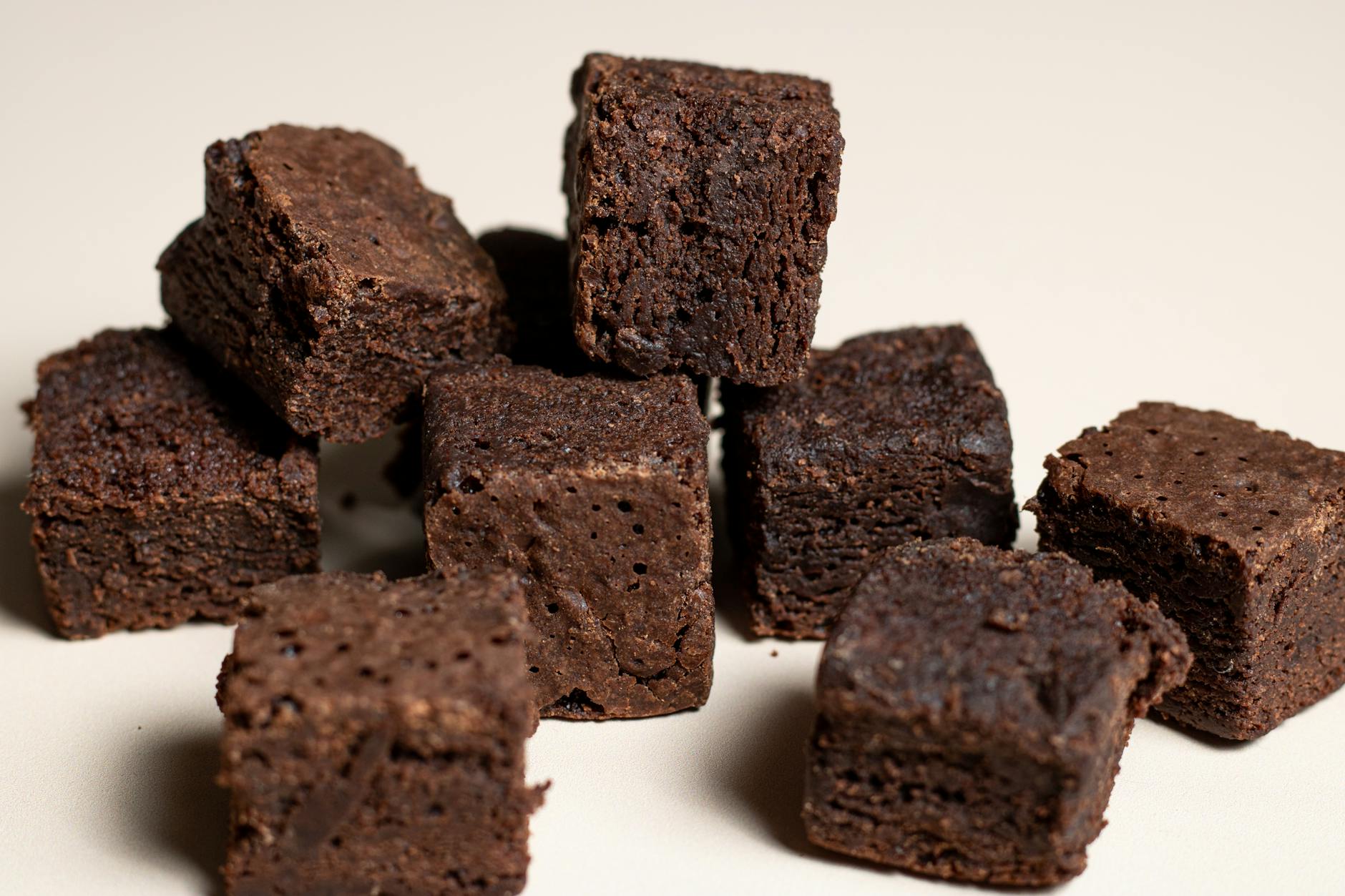
Before we can fix the problem, we have to define what went wrong. A cakey brownie has a high flour-to-fat ratio and often contains a chemical leavener like baking powder. It is airy, light, and has a crumb structure similar to a traditional chocolate cake. While some people enjoy this, most brownie purists are looking for the fudgy variety—dense, moist, and intensely chocolatey with almost no visible "crumb." Then there is the chewy brownie, which sits in the middle, characterized by a slight pull when you bite into it, usually achieved through a specific balance of sugar and eggs.
The Science of Brownie Anatomy
Reason 1: The Flour Trap (Too Much Structure)
How Excess Flour Creates a Cake-Like Crumb
The "Scoop vs. Level" Mistake
Pro-Tip: The Flour Fix
The Mistake: Using a measuring cup to scoop flour, leading to a high fat-to-flour ratio imbalance.
The Solution: Use a kitchen scale. If you don't have one, reduce your flour by 2-3 tablespoons from the written recipe to ensure a denser bite.
Reason 2: Cocoa Powder vs. Melted Chocolate
The Fat Content Discrepancy
Many recipes rely solely on Dutch-process cocoa powder for flavor. While cocoa powder provides a deep, earthy chocolate taste, it is essentially a starch. It absorbs moisture and lacks the structural fats found in bar chocolate. When you use only cocoa powder, you are adding more "dry" mass to the batter without the lubricating benefits of cocoa butter.
Why Melted Chocolate Equals Fudgy Results
Reason 3: The Egg Factor and Aeration
Too Many Eggs = Too Much Lift
Eggs are the ultimate multi-taskers in baking. They provide moisture, fat, and protein. However, they are also powerful leaveners. The proteins in egg whites trap air when beaten, which expands in the oven. If your recipe calls for three or four large eggs for an 8x8 pan, you are likely heading toward cake territory. The excess protein creates a lattice that supports a higher rise, which is exactly what you want in a sponge cake but the enemy of a dense brownie.
Whisking vs. Folding: How Air Affects Texture
The way you incorporate your eggs matters just as much as the quantity. If you vigorously whisk your eggs and sugar together until they are pale and frothy, you are performing emulsification and aeration. This creates a meringue-like "crackly" top, but it also incorporates millions of tiny air bubbles. To keep things fudgy, consider whisking the sugar and melted butter first, then folding in the eggs one by one until just combined. You want to avoid overbeating the eggs to prevent that unwanted lift.
The Golden Egg Ratio
For the ultimate fudgy experience, try this CookBuddyGuide secret: Replace one whole egg in your recipe with a single egg yolk. The yolk adds pure fat and lecithin without the drying, aerating proteins found in the white. This significantly increases the richness and density of the final product.
Reason 4: The Leavening Agent Myth
Do Brownies Really Need Baking Powder?
In my practical view? No. If you want to know how to make brownies fudgy not cakey, the first thing you should do is look at the leavening agents. Baking powder and baking soda are designed to create carbon dioxide bubbles. These bubbles push the batter upward, creating a light, airy crumb. While some "chewy" recipes use a tiny pinch (1/4 teaspoon) to provide a bit of lift, fudgy brownies should rely entirely on the moisture and fat content for their texture.
Chemical Leaveners vs. Natural Rise
The science of brownie texture dictates that density is the goal. When you omit chemical leaveners, the only "rise" you get is from the steam of the moisture in the butter and eggs. This results in a brownie that collapses slightly as it cools, creating that concentrated, truffle-like consistency. If your current favorite recipe calls for a teaspoon of baking powder and you’re wondering why it tastes like cake—there is your culprit. Omit it entirely next time.
Reason 5: The Overbaking Epidemic
The "Clean Toothpick" Lie
The Science of the Pan
The edges of the pan reach a much higher temperature than the center. By the time the center is "done" by traditional standards, the edges have already begun to dry out and turn cakey. The impact of overbaking brownies is irreversible; once the moisture has evaporated and the proteins have fully set, you lose that fudgy center forever. Look for a slight jiggle in the center and edges that have just begun to pull away from the parchment paper sling.
The Perfect Bake Test
- The Visual: The edges should be set and slightly cracked, but the center should still look slightly underdone.
- The Toothpick: It should come out with several moist, fudgy crumbs clinging to it. Not liquid batter, but definitely not clean.
- The Time: Start checking 5 minutes before the recipe says it's done. The "fudgy window" is often only 2-3 minutes wide.
How to Make Brownies Fudgy Not Cakey: The Master Formula
The Ideal Fat-to-Flour Ratio
For an 8x8 inch pan, a fudgy brownie should generally follow this weight-based ratio:
- Fat (Butter + Chocolate): 200g - 225g
- Sugar: 250g - 300g
- Flour: 60g - 90g
Sugar Types: Brown Sugar vs. White Sugar
While white sugar helps create those shiny, crackly tops, brown sugar is your best friend for fudginess. Brown sugar contains molasses, which is hygroscopic—meaning it attracts and holds onto moisture. This prevents the brownies from drying out in the oven. Choose a 50/50 split of granulated white sugar and light brown sugar for the perfect balance of texture and flavor.
The Importance of Chilling the Batter
If you have the patience, let your batter rest in the fridge for 30 minutes (or even overnight) before baking. This allows the flour to fully hydrate and the fats to solidify slightly. It results in a much more uniform bake and a deeper flavor profile. It’s a trick Use when preparing our simple five-ingredient dinner recipes—I’ll prep the brownie batter first, let it chill while we eat, and then pop it in the oven for a fresh dessert.
Advanced Troubleshooting: Pan Material and Oven Hot Spots
Glass vs. Metal vs. Ceramic
The baking pan material you choose has a massive impact on the final texture.
- Light-colored metal: The gold standard. It conducts heat evenly and prevents the bottom from burning.
- Dark metal: Absorbs heat quickly. It can lead to overbaked, tough edges before the center is done. If using dark metal, lower your oven temperature by 25°F.
- Glass or Ceramic: These are insulators. They take a long time to heat up but retain heat for a long time. Brownies in glass often end up with gummy centers and overbaked edges because of the uneven heat distribution.
The Ice Bath Technique for Fudgy Edges
This is a professional trick used to stop carryover cooking instantly. As soon as the brownies come out of the oven, place the bottom of the pan into a larger tray filled with ice water for about 5 minutes. This "shocks" the batter, stopping the heat from traveling further into the center and locking in that fudgy consistency. Be careful not to get any water in the brownies!
Final Tips for Success
Always use room temperature eggs. Cold eggs can cause the melted chocolate and butter to seize, leading to a lumpy batter that won't bake evenly. Additionally, always use a cooling rack. Letting the pan sit on a flat counter traps heat underneath, which can lead to a soggy bottom. Finally, don't forget the chocolate chips! Folding in a handful of chips at the end adds pockets of pure melted fat that guarantee a fudgy experience in every bite.
Frequently Asked Questions
A: Unfortunately, you can't change the internal structure once the proteins have set. However, you can repurpose them! Crumble them over ice cream, use them as a base for a trifle, or turn them into brownie truffles by mixing the crumbs with a bit of chocolate ganache.
A: Most box mixes give two sets of instructions: one for "fudgy" and one for "cakey." The cakey version usually asks for an extra egg. To make a box mix even fudgier, use melted butter instead of oil and reduce the number of eggs by one.
A: Yes! Dutch-process cocoa is neutralized and won't react with baking soda, leading to a denser result. Natural cocoa powder is acidic and can provide a bit of lift if there is soda in the recipe, contributing to a cakey texture.
Conclusion: Your Path to Fudgy Perfection
Solving the mystery of "why are my brownies cakey" isn't about luck; it's about controlling the variables. By focusing on your fat-to-flour ratio, choosing melted chocolate over just cocoa, and being extremely disciplined with your bake time, you can achieve that perfect, dense chocolate dessert every single time. Stop relying on the "clean toothpick" and start trusting your kitchen scale. Your future self—and anyone lucky enough to share your kitchen—will thank you for it. Happy baking!