Quick Answer
This guide explains to make flaky biscuits without buttermilk using pantry staples. Find the best buttermilk substitute for biscuits and practical tips for tender, tall layers.
Practical note
For How to Make Flaky Biscuits Without Buttermilk, this guide centers on The Flour, The Butter, The Leavening. Those are the checkpoints we would use first in a normal home kitchen before making a bigger change.
Decision table
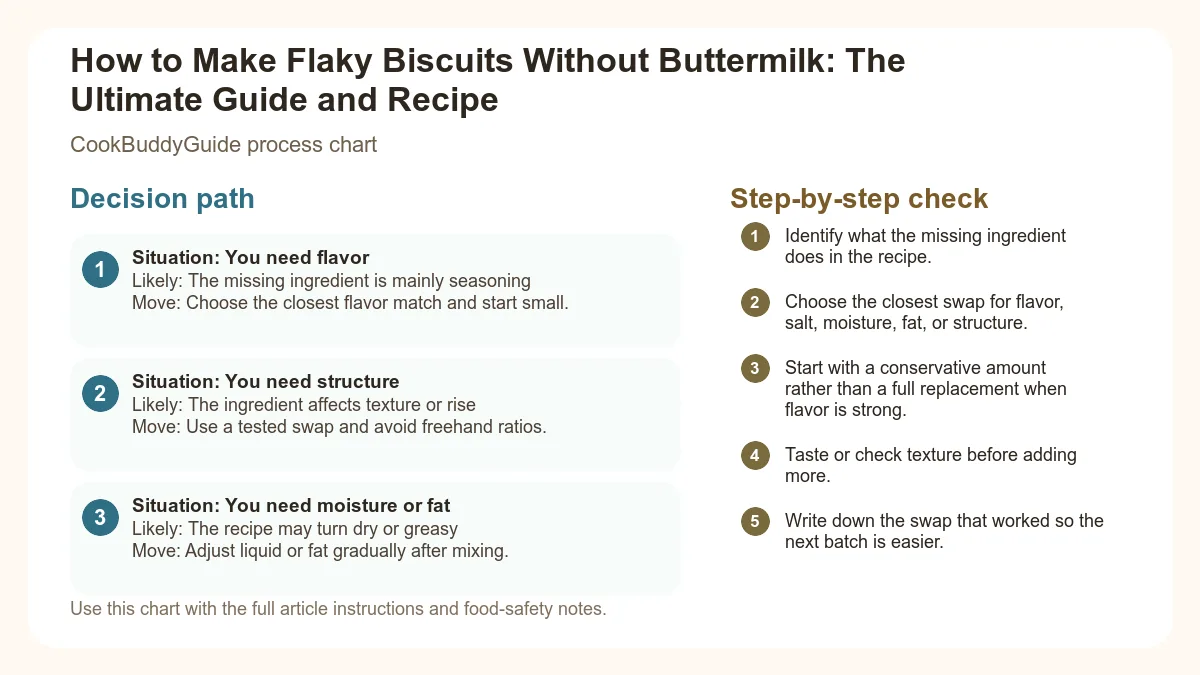
| Situation | Likely cause or meaning | Best move |
|---|---|---|
| You need flavor | The missing ingredient is mainly seasoning | Choose the closest flavor match and start small. |
| You need structure | The ingredient affects texture or rise | Use a practical swap and avoid freehand ratios. |
| You need moisture or fat | The recipe may turn dry or greasy | Adjust liquid or fat gradually after mixing. |
Step-by-step fix
- Identify what the missing ingredient does in the recipe.
- Choose the closest swap for flavor, salt, moisture, fat, or structure.
- Start with a conservative amount rather than a full replacement when flavor is strong.
- Taste or check texture before adding more.
- Write down the swap that worked so the next batch is easier.
Common mistakes
- Replacing a strong ingredient 1:1 before tasting.
- Choosing a flavor match when the recipe actually needs structure.
- Forgetting that salty swaps can change the whole dish.
- Adding extra liquid before the batter, dough, or sauce has time to hydrate.
Related topic hubs
- The Science of the 'Buttermilk' Effect
- Top 4 Buttermilk Substitutes for Biscuits
- Essential Ingredients for Success
- The Master Recipe: Flaky Biscuits Without Buttermilk
- Pro Techniques for Sky-High Layers
- Troubleshooting Common Biscuit Blunders
- Flavor Variations and Add-ins
- Storage, Reheating, and Freezing
The Science of the 'Buttermilk' Effect in Baking
To understand why we usually reach for buttermilk, we have to look at the acid-base reaction happening inside your dough. Traditional buttermilk is slightly acidic. When that acid hits the baking soda (a base) in your dough, it creates carbon dioxide gas. These tiny bubbles are what cause the dough to lift and expand in the heat of the oven.
The Role of Acid and Leavening Agents
Fat Content and Tenderness
Buttermilk also provides a specific fat-to-protein ratio. It is thicker than standard milk, which contributes to a richer mouthfeel. When we use a buttermilk substitute for biscuits, we often try to mimic this viscosity. For example, using heavy cream or full-fat Greek yogurt adds the necessary lipids that coat the flour molecules, preventing them from forming tough gluten strands when they get wet. This is the "CookBuddy" approach: we don't just swap ingredients; we balance the chemistry.
Top 4 Buttermilk Substitutes for Biscuits
1. The Classic: Milk and Vinegar (or Lemon Juice)
2. The Creamiest: Greek Yogurt and Milk
If you want a biscuit that feels substantial and rich, yogurt is your best friend. The Ratio: 3/4 cup plain Greek yogurt whisked with 1/4 cup milk. According to experts on using yogurt or sour cream, this method provides the high acidity needed for a massive rise while adding a beautiful creaminess to the crumb. Pro Tip: Ensure the yogurt is plain; vanilla-flavored biscuits are a mistake I only made once!
3. The Richest: Sour Cream and Milk
Similar to yogurt, sour cream adds a high fat content that leads to an incredibly tender biscuit. The Ratio: 3/4 cup sour cream and 1/4 cup milk. This combination produces a biscuit that is almost "shortbread-like" in its tenderness. It is perfect for biscuits intended for strawberry shortcake or savory biscuits topped with heavy gravy.
4. The Simplest: Plain Whole Milk and Extra Baking Powder
If you have no acids at all, you can use plain milk, but you must change the leavening. The Ratio: Use 1 cup of whole milk, but increase the baking powder in the recipe by an extra teaspoon. Warning: You will lose the "tang" of a traditional biscuit, and the Maillard reaction (the browning of the crust) might be slightly less pronounced, but you will still get a decent rise.
For more detailed ratios on these swaps, you can check out this guide on the best substitutes for buttermilk.
Essential Ingredients for Success
Before we get to the mixing bowl, let’s talk about your kit. The quality of your ingredients is the difference between a "good" biscuit and a "life-changing" biscuit.
- The Flour: Most home cooks reach for all-purpose flour. Consider an unbleached variety with a protein content around 10-11%. If you want that ultra-soft, Southern-style texture, you can use self-rising flour (just remember to omit the added baking powder and salt from the recipe).
- The Leavening: Check the expiration date on your baking powder! If it’s been open for more than 6 months, it might be dead. To test, drop a half-teaspoon into hot water; if it doesn't fizz aggressively, throw it out.
- The Salt: Choose Diamond Crystal Kosher salt. It has a larger grain and a cleaner salt flavor that doesn't overwhelm the butter.
The Master Recipe: Flaky Biscuits Without Buttermilk
Ingredients
- 2 ½ cups (315g) All-purpose flour (plus extra for dusting)
- 1 tablespoon Baking powder
- 1 teaspoon Kosher salt
- 1 tablespoon Granulated sugar (optional, for browning)
- ½ cup (113g) Unsalted butter, frozen or very cold
- 1 cup buttermilk substitute for biscuits (Consider the Milk + Vinegar method)
- 2 tablespoons melted butter (for brushing the tops)
Equipment
- Large mixing bowl
- Pastry blender or box grater
- Biscuit cutter (2.5 or 3-inch)
- Baking sheet or 12-inch cast iron skillet
- Parchment paper
Instructions
- Preheat and Prep: Preheat your oven to 425°F (218°C). Line a baking sheet with parchment paper or lightly grease your cast iron skillet.
- Mix Dry Ingredients: In a large bowl, whisk together the flour, baking powder, salt, and sugar.
- Cut in the Butter: Using a pastry blender, cut the cold butter into the flour mixture until it resembles coarse crumbs with some pea-sized chunks remaining. Alternatively, grate the frozen butter directly into the flour and toss gently to coat.
- Add the Liquid: Make a well in the center of the flour. Pour in your cold buttermilk substitute. Use a wooden spoon or spatula to fold the mixture together just until a shaggy dough forms. Do not overmix!
- Lamination (The Secret Step): Turn the dough out onto a lightly floured surface. Gently pat it into a rectangle. Fold the dough in thirds (like a letter), rotate 90 degrees, and repeat 3-4 times. This creates the flaky layers we’re after.
- Cut the Biscuits: Pat the dough down to about 1-inch thickness. Use a biscuit cutter to press straight down—do not twist. Place the biscuits on the prepared pan, making sure they touch each other for a higher rise.
- Bake: Brush the tops with a little extra milk or melted butter. Bake for 12-15 minutes, or until the tops are golden brown.
- Finish: Remove from the oven and immediately brush with melted butter. Serve warm!
Pro Techniques for Sky-High, Flaky Layers
The 'Cold is King' Rule
The physics of a biscuit is simple: steam creates lift. When those little pockets of cold butter hit the high heat of a 425°F oven, the water in the butter evaporates instantly. This creates a puff of steam that separates the layers of dough. If your butter is warm or at room temperature, it will simply melt into the flour, resulting in a greasy, heavy biscuit. Often, chill my mixing bowl and flour in the freezer for 15 minutes before I even start. For a deep dive into this, read about the science of flaky biscuit layers.
Lamination: The Secret Folding Method
The 'No-Twist' Rule for Cutting
This is the mistake most beginners make. When you use your biscuit cutter, you must press straight down and pull straight up. If you twist the cutter, you "cauterize" or seal the edges of the dough. This prevents the layers from expanding upward. A sealed edge means a short, squat biscuit. A clean cut means the layers can bloom like a flower in the oven.
For more dough handling advice, consider these tips for handling biscuit dough.
Troubleshooting Common Biscuit Blunders
This is usually caused by one of two things: expired baking powder or overworking the dough. If you mix the dough until it’s smooth, you’ve developed too much gluten. Biscuit dough should look "shaggy" and slightly messy before you start folding it. Also, ensure your oven is actually at 425°F; use an oven thermometer to be sure!
You likely added too much flour. When measuring flour, never scoop the measuring cup directly into the bag—this packs the flour down. Instead, spoon the flour into the cup and level it off with a knife. Or better yet, use a kitchen scale (315g for this recipe).
The Maillard reaction needs protein and sugar to occur. If your biscuits are pale, try brushing the tops with heavy cream or a beaten egg wash before baking. Also, make sure you aren't baking them on the bottom rack of the oven; the middle rack is best for even browning.
Flavor Variations and Add-ins
Once you master the base recipe for biscuits without buttermilk, the world is your oyster. These are great additions to serve alongside our 5-Ingredient Dinner Recipes.
Savory Herb and Cheese Biscuits
Sweet Honey-Glazed Biscuits
Add an extra tablespoon of sugar to the dough. As soon as they come out of the oven, brush them with a mixture of 2 tablespoons melted butter and 1 tablespoon honey. These are incredible for breakfast or as a base for a fruit cobbler.
Storage, Reheating, and Freezing
How to Keep Biscuits Fresh
Store cooled biscuits in an airtight container at room temperature for up to 2 days. To keep them from getting soggy, place a paper towel in the container to absorb any excess moisture.
The Best Way to Reheat
Avoid the microwave! It turns biscuits into rubber. Instead, wrap them in aluminum foil and pop them into a 350°F oven for 5-7 minutes. They will taste almost as good as day one.
Freezing Unbaked Biscuits
Conclusion: You Are the Master of Your Kitchen
Making biscuits without buttermilk isn't just a workaround; it's a demonstration of your skills as a home cook. By mastering the buttermilk substitute for biscuits and focusing on the lamination technique, you can produce a result that rivals any Southern grandma's kitchen. Remember: keep your butter cold, don't twist that cutter, and trust the process. Now, get that oven preheated and start baking!