
Quick Answer
The right substitute for sour cream depends on what that ingredient contributes: flavor, salt, acidity, fat, moisture, or structure. Use the comparison below to choose the closest match and adjust the amount for your recipe.
Practical note
For sour cream recipes substitutes, we judge swaps by job first: flavor, salt, acid, fat, moisture, or structure. That keeps a substitution from fixing one problem while creating another.
Decision table
| Situation | Likely cause or meaning | Best move |
|---|---|---|
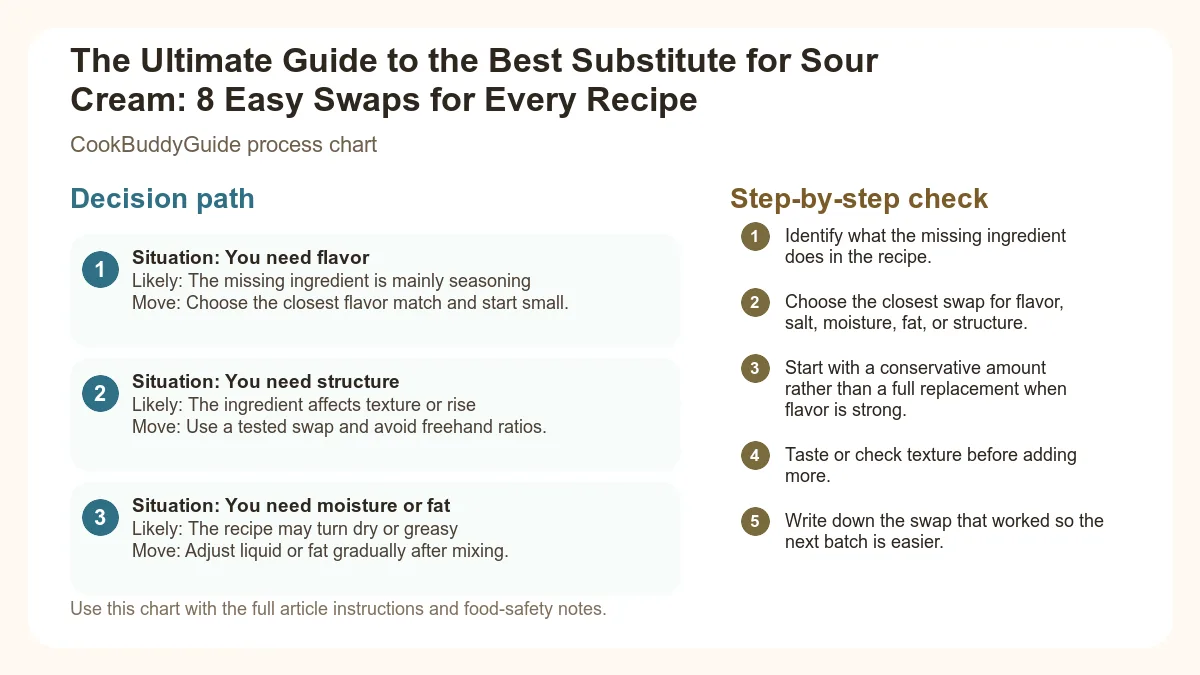
| You need flavor | The missing ingredient is mainly seasoning | Choose the closest flavor match and start small. |
| You need structure | The ingredient affects texture or rise | Use a practical swap and avoid freehand ratios. |
| You need moisture or fat | The recipe may turn dry or greasy | Adjust liquid or fat gradually after mixing. |
Step-by-step fix
- Identify what the missing ingredient does in the recipe.
- Choose the closest swap for flavor, salt, moisture, fat, or structure.
- Start with a conservative amount rather than a full replacement when flavor is strong.
- Taste or check texture before adding more.
- Write down the swap that worked so the next batch is easier.
Common mistakes
- Replacing a strong ingredient 1:1 before tasting.
- Choosing a flavor match when the recipe actually needs structure.
- Forgetting that salty swaps can change the whole dish.
- Adding extra liquid before the batter, dough, or sauce has time to hydrate.
Related topic hubs
Table of Contents
- The Role of Fat and Acid in Cooking
- The #1 Best All-Purpose Substitute: Greek Yogurt
- Dairy-Based Substitutes for Richness and Tang
- Dairy-Free and Vegan Sour Cream Substitutes
- Choosing the Right Substitute by Recipe Type
- Practical Tips: Lessons from the CookBuddyGuide Kitchen
- Summary Comparison Table
Why You Need a Reliable Sour Cream Replacement
The Role of Fat and Acid in Cooking
To find the best substitute for sour cream, we first have to understand what sour cream actually does. Standard sour cream contains about 18% to 20% butterfat. This high fat content provides a luxurious consistency and "mouthfeel" that coats the tongue. But the real magic lies in the lactic acid produced during the fermentation process.
In baking, this acid acts as a leavening agent when it reacts with baking soda. This reaction creates carbon dioxide bubbles, which is why sour cream muffins and cheesecake are so incredibly light yet moist. If you swap sour cream for something non-acidic (like plain heavy cream), your cake will likely turn out dense and flat. This is why many of our recommended swaps include a splash of lemon juice or apple cider vinegar to mimic that specific pH level.
When to Substitute vs. When to Run to the Store
The #1 Best All-Purpose Substitute: Greek Yogurt
Why Greek Yogurt Wins
Conversion Ratio and Texture Adjustments
The Ratio: 1:1. You can swap one cup of Greek yogurt for one cup of sour cream in almost any recipe.
- For Toppings: Use full-fat (5%) Greek yogurt for the best flavor. Non-fat yogurt works, but it can have a slightly "chalky" finish when eaten raw on tacos.
- For Dips: If your yogurt feels a bit too thick, whisk in a teaspoon of lemon juice. This thins the texture while amping up the tangy flavor.
Dairy-Based Substitutes for Richness and Tang
Plain Yogurt: The Thinner Alternative
Cream Cheese Thinned with Milk: The Richness King
When richness is the goal—think cheesecake or a thick dip—cream cheese is your best friend. However, cream cheese is much denser and less acidic than sour cream. To make it work, you need to alter the fat content and acidity manually.
The Cream Cheese "Sour Cream" Hack
Use this for heavy dips or as a base for thick sauces.
- 3/4 cup Cream cheese (softened to room temperature)
- 3 tbsp Whole milk or heavy cream
- 1 tsp Lemon juice or apple cider vinegar
Instructions: Beat the softened cream cheese until smooth. Slowly whisk in the milk and acid until the mixture reaches a dollop-able consistency. This is the "Richness King" for a reason!
Crème Fraîche: The Gourmet Choice
Cottage Cheese: The High-Protein Hack
Don't be fooled by the lumps! If you blend cottage cheese, it becomes a velvety, high-protein sour cream replacement. According to this substituting cottage cheese for sour cream guide, the key is the addition of acid.
Dairy-Free and Vegan Sour Cream Substitutes
Finding a substitute for sour cream when you're avoiding dairy used to mean buying highly processed "imitation" tubs. Today, we have much better whole-food vegan alternatives. For a deeper look at these, dairy-free sour cream alternatives offer a range of soy and nut-based solutions.
Cashew Cream: The Creamiest Plant-Based Swap
Cashew cream is the gold standard for vegan cooking. When soaked and blended, cashews undergo a natural emulsification that mimics the fat content of dairy.
Homemade Vegan Cashew Sour Cream
- 1 cup Raw cashews (soaked in hot water for 1 hour)
- 1/2 cup Water (plus more for thinning)
- 1 tbsp Lemon juice
- 1 tsp Apple cider vinegar
- 1/2 tsp Sea salt
Instructions: Drain the soaked cashews. Place all ingredients in a high-speed blender and process until completely smooth. The apple cider vinegar provides that fermented "funk" that is essential for a realistic tangy flavor.
Coconut Cream: The Pantry Staple
Silken Tofu: The Low-Fat Vegan Option
For a protein-packed, low-fat alternative, silken tofu is unmatched. Because it is neutral in flavor, it takes on the characteristics of whatever you add to it. Blend one block of silken tofu with a tablespoon of lemon juice and a teaspoon of apple cider vinegar. The texture is remarkably similar to a light sour cream, making it perfect for creamy salad dressings or as a base for vegan ranch.
Choosing the Right Substitute by Recipe Type
Not all substitutes are created equal. The sour cream replacement you choose for a cold dip might fail miserably in a hot oven. Here is how to choose based on your specific recipe needs, with insights from sour cream replacement in baking experts.
Best for Baking (Cakes, Muffins, Breads)
In baking, you need lactic acid to react with your leaveners.
- Top Pick: Full-fat Greek yogurt. It has the perfect balance of moisture and acidity.
- Runner Up: Buttermilk (use 3/4 cup for every 1 cup of sour cream, as it is much thinner).
- The Science: Sour cream helps "shorten" gluten strands, leading to a more tender cake. If you use a lower-fat substitute, your muffins might be slightly tougher.
Best for Cold Dips and Dressings
Here, texture and tangy flavor are the most important factors.
- Top Pick: Blended cottage cheese or Greek yogurt.
- Vegan Pick: Cashew cream.
- Tip: Let your dip sit in the fridge for at least 30 minutes after substituting. This allows the flavors to meld and the consistency to firm up.
Best for Hot Sauces and Soups (Beef Stroganoff)
Heat is the enemy of many dairy products. If the protein content is too high and the fat too low, the substitute for sour cream will curdle.
- Top Pick: Crème fraîche or heavy cream with a squeeze of lemon.
- Avoid: Non-fat yogurt. It will almost certainly separate into grainy clumps the moment it hits the hot pan.
Best for Toppings (Tacos and Potatoes)
Since this is a visual and direct-flavor application, you want something that looks and tastes like the real thing.
- Top Pick: Greek yogurt (5% fat).
- Budget Pick: Plain yogurt strained for 30 minutes.
Practical Tips: Lessons from the CookBuddyGuide Kitchen
The Temperature Rule
For baking, always bring your substitute to room temperature. Cold ingredients don't emulsify properly with room-temperature butter and sugar, which can lead to a "broken" batter and an uneven bake.
Adding the 'Tang' Factor
Avoiding the 'Curdle' Disaster
If you are using a lower-fat sour cream replacement like yogurt or silken tofu in a hot dish, never let the sauce come to a boil once the substitute is added. Keep the heat on "low" and stir constantly. The high heat causes the proteins to denature and tighten, which is what creates that unappealing curdled texture.
Summary Comparison Table
To make your life easier next time you're in the middle of a recipe, here is a quick-reference chart for the best substitute for sour cream options.
| Substitute | Ratio | Best For... | Dietary Note |
|---|---|---|---|
| Greek Yogurt | 1:1 | Everything (Baking, Tacos, Dips) | High Protein |
| Plain Yogurt | 1:1 (Strain first) | Baking and Dressings | Lower Fat |
| Crème Fraîche | 1:1 | Hot Sauces (Stroganoff) | Gourmet / High Fat |
| Cream Cheese + Milk | 3/4 cup + 3 tbsp | Cheesecake and Thick Dips | Ultra Rich |
| Cottage Cheese | 1:1 (Blended) | Potatoes and High-Protein Meals | Lean / High Protein |
| Cashew Cream | 1:1 | Vegan Toppings and Sauces | Vegan / Dairy-Free |
| Coconut Cream | 1:1 (Thick part only) | Curries and Vegan Baking | Vegan / Paleo |
| Silken Tofu | 1:1 (Blended) | Vegan Dressings and Dips | Vegan / Low Fat |
Frequently Asked Questions
This usually happens because the yogurt was too cold or the soup was too hot (boiling). Lower-fat yogurts are more prone to curdling. Next time, try "tempering" the yogurt or using a higher-fat sour cream replacement like crème fraîche.
No. Heavy cream is unfermented and has a much higher fat content (36%+) and no acidity. If you use it as a substitute for sour cream in baking, your recipe will likely fail to rise unless you add an acid like apple cider vinegar.
Conclusion: The Versatility of the Swap
The next time you’re halfway through a recipe and realize the sour cream is missing, don't panic. Check your pantry for these 8 swaps, remember the "tang" factor, and keep on cooking. Your beef stroganoff (and your family) won't even know the difference!