Quick Answer
Kosher salt vs sea salt: discover the key kosher salt table salt sea salt differences. Master conversions, flavor profiles, and why pros choose Diamond Crystal.
Practical note
For Kosher Salt vs Sea Salt, this guide centers on Diamond Crystal, Morton Salt, Baking. Those are the checkpoints we would use first in a normal home kitchen before making a bigger change.
Decision table
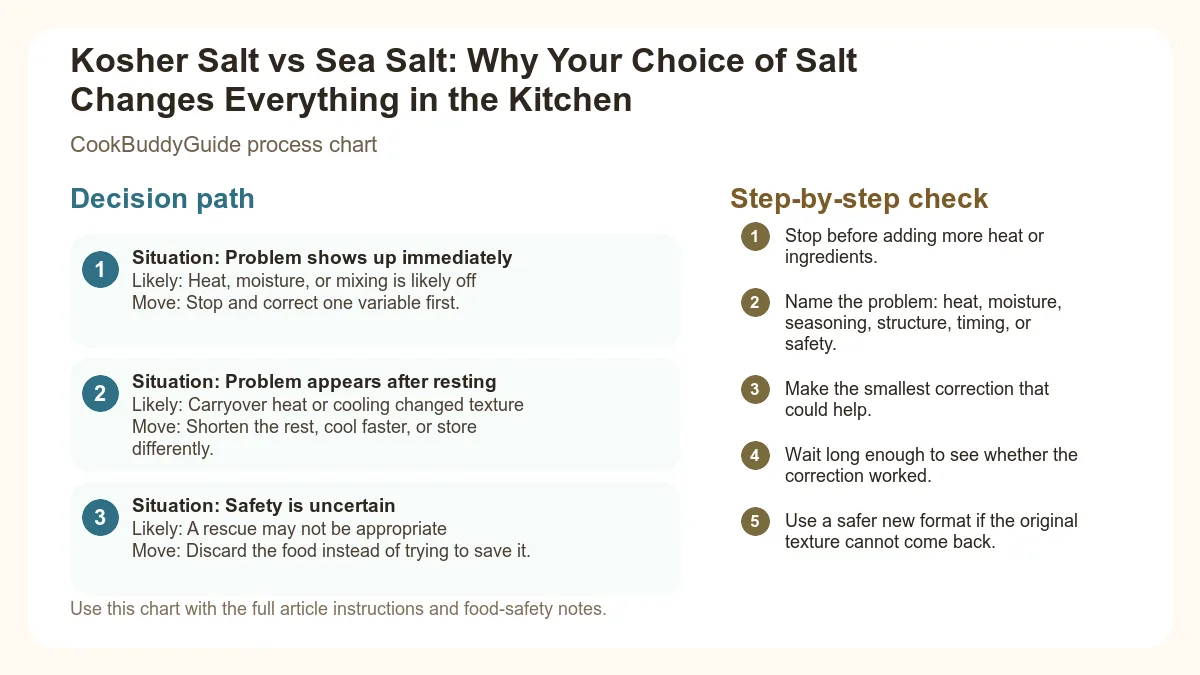
| Situation | Likely cause or meaning | Best move |
|---|---|---|
| Problem shows up immediately | Heat, moisture, or mixing is likely off | Stop and correct one variable first. |
| Problem appears after resting | Carryover heat or cooling changed texture | Shorten the rest, cool faster, or store differently. |
| Safety is uncertain | A rescue may not be appropriate | Discard the food instead of trying to save it. |
Step-by-step fix
- Stop before adding more heat or ingredients.
- Name the problem: heat, moisture, seasoning, structure, timing, or safety.
- Make the smallest correction that could help.
- Wait long enough to see whether the correction worked.
- Use a safer new format if the original texture cannot come back.
Common mistakes
- Adding several fixes at once and losing track of what helped.
- Using high heat to rush a texture problem.
- Trying to rescue food when safety is uncertain.
- Repeating the recipe without writing down the likely cause.
Related topic hubs
Table of Contents
- The Science of Salt: Why Crystal Size Matters
- Kosher Salt: The Professional Standard
- Sea Salt: From Cooking to Luxury Finishing
- Table Salt: The Hidden Flavor Killer
- A Practical Salt Conversion Table
- Practical Application: Which Salt for Which Task?
- Practical Tips for Seasoning Like a Chef
- Common Mistakes and How to Fix Them
The Science of Salt: Why Crystal Size Changes Your Recipe
Volume vs. Weight: The Density Dilemma
The most critical concept to understand regarding kosher salt vs sea salt is density. Imagine a box filled with golf balls and another filled with fine sand. Even if the boxes are the same size, the sand is much denser and heavier because there is less air between the grains. This is exactly what happens with different different salt crystal sizes. A tablespoon of fine-grain table salt contains nearly twice the amount of actual salt by weight as a tablespoon of flaky, coarse grain kosher salt.
Surface Area and Dissolving Speed
The shape of the crystal also dictates how it interacts with food. Large, jagged crystals have more surface area relative to their weight. This allows them to adhere better to the surface of a steak or a piece of fish. When you are seasoning your chicken breasts, a fine grain salt will often bounce off or dissolve instantly into a wet slurry. A coarse grain kosher salt stays put, creating those essential seasoning layers that build a crust during searing.
Kosher Salt: The Professional Standard
Why It’s Called "Kosher" Salt
A common misconception is that kosher salt is "blessed" or inherently more religious than other salts. In reality, it is called "koshering salt." Its original purpose in Jewish culinary tradition was to draw blood out of meat, a necessary step in making meat kosher. To do this effectively, the salt needed a specific flaky texture and large surface area to absorb moisture without dissolving too quickly. Today, it has become one of the most essential kitchen essentials for chefs worldwide.
Diamond Crystal vs. Morton: The Great Debate
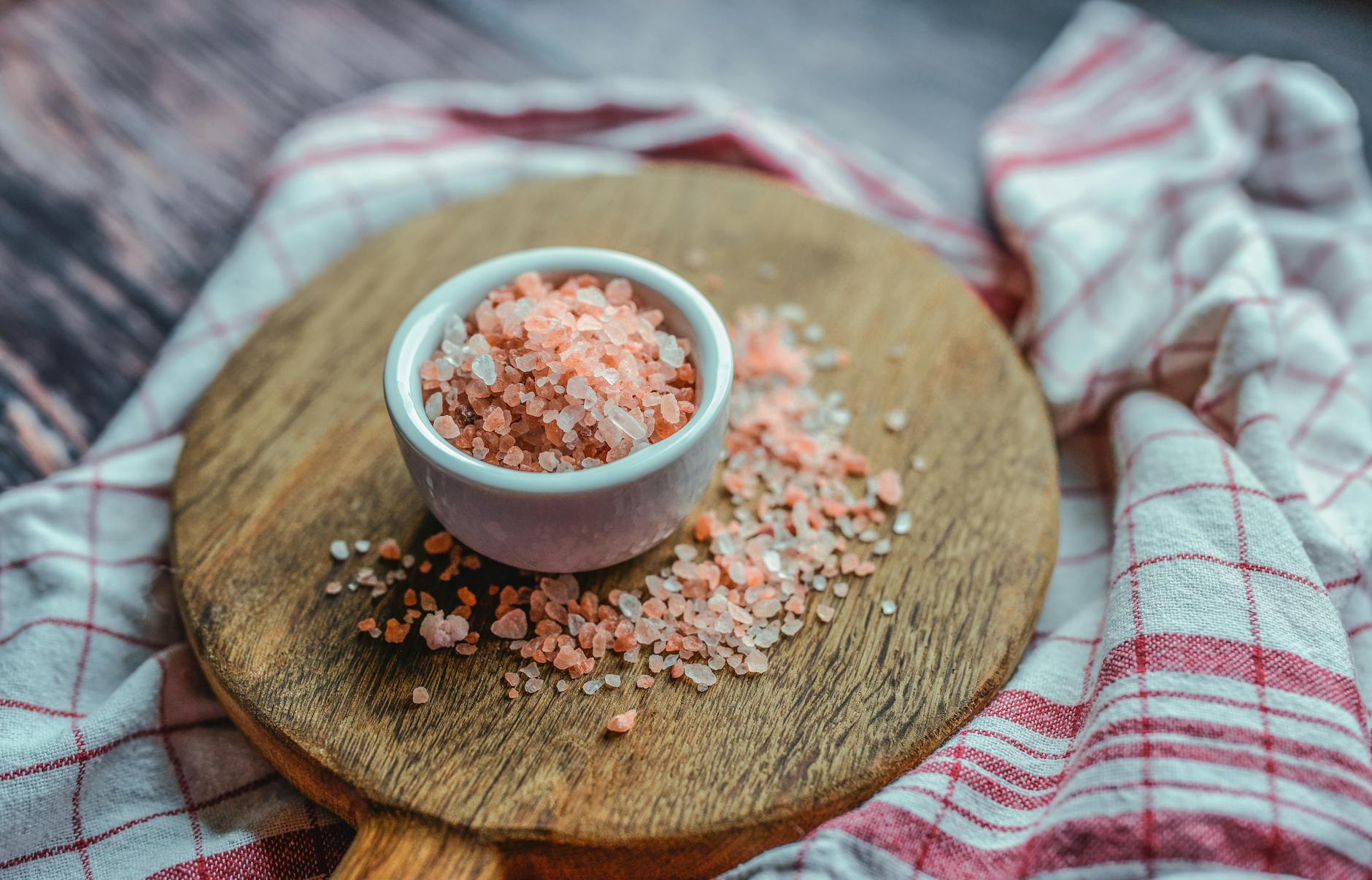
- Diamond Crystal: These crystals are formed using the Alberger process, resulting in hollow, pyramid-shaped flakes. They are incredibly light and "pinchable." Because they are less salty by volume, they are very forgiving for home cooks.
- Morton Salt: This salt is made by rolling salt crystals into dense, flat flakes. It is roughly twice as salty by volume as Diamond Crystal. If a recipe calls for "kosher salt" and doesn't specify the brand, always start with less if you are using Morton.
Many why chefs prefer kosher salt is due to this tactile control. Being able to feel the grains between your fingers allows for much more precise seasoning than a shaker ever could.
Testing Note: The "Pinch" Test
To truly understand the kosher salt table salt sea salt differences, try this at home: Place a teaspoon of table salt in one bowl and a teaspoon of Diamond Crystal Kosher salt in another. Pick up a pinch of each. You'll notice the table salt feels like sand—it's hard to control and slips through your fingers. The kosher salt feels like small snowflakes; you can feel exactly how much you are holding. This tactile feedback is why pros keep their salt in a salt cellar rather than a shaker.
Sea Salt: From Cooking to Luxury Finishing
How Sea Salt is Harvested
Sea salt is produced by evaporating seawater. This can be done through solar evaporation (letting the sun do the work in large ponds) or by boiling the brine. Because it is less processed than table salt, it often retains trace minerals like magnesium, calcium, and potassium. While some claim these minerals offer health benefits, the reality is they are present in such small amounts that their primary contribution is flavor complexity, not nutrition.
Fine Sea Salt vs. Flaky Sea Salt (Maldon)
In your pantry, you likely have two types of sea salt. Fine sea salt is a great all-purpose substitute for table salt because its grain size is similar, but it lacks the chemical additives. However, the star of the show is Maldon Sea Salt. This is a "finishing salt." Its massive, paper-thin pyramid flakes provide a delightful crunch and a burst of salinity when sprinkled over a finished dish, like a chocolate chip cookie or a sliced ribeye. Knowing when to use finishing salt is what separates a good home cook from a great one.
Table Salt: The Hidden Flavor Killer
The Problem with Iodine and Anti-Caking Agents
Table salt is the most highly processed version of Sodium Chloride. It is mined from underground salt deposits and ground into uniform, tiny cubes. To prevent clumping in humid environments, manufacturers add anti-caking agents like sodium ferrocyanide or calcium silicate. More importantly, most table salt is "iodized."
Iodine was originally added to salt in the 1920s to prevent goiters (thyroid issues). While a noble public health goal, iodine has a distinct metallic, slightly bitter aftertaste. In delicate dishes like a light fish poached in butter or a vanilla custard, that metallic tang can ruin the flavor profile. According to the iodine content in table salt guidelines, while it's a source of a necessary nutrient, most people in developed nations get enough iodine from other dietary sources, making iodized salt unnecessary for most cooking.
When Table Salt is Actually Useful
- Baking: When you need salt to distribute evenly through a dry flour mixture.
- Pasta Water: Since you need a lot of salt to make pasta water "taste like the sea," table salt is the most cost-effective option.
A Practical Salt Conversion Table
If you take away only one thing from this article, let it be this: You cannot swap salts 1:1 by volume. If a recipe calls for table salt and you use kosher, your food will be bland. If it calls for kosher and you use table salt, your food will be a salt bomb. Use this salt conversion guide for recipes to ensure your seasoning is always on point.
| Salt Type | Volume Measurement | Weight (Approximate) |
|---|---|---|
| Table Salt (Fine) | 1 teaspoon | 6 grams |
| Fine Sea Salt | 1 teaspoon | 6 grams |
| Morton Kosher Salt | 1.5 teaspoons | 6 grams |
| Diamond Crystal Kosher | 2 teaspoons | 6 grams |
Note: If a recipe doesn't specify the brand of kosher salt, assume it is Diamond Crystal, as this is the industry standard for recipe development. If the food tastes flat, you can always add more!
Practical Application: Which Salt for Which Task?
Best Salt for Seasoning Meat and Brining
For brining meat, kosher salt is king. When I dry-brine a chicken overnight, Use Diamond Crystal. The large flakes draw out just enough moisture to dissolve the salt into a concentrated brine, which then gets re-absorbed into the muscle fibers, seasoning the meat deeply. This process also breaks down proteins, leading to a juicier result. If you used table salt here, the high density would likely "cure" the outside of the meat like ham before it could penetrate the center.
Best Salt for Pasta Water and Vegetables
Best Salt for Baking and Pastry
Practical Tips for Seasoning Like a World-Class Chef
Technique: Seasoning from a Height
You may have seen chefs on TV holding their hands high above the pan. This isn't just for drama. When you drop salt from 10–12 inches above the food, the grains have time to spread out in the air. This ensures even coverage and prevents "salt pockets" where one bite is bland and the next is a salt lick.
The 'Layering' Technique
Seasoning shouldn't just happen at the end. I practice "seasoning in layers."
- The Beginning: Salt your aromatics (onions, garlic) to draw out moisture and soften them.
- The Middle: Salt after adding bulk ingredients (like tomatoes or stock).
- The End: Taste and adjust right before serving.
Tasting at Different Temperatures
Did you know that cold foods require more salt than hot foods? Our taste buds are less sensitive to salinity when food is cold. If you are making a potato salad or a chilled soup, season it while it's warm, but give it one final taste once it's chilled. You will almost always need an extra pinch of coarse grain salt to make the flavors pop.
Common Mistakes and How to Fix Them
A: Not necessarily. While the "add a potato" trick is a bit of a myth (potatoes absorb liquid, not just salt), you can balance over-salting with acid. A squeeze of lemon juice or a splash of vinegar can mask the perception of salt. Alternatively, you can increase the volume of the dish by adding more unsalted stock or water.
A: This usually happens because of steam. If you shake salt directly over a steaming pot, moisture enters the shaker. This is why Consider using a salt cellar or "salt pig." It allows you to reach in with dry fingers and provides easy access without the risk of clumping.
A: Generally, no. Kosher salt is already "coarse," but it is soft. Grinders are designed for hard, rock-like sea salt crystals. Putting kosher salt in a grinder often results in a jammed mechanism or an inconsistent powder.
Storing Your Salt for Longevity
Salt is a mineral; it doesn't "go bad" in the traditional sense. However, it is hygroscopic, meaning it absorbs moisture from the air. Store your kitchen essentials in a cool, dry place. If you use a wooden salt cellar, ensure it isn't placed directly next to the stove where it will be blasted by steam every time you boil water.
Conclusion: Mastering the Grain
Understanding the nuances of kosher salt vs sea salt is a major milestone in any home cook's journey. It moves you away from robotic recipe-following and toward intuitive, sensory-based cooking. Remember the 1:1.5:2 rule for conversions, keep your Diamond Crystal for everyday seasoning, save your Maldon for the final flourish, and always—always—season from a height.
Next time you're standing in the grocery aisle staring at the dozens of options, remember that you aren't just buying a seasoning; you're buying a tool. Choose the right tool for the job, and your kitchen results will transform overnight. Happy cooking!