Quick Answer
Yes, you can freeze bread, but the texture may change after thawing. Freeze it while fresh in an airtight, labeled container, and thaw perishable foods in the refrigerator before using them in the ways described below.
Practical note
For Can You Freeze Bread? Guide to Freezing and Thawing Every Type of Loaf, the home-kitchen check is not only the number of days. We look at the start date, fridge temperature, container seal, serving time, and spoilage signs. If one of those facts is missing, the safer move is to use the shorter window.
Decision table
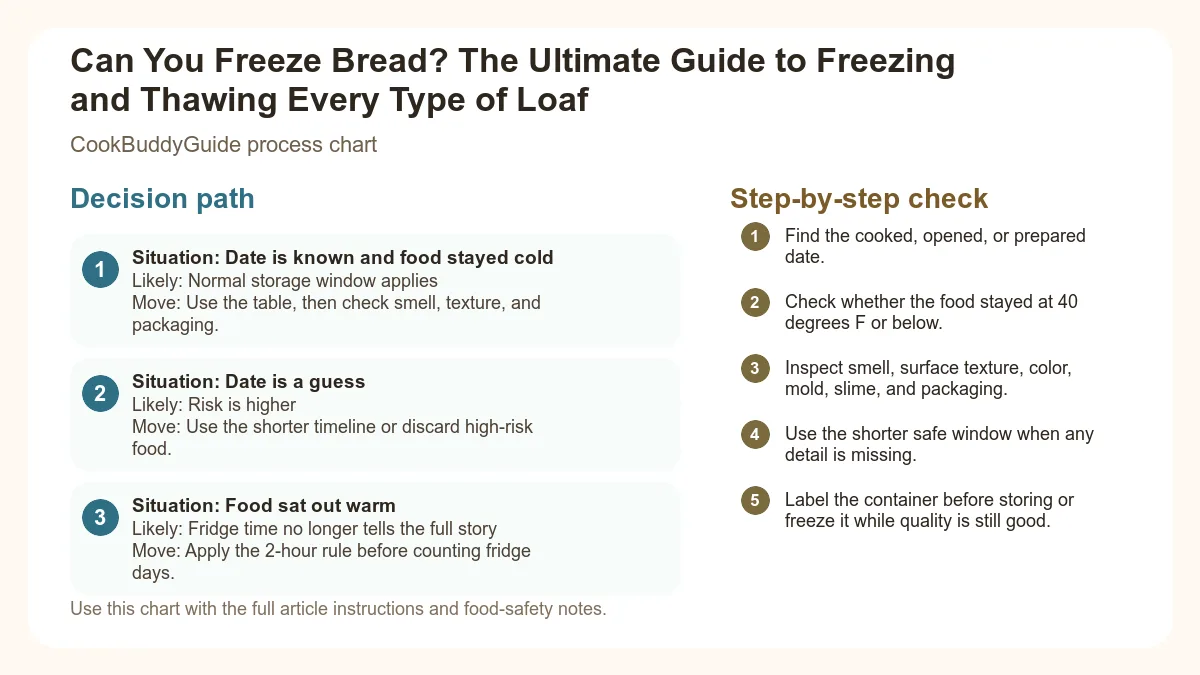
| Situation | Likely cause or meaning | Best move |
|---|---|---|
| Date is known and food stayed cold | Normal storage window applies | Use the table, then check smell, texture, and packaging. |
| Date is a guess | Risk is higher | Use the shorter timeline or discard high-risk food. |
| Food sat out warm | Fridge time no longer tells the full story | Apply the 2-hour rule before counting fridge days. |
Step-by-step fix
- Find the cooked, opened, or prepared date.
- Check whether the food stayed at 40 degrees F or below.
- Inspect smell, surface texture, color, mold, slime, and packaging.
- Use the shorter safe window when any detail is missing.
- Label the container before storing or freeze it while quality is still good.
Common mistakes
- Counting fridge days from the day you noticed the container instead of the day it was made.
- Ignoring time spent on the counter, in a lunch bag, or on a serving table.
- Trusting smell alone when the date or temperature history is unknown.
- Putting warm food into a deep container that cools slowly.
Related topic hubs
Table of Contents
- The Science of Bread Storage: Freezer vs. Fridge
- The Universal Golden Rules of Freezing Bread
- Step-by-Step: Freezing Sliced Sandwich Bread
- Freezing Artisan Breads, Sourdough, and Baguettes
- The Best Wrapping Materials: What Actually Works?
- How to Thaw Frozen Bread Without It Getting Soggy
- Shelf Life Comparison: Storage Duration Chart
- Common Mistakes to Avoid
- Creative Ways to Use Older Frozen Bread
The Science of Bread Storage: Why the Freezer Beats the Fridge
According to the Serious Eats bread storage guide, the refrigerator actually accelerates this process. The cold temperatures of a fridge (typically around 38°F to 40°F) are the "sweet spot" for starch retrogradation, causing moisture loss and making your bread go stale up to six times faster than if it were left at room temperature.
The freezer, however, is a different story. By dropping the temperature well below freezing, you effectively "lock" the gluten structure and starch molecules in place. The water molecules turn to ice before they can migrate out of the starch, essentially hitting the pause button on the staling process. When you freeze bread, you aren't just preserving it; you are preserving its "fresh-baked" potential.
The Universal Golden Rules of Freezing Bread
1. Never Freeze Warm Bread
2. The Double-Wrap Method
Air is the enemy of frozen food. To prevent the dehydration that leads to freezer burn, you need an airtight seal. Use a two-layer system. First, wrap the bread tightly in plastic wrap or aluminum foil. Then, place that wrapped loaf inside a heavy-duty Ziploc freezer bag. This creates a dual barrier against the dry air of the freezer and prevents the bread from absorbing "freezer smells." As noted in this guide on how to freeze and thaw bread perfectly, this double-layering is the secret to maintaining the original flavor profile.
3. Squeeze Out the Air
When using Ziploc freezer bags, don't just zip them shut. Use a straw to suck out the remaining air or press the bag firmly against the bread as you seal it. The less air inside the bag, the less chance there is for ice crystals to form on the gluten structure of your bread.
Step-by-Step: Freezing Sliced Sandwich Bread
Master Technique: The Flash-Freeze Method for Slices
Use this method to ensure your slices never stick together in a solid block.
- Slice the loaf: If the bread isn't pre-sliced, slice it to your desired thickness. For sandwich bread, consider 1/2 inch slices.
- Flash freezing: Lay the slices out in a single layer on a baking sheet lined with parchment paper. Place the sheet in the freezer for about 45–60 minutes. This hardens the surface so they won't stick.
- The Parchment Trick: If you're in a hurry and can't flash-freeze, place a small square of parchment paper between every two slices. This acts as a physical barrier.
- Bag it up: Transfer the slices into a large Ziploc freezer bag. Squeeze out all the air and label with the date.
- To Serve: Take a slice directly from the freezer and pop it into the toaster oven. No defrosting bread required!
Freezing Artisan Breads, Sourdough, and Baguettes
Artisan breads, like a crusty sourdough boule or a French baguette, require a slightly different approach. These breads rely on a specific contrast between a crispy crust and a moist, airy crumb. Because sourdough fermentation creates a more acidic environment, these loaves actually tend to hold up better in the freezer than standard white bread.
When dealing with a large boule, Often, find it best to cut it in half or quarters before freezing. Unless you are hosting a dinner party, you likely won't eat an entire large loaf in one sitting once it's thawed. By freezing in smaller portions, you reduce waste. For baguettes, Use the "cut and wrap" method: cut the long loaf into 6-inch sections, wrap each tightly in plastic wrap, and then bundle them into a freezer bag. This makes them the perfect size for individual sandwiches or a side of garlic bread.
According to The Kitchn's best way to freeze bread, artisan loaves benefit from being wrapped in a layer of aluminum foil over the plastic. The foil provides a superior moisture barrier and also makes it easy to pop the loaf straight into the oven for reheating (more on that in the thawing section!).
The Best Wrapping Materials: What Actually Works?
- Plastic Wrap (Cling Film): Essential for the first layer. It conforms to the shape of the bread, eliminating air pockets. Rating: 5/5 for first-layer protection.
- Heavy-Duty Aluminum Foil: Excellent for preventing odor transfer. It’s also great because you can write the date directly on it with a Sharpie. Rating: 4/5 (needs a plastic layer underneath for best results).
- Ziploc Freezer Bags: These are thicker than standard storage bags. Look for the "Freezer" label to ensure a lower oxygen transmission rate. Rating: 5/5 for convenience.
- Reusable Silicone Bags: A great sustainable option. They are thick and provide an excellent seal, though they can be bulky in a crowded freezer. Rating: 4/5.
Kitchen Tip: If you are freezing a very crusty bread, be careful with plastic wrap. The sharp crust can sometimes puncture the wrap. In these cases, I double-bag or use aluminum foil as the primary layer.
How to Thaw Frozen Bread Without It Getting Soggy
Thawing is where most people go wrong. If you leave a loaf to thaw in its bag on the counter, the moisture that was frozen on the surface of the bread will soak back into the crust, making it leathery. Here are my three preferred methods for defrosting bread depending on what you're eating.
The Countertop Method (Best for Sliced Bread)
If you have individual slices, simply take them out of the bag and lay them on a cooling rack at room temperature. They will thaw in about 10–15 minutes. By using a rack instead of a plate, air can circulate around the slice, preventing a "soggy bottom." Once thawed, you can use them for sandwiches just like fresh bread.
The Oven Re-Crisping Method (Best for Artisan Loaves)
This is the "gold standard" for bringing a frozen boule back to life. It restores the crispy crust while keeping the interior soft. Professional bakers at King Arthur Baking recommend this method for the best texture.
Master Technique: The Oven Revival
- Preheat your oven to 350°F (175°C).
- Remove the bread from the freezer and strip off all plastic wrapping.
- The Kitchen Hack: If the crust feels very hard or dry, lightly mist the frozen loaf with a spray bottle of water. This creates steam in the oven, mimicking a professional bakery oven.
- Place the frozen loaf directly on the oven rack (or on a baking sheet).
- Bake for 15–25 minutes (depending on size) until the center is soft and the crust is crisp.
- Let it rest for 5 minutes before slicing. This allows the internal moisture to redistribute.
The Toaster Method (Best for Quick Mornings)
You don't actually need to thaw bread before toasting it. Most modern toasters have a "frozen" button that adds about 30 seconds to the cycle. This is the most efficient way to handle stale bread or frozen slices for a quick breakfast. If you are using a toaster oven, consider a low setting (325°F) for 5 minutes to ensure the middle isn't cold while the outside is burnt.
Note on Microwaves: Avoid the microwave if possible. Microwaves heat water molecules rapidly, which can cause the gluten structure to become extremely tough and chewy within minutes of cooling down. If you must use it, wrap the slice in a damp paper towel and heat in 10-second bursts, but be prepared to eat it immediately!
Shelf Life Comparison: Storage Duration Chart
| Bread Type | Room Temp | Refrigerator | Freezer (Peak Quality) |
|---|---|---|---|
| Store-Bought Sliced | 5–7 Days | Not Recommended | 3 Months |
| Homemade White/Wheat | 2–3 Days | Not Recommended | 2 Months |
| Artisan Sourdough | 3–4 Days | Not Recommended | 6 Months |
| Baguettes/French Bread | 1 Day | Not Recommended | 1 Month |
| Bagels/English Muffins | 5 Days | 7 Days | 4 Months |
Signs of Trouble: If you see "white spots" on your frozen bread, don't panic. If they are hard and crystalline, it's just ice (freezer burn). If they are fuzzy or discolored, it's mold that likely started growing before you froze the bread. When in doubt, throw it out.
Common Mistakes to Avoid When Freezing Bread
- Freezing in the Grocery Bag: As mentioned, that thin plastic is meant for display, not preservation. It is not an airtight seal. Always add a second layer.
- Not Labeling: Frozen bread all looks the same after a month. Label with the type of bread and the date you froze it. You don't want to defrost a loaf of rye when you were looking for sourdough.
- Refreezing Thawed Bread: Every time you freeze and thaw bread, the starch retrogradation process takes another toll on the texture. Refrozen bread is almost always dry and crumbly. Only thaw what you plan to eat.
- Storing Near "Smelly" Foods: Bread is a sponge for odors. If you store a poorly wrapped loaf next to frozen salmon or bags of chopped onions, your morning toast will taste very... interesting.
Creative Ways to Use Bread That’s Been Frozen Too Long
The "Rescue" French Toast Casserole
Freezer-burned bread is actually better for this recipe because it absorbs the custard without falling apart.
- The Bread: Cube your frozen bread (no need to thaw).
- The Custard: Whisk 4 eggs, 1 cup milk, 1 tsp cinnamon, and a splash of vanilla.
- The Soak: Toss the cubes in the custard and let sit for 20 minutes (or overnight in the fridge).
- The Bake: Bake at 350°F for 30 minutes until golden and puffy.
Other great uses for older frozen bread include:
- Homemade Garlic Croutons: Cube the bread, toss with olive oil and garlic powder, and bake until crisp.
- Savory Bread Pudding: Use it as a base for a strata with spinach, cheese, and sausage.
- Fresh Breadcrumbs: Pulse the frozen bread in a food processor and toast the crumbs for a crunchy topping on pasta or casseroles.
Conclusion: Master the Freezer, Master Your Kitchen
Understanding how to freeze bread properly is more than just a kitchen hack; it's a way to ensure that the time and money you invest in your food isn't wasted. By respecting the science of starch retrogradation and following the double-wrap method, you can enjoy bakery-quality bread any day of the week.
The next time you see a "buy one, get one" deal on your favorite artisanal loaves, or you find yourself with half a baguette left over after dinner, don't let it sit on the counter to die. Let it cool, wrap it tight, and let your freezer do the work. Your future self—and your breakfast—will thank you.
Frequently Asked Questions
It is not recommended. Each freeze-thaw cycle damages the gluten structure and results in significant moisture loss, leading to a very dry and crumbly texture.
No. Freezing deactivates mold and stops it from growing, but it does not kill the spores. Once the bread thaws, the mold can become active again.
Yes! In fact, many gluten-free breads are sold frozen because they lack the preservatives of standard loaves. They follow the same rules: wrap tightly and toast from frozen.