Quick Answer
Broth is usually lighter and seasoned for serving, while stock gets more body from bones and connective tissue and is commonly used as a cooking base. Use broth when its flavor will be prominent and stock when a sauce, soup, or braise benefits from more body.
Practical note
For Broth vs Stock Cooking, this guide centers on The Bones, The Mirepoix, The Aromatics. Those are the checkpoints we would use first in a normal home kitchen before making a bigger change.
Decision table
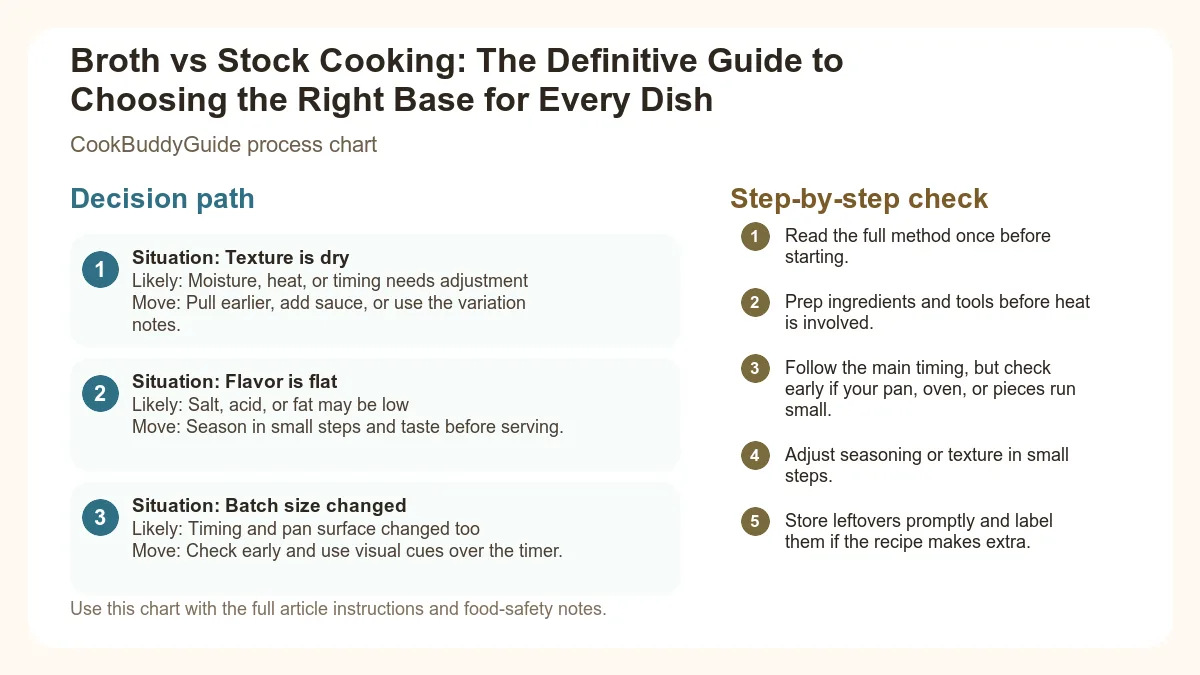
| Situation | Likely cause or meaning | Best move |
|---|---|---|
| Texture is dry | Moisture, heat, or timing needs adjustment | Pull earlier, add sauce, or use the variation notes. |
| Flavor is flat | Salt, acid, or fat may be low | Season in small steps and taste before serving. |
| Batch size changed | Timing and pan surface changed too | Check early and use visual cues over the timer. |
Step-by-step fix
- Read the full method once before starting.
- Prep ingredients and tools before heat is involved.
- Follow the main timing, but check early if your pan, oven, or pieces run small.
- Adjust seasoning or texture in small steps.
- Store leftovers promptly and label them if the recipe makes extra.
Common mistakes
- Changing the recipe before trying the base method once.
- Measuring casually when texture depends on ratios.
- Waiting until the end to fix seasoning.
- Ignoring carryover heat or resting time.
Related topic hubs
The broth vs stock cooking debate isn't just about semantics; it’s about the science of collagen, the intensity of umami flavor, and how a liquid behaves when it hits a hot pan. While they are often interchangeable in a pinch, understanding the difference between broth and stock is the single most effective way to level up your home cooking from "good" to "extraordinary."
Table of Contents
- What is Stock? The Science of Bones and Body
- What is Broth? The Art of Meat and Flavor
- The Key Distinction: Mouthfeel vs. Flavor Profile
- How They Behave Differently When Reduced
- When to Use Which: A Practical Guide for Home Cooks
- The Store-Bought Reality Check: Labels vs. Content
- Does the Difference Actually Matter for Everyday Cooking?
- CookBuddy Practical Tips: Making the Most of Your Liquids
What is Stock? The Science of Bones and Body
The Role of Collagen and Gelatin
The magic of stock lies in the bones. Connective tissues and joints are packed with collagen. When you simmer a chicken carcass or beef marrow bones for several hours, that collagen breaks down into gelatin. This is why a high-quality gelatin and body in stock is so essential—it provides a viscous, rich mouthfeel that coats the back of a spoon. If your liquid turns into a literal jelly when chilled in the fridge, congratulations: you’ve made a perfect stock.
Ingredients: The Holy Trinity of Stock Making
- The Bones: Roasting them beforehand creates a "brown stock" with deep, caramelized notes. Raw bones result in a "white stock," which is cleaner and more neutral.
- The Mirepoix: Usually a 2:1:1 ratio of onions, carrots, and celery.
- The Aromatics: Peppercorns, bay leaves, and parsley stems. Notice something missing? Salt. Traditional stock is left unseasoned to allow for reduction later.
The Long Simmer: Why Time is the Secret Ingredient
Pro Technique: The "Perfect Clarity" Chicken Stock
Ingredients: 2-3 lbs chicken carcasses, 2 onions (halved), 3 carrots (large chunks), 3 celery stalks, 1 head of garlic (halved), 10 peppercorns, 2 bay leaves.
Method:
- Place bones in a large pot and cover with cold water by 2 inches.
- Bring to a bare simmer (do not boil, or the fat will emulsify and make the stock cloudy).
- Skim the grey foam (impurities) that rises to the top for the first 30 minutes.
- Add vegetables and aromatics. Simmer for 5 hours.
- Strain through a fine-mesh sieve. Do not press on the solids! Let gravity do the work to keep the liquid clear.
What is Broth? The Art of Meat and Flavor
While stock is about structure, broth is about immediate, sippable flavor. According to the broth vs stock difference, broth is primarily made by simmering meat rather than just bones. Think of the liquid left over after poaching a chicken breast or making a pot of vegetable broth.
Meat-Based Extraction
Because broth uses muscle meat, it infuses the water with protein-driven umami flavor much faster than bones. Since meat doesn't have the same collagen levels as joints and cartilage, broth remains thin and liquid even when cold. It doesn't have that "jiggle," but it tastes much more like a finished soup right out of the pot.
Seasoning and Aromatics
The Short Simmer: Efficiency in the Kitchen
One of the biggest advantages of broth is speed. Since you aren't waiting for tough connective tissue to break down, a flavorful broth can be achieved in 45 to 90 minutes. It’s the "busy weeknight" version of a culinary base. If you're looking for ways to use up leftovers, consider making stock with rotisserie chicken remains, though the resulting liquid often sits in the "middle ground" between a broth and a stock.
The Key Distinction: Mouthfeel vs. Flavor Profile
The fundamental difference between broth and stock comes down to a physical sensation on your palate called mouthfeel.
The 'Jiggle' Test: Why Stock Solidifies in the Fridge
Mouthfeel: The Silky Secret of Restaurant-Style Sauces
When you eat a high-end French sauce, it feels "silky" or "velvety." That isn't just butter; it’s the gelatin from the stock. Broth feels like water in the mouth—clean, but thin. Stock feels substantial. This is why a nutritional differences in broth study often points out that bone-based stocks (or bone broths) contain more protein and amino acids than simple meat broths.
Testing Note: Tasting with a Cold Spoon
How They Behave Differently When Reduced
This is where the broth vs stock cooking distinction becomes a make-or-break issue for your recipes. Understanding culinary techniques like reduction is vital for anyone moving beyond basic recipes.
Making a Pan Sauce: Why Stock is Non-Negotiable
When you make a pan sauce, you are boiling away water to concentrate flavor and thicken the liquid. Because stock is full of gelatin, it thickens naturally as it reduces. You don't need flour or cornstarch; the liquid becomes a syrupy glaze all on its own. This is the path to a perfect demi-glace.
The Salt Trap: Why Reducing Broth Can Be Dangerous
From Stock to Demi-Glace
If you take a rich beef stock and reduce it by half, you have a jus parisienne. Reduce it further until it coats a spoon thickly, and you have demi-glace. This is the "liquid gold" chefs rave about. You simply cannot achieve this with broth; it will just stay thin and get saltier.
When to Use Which: A Practical Guide for Home Cooks
Soups and Stews: Building a Foundation
- Use Stock for: Hearty, long-simmered stews like Beef Bourguignon or Irish Stew. The gelatin adds body that stands up to heavy meats and root vegetables.
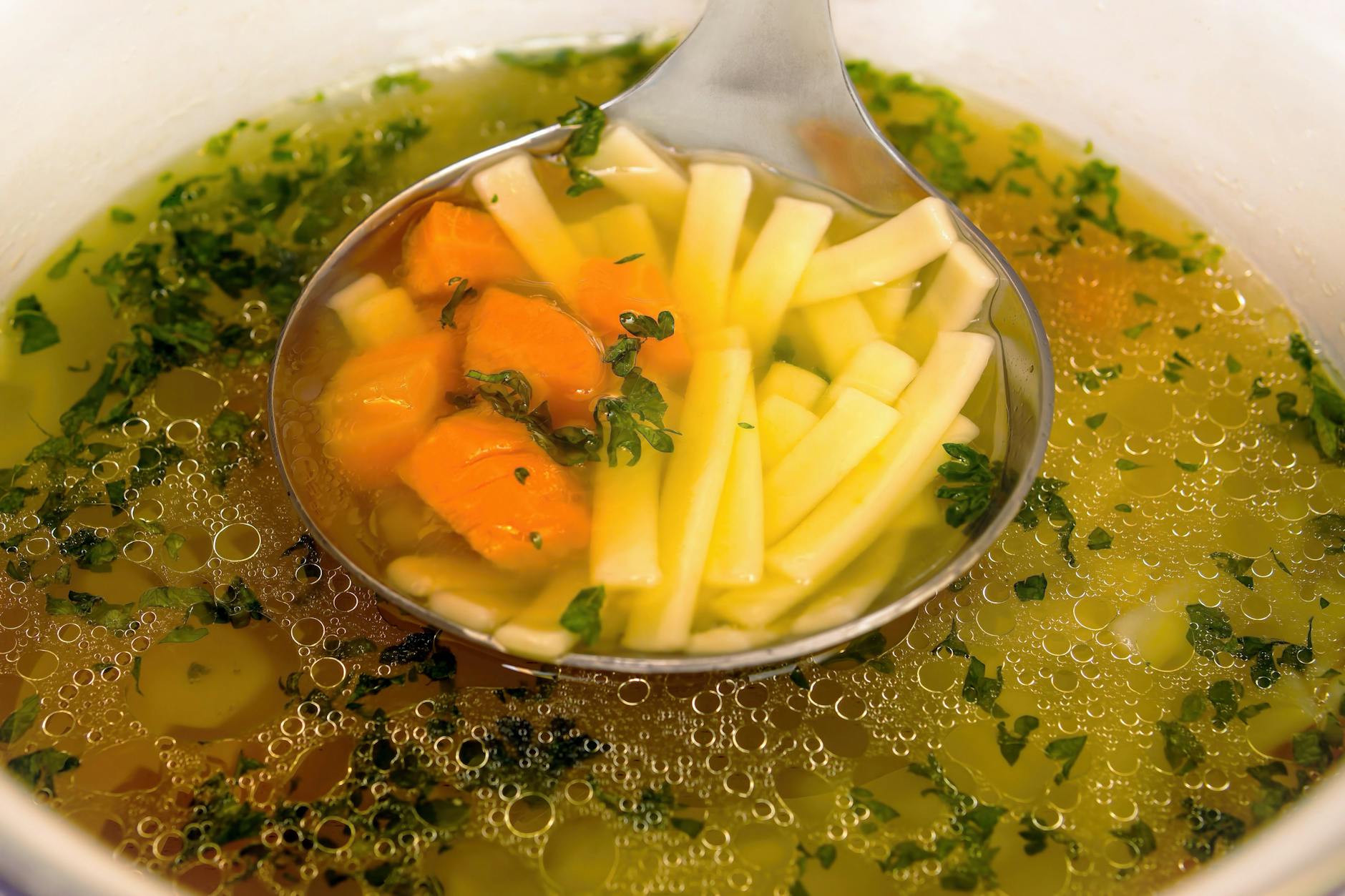
- Use Broth for: Light, delicate soups where the liquid is the star, like Chicken Noodle, Minestrone, or Miso soup.
The Risotto Rule: Why Gelatin Matters for Creaminess
Braises and Deglazing
When deglazing a pan after searing meat, stock is the superior choice. It picks up the fond (the brown bits) and immediately begins to form a sauce. If you’re using an Instant Pot, check out our Instant Pot Recipes for Beginners for tips on how much liquid to use to avoid the "burn" notice while still getting a good sauce.
The "Cheat Code" Pan Sauce
Ingredients: 1/2 cup unsalted beef stock, 1 tbsp minced shallots, 1 tsp cold butter, 1 tsp balsamic vinegar.
Method:
- After searing your steak, remove it from the pan.
- Add shallots and cook for 30 seconds.
- Pour in the stock and scrape the bottom of the pan.
- Reduce by half until the bubbles look "thick."
- Whisk in cold butter and vinegar. Serve immediately.
The Store-Bought Reality Check: Labels vs. Content
Here is a frustrating truth: the labels on supermarket shelves are often lies. According to the USDA labeling for broth, the terms "stock" and "broth" can be used almost interchangeably by manufacturers.
Is 'Bone Broth' Just Stock with a Better Marketing Team?
Essentially, yes. "Bone broth" is a trendy term for what chefs have called "stock" for centuries. The only real difference is that bone broth is usually simmered even longer (sometimes 24+ hours) and is designed to be sipped as a beverage. Don't pay a 50% markup for the word "broth" if you're just going to use it for cooking.
Reading the Label: Sodium, Yeast Extract, and Fillers
Many commercial "stocks" contain no actual gelatin. Instead, they use yeast extract for umami flavor and thickeners like xanthan gum to mimic the mouthfeel of real stock. Always check the ingredient list. If the first few ingredients are water, salt, and sugar, you’re buying flavored water, not stock.
CookBuddy Recommendation: The Low-Sodium Rule
Does the Difference Actually Matter for Everyday Cooking?
When You Can Swap Them (And When You Shouldn't)
- Swap them when: Making a soup with lots of ingredients, cooking beans, or making a quick braise.
- Don't swap them when: Making a pan sauce, a holiday gravy, or a classic risotto. In these cases, the lack of gelatin in broth will lead to a thin, greasy, or overly salty result.
The "Better Than Bouillon" Hack
If you don't have time to simmer a chicken carcass for six hours, consider keeping a jar of "Better Than Bouillon" or a similar concentrated base in your fridge. It’s a step up from dry cubes and provides a much deeper flavor profile. However, it still lacks gelatin.
The "Doctoring" Method: Turn Broth into Stock
The Fix: Sprinkle 1 teaspoon of unflavored powdered gelatin over 1 cup of cold broth. Let it "bloom" for 2 minutes, then heat it up. The gelatin will melt into the liquid, giving it the body and mouthfeel of a 12-hour simmered stock instantly.
CookBuddy Practical Tips: Making the Most of Your Liquids
Don't let your kitchen scraps go to waste. You are sitting on a goldmine of flavor every time you prep dinner.
The Scrap Bag: Making 'Free' Stock
Keep a gallon-sized freezer bag in your kitchen. Every time you peel a carrot, chop the end off an onion, or have leftover parsley stems, toss them in the bag. When the bag is full, throw it in a pot with some water and a chicken carcass. In a few hours, you’ll have a high-quality base for zero extra dollars.
Degreasing Techniques for a Clearer Result
A common mistake is leaving too much fat in the stock, which can make it feel greasy. The easiest way to fix this? Chill the stock overnight. The fat will solidify into a hard white cap on top, which you can easily lift off with a spoon. This leaves you with a crystal-clear, pure liquid underneath.
Freezing and Storage Hacks
Frequently Asked Questions
A: Yes, but you’ll need to compensate with more aromatics and salt. Water is a neutral canvas, whereas broth/stock provides a head start on flavor. For grains like quinoa, water is fine, but for soup, water often tastes "hollow."
A: You probably let it boil. Boiling agitates the fat and proteins, emulsifying them into the liquid. To keep it clear, keep it at a "lazy bubble" (a bare simmer) and never stir the pot.
A: Technically, no. Since vegetables don't have bones or collagen, all "vegetable stock" is actually "vegetable broth." It will never have the same gelatinous body as meat-based stock unless you add a thickener.
Conclusion: Master Your Kitchen Liquids
The journey of broth vs stock cooking is one of the most rewarding paths a home cook can take. To summarize: use stock when you want body, richness, and the ability to create silky reductions. Use broth when you want quick, clean flavor for sipping or light soups.
Don't be afraid to experiment. The next time you roast a chicken, save that carcass! You're only a few hours away from a "liquid gold" that no store-bought carton can ever match. Your sauces will be shinier, your stews will be heartier, and your kitchen will smell like a professional bistro.
Ready to put your new knowledge to the test? Check out our 45-minute chicken stock recipe and see the difference for yourself!