Quick Answer
The right substitute for honey in baking depends on what that ingredient contributes: flavor, salt, acidity, fat, moisture, or structure. Use the comparison below to choose the closest match and adjust the amount for your recipe.
Practical note
For Substitute for Honey in Baking, the most useful home checks are temperature, measuring, resting time, and visible texture. Those details tell you more than guessing, especially before adding extra flour, liquid, heat, or leavening.
Decision table
| Situation | Likely cause or meaning | Best move |
|---|---|---|
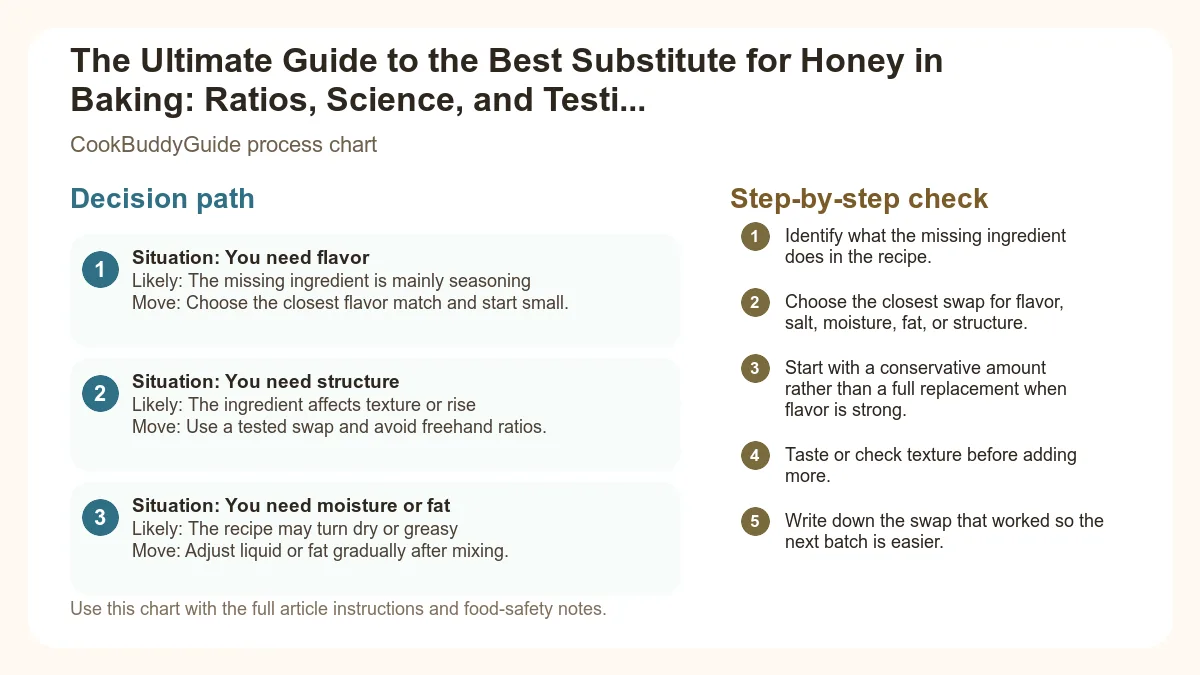
| You need flavor | The missing ingredient is mainly seasoning | Choose the closest flavor match and start small. |
| You need structure | The ingredient affects texture or rise | Use a practical swap and avoid freehand ratios. |
| You need moisture or fat | The recipe may turn dry or greasy | Adjust liquid or fat gradually after mixing. |
Step-by-step fix
- Identify what the missing ingredient does in the recipe.
- Choose the closest swap for flavor, salt, moisture, fat, or structure.
- Start with a conservative amount rather than a full replacement when flavor is strong.
- Taste or check texture before adding more.
- Write down the swap that worked so the next batch is easier.
Common mistakes
- Replacing a strong ingredient 1:1 before tasting.
- Choosing a flavor match when the recipe actually needs structure.
- Forgetting that salty swaps can change the whole dish.
- Adding extra liquid before the batter, dough, or sauce has time to hydrate.
Related topic hubs
Table of Contents
Why Honey is Unique: The Science of Honey in Baking
To choose the right substitute for honey in baking, you first need to understand that honey is a "reducing sugar" composed primarily of fructose and glucose. Unlike granulated table sugar (sucrose), honey brings specific functional properties to a recipe that can be tricky to replicate without the right knowledge.
Hygroscopic Properties and Moisture Retention
Acidity and the Interaction with Leavening Agents
One of the most overlooked aspects of honey is its pH level. Honey is naturally acidic, typically ranging between 3.5 and 4.5. This acidity is crucial because it reacts with baking soda (a base) to create carbon dioxide gas, which provides "lift" to your baked goods. If you swap honey for a neutral syrup without adjusting the leavening, your muffins may turn out flat and dense. Understanding honey's acidity and moisture is the first step toward a successful substitution.
The Maillard Reaction: Why Honey Browns Faster
Have you ever noticed that honey-based cookies brown much faster than others? This is due to the Maillard reaction. Because honey is high in fructose, it begins to undergo caramelization and Maillard browning at lower temperatures than sucrose. This gives honey-baked goods their signature deep golden color and complex, toasted flavor profile. When substituting, consider reducing the oven temperature to prevent the exterior from burning before the interior is fully cooked.
Top 7 Substitutes for Honey in Baking
1. Maple Syrup: The Gold Standard Replacement
- Ratio: 1:1 (1 cup maple syrup for 1 cup honey).
- Flavor: It adds a distinct woody, autumnal note rather than honey’s floral notes.
2. Agave Nectar: The Neutral Alternative
If you want the sweetness of honey without the strong flavor, agave nectar is your best friend. It is highly soluble and has a very low glycemic index. Many professional bakers prefer it as a honey replacement baking option for delicate sponges.
- Ratio: 1:1, but reduce other liquids in the recipe by 1 to 2 tablespoons.
3. Brown Rice Syrup: For Thick Textures
Brown rice syrup is a thick, glucose-based sweetener. It is significantly less sweet than honey, which makes it perfect for those who prefer a more subtle sweetness in their easy five ingredient recipes like granola bars.
- Ratio: 1.25:1 (Use 1 1/4 cups of brown rice syrup for every 1 cup of honey).
- Testing Note: Its high viscosity makes it an excellent binder. It’s the best choice for "no-bake" recipes where honey acts as the glue.
4. Molasses: For Deep, Robust Flavors
Molasses is the dark, viscous byproduct of sugar refining. It is highly acidic and very strong. While it's a functional substitute for honey in baking, it will drastically change the flavor and color of your bake.
- Ratio: 1:1, but Consider a 50/50 split with a lighter syrup if you don't want a "gingerbread" taste.
- Testing Note: Molasses is excellent for dark ryes or spice cakes. For more on the flavor profiles of these options, check out this guide on best substitutes for honey.
5. Corn Syrup: The Professional's Choice for Texture
Light corn syrup is a staple in professional bakeries because it prevents sugar crystallization and provides a smooth, chewy texture. It is a "neutral" honey replacement baking choice.
- Ratio: 1:1.
- Testing Note: Corn syrup lacks the acidity of honey. If your recipe relies on honey to react with baking soda, add a 1/4 teaspoon of lemon juice or cream of tartar to maintain the lift.
6. Granulated Sugar and Liquid: The Pantry Staple Hack
If you have no liquid syrups at all, you can create a recipe conversion using standard white sugar. This is the ultimate "emergency" substitute for honey in baking.
- Ratio: 1 1/4 cups granulated sugar + 1/4 cup water (or milk) = 1 cup honey.
- Testing Note: This mixture lacks the hygroscopic benefits of honey, so your bake will likely be crispier and have a shorter shelf life.
7. Barley Malt Syrup: The Niche Choice
Commonly used in bagel making, barley malt syrup has a malty, rich flavor and a very thick consistency. It is less sweet than honey and has a very dark color.
- Ratio: 1:1.
Pro-Tip: The "Golden Syrup" Alternative
If you can find golden syrup (popular in the UK), it is arguably the closest match to honey in terms of viscosity and caramelization. It is an inverted sugar syrup that mimics honey’s moisture retention perfectly. Use it as a direct 1:1 swap without any other adjustments to the recipe.
How to Adjust Your Recipe When Swapping Honey
The Liquid Balance Rule
Honey is approximately 17% water. When you use a dry substitute for honey in baking (like sugar), you are removing that moisture. Conversely, if you use a very thin syrup like agave, you are adding "perceived" moisture because of the lower viscosity. The Fix: For every cup of sugar substituted for honey, add 1/4 cup of liquid. If using agave, remove 2 tablespoons of liquid from the overall recipe.
Compensating for Sweetness Levels
Not all sugars are created equal. Fructose (found in high concentrations in honey and agave) tastes sweeter to humans than glucose or sucrose. If you use brown rice syrup or corn syrup, your final product will taste less sweet. For a deep dive into how these swaps affect the final product, consider reading about sweetener substitutions for baking.
Adjusting Baking Soda and Powder
Because honey is acidic, recipes using it often call for baking soda. If you switch to a non-acidic honey replacement baking option like corn syrup or simple syrup, the baking soda won't have anything to react with. The result? A soapy taste and a flat cake. The Fix: If your substitute isn't acidic, replace the baking soda with baking powder (which contains its own acid) or add a pinch of cream of tartar.
Vegan Honey Replacements for Ethical Baking
Bee-Free Honey Brands
Dandelion Syrup and Fruit-Based Alternatives
You can actually make your own substitute for honey in baking using dandelion petals, sugar, and lemon. It creates a thick, honey-like syrup that is remarkably similar in flavor. Coconut nectar is another fantastic vegan option; it is thick, dark, and has a lower glycemic index, making it a favorite for health-conscious bakers.
Common Mistakes When Replacing Honey
I’ve ruined more than a few batches of cookies so you don't have to. Here are the three most common pitfalls when looking for a substitute for honey in baking.
Over-browning and Burning
The Fix: Always follow the baking with honey guide advice: lower your oven temp by 25°F and check for doneness 5–10 minutes early.Structural Collapse in Cakes
Honey provides structure because of its thickness. If you use a very thin honey replacement baking option like maple syrup in a recipe that requires a lot of honey (like a honey cake), the batter may be too thin to hold the air bubbles created by the leavening agent. This leads to a collapsed, gummy center.
Altering the Shelf Life
If you replace honey with granulated sugar, don't expect your bread to stay soft for a week. Without the humectant properties of honey, the starches in your baked goods will undergo "retrogradation" (staling) much faster. The Fix: Store honey-free bakes in a strictly airtight container, or freeze them immediately after cooling to preserve moisture.
Quick Reference Honey Substitution Chart
Use this chart as a quick guide when you're in the middle of a recipe and need a substitute for honey in baking fast. For even more detailed ratios, refer to the common honey replacement options provided by Food Network.
| Substitute | Ratio | Key Adjustment |
|---|---|---|
| Maple Syrup | 1:1 | Lower oven temp by 25°F. |
| Agave Nectar | 1:1 | Reduce other liquids by 2 tbsp. |
| Brown Rice Syrup | 1.25:1 | Expect a less sweet final product. |
| Light Corn Syrup | 1:1 | Add a pinch of cream of tartar for acidity. |
| Granulated Sugar | 1.25:1 | Add 1/4 cup liquid per cup of sugar. |
| Molasses | 1:1 | Best for dark, spiced recipes only. |
Frequently Asked Questions
Honey is one of the only foods that technically never expires if sealed properly. If it has crystallized (turned hard and cloudy), simply place the jar in a bowl of warm water until it liquefies again. It is perfectly safe to use as a honey replacement baking option even if it's been in your pantry for years!
Maple syrup has a higher water content and lower viscosity than honey. When the fat in your cookies melts in the oven, the thinner syrup allows the dough to spread faster. To fix this, try chilling your dough for at least 2 hours before baking.