Quick Answer
Master gluten free baking substitutes in this guide. It also explains how to use gluten free flour alternatives for perfect cakes, cookies, and bread every time.
Practical note
For Gluten Free Baking Substitutes, the most useful home checks are temperature, measuring, resting time, and visible texture. Those details tell you more than guessing, especially before adding extra flour, liquid, heat, or leavening.
Decision table
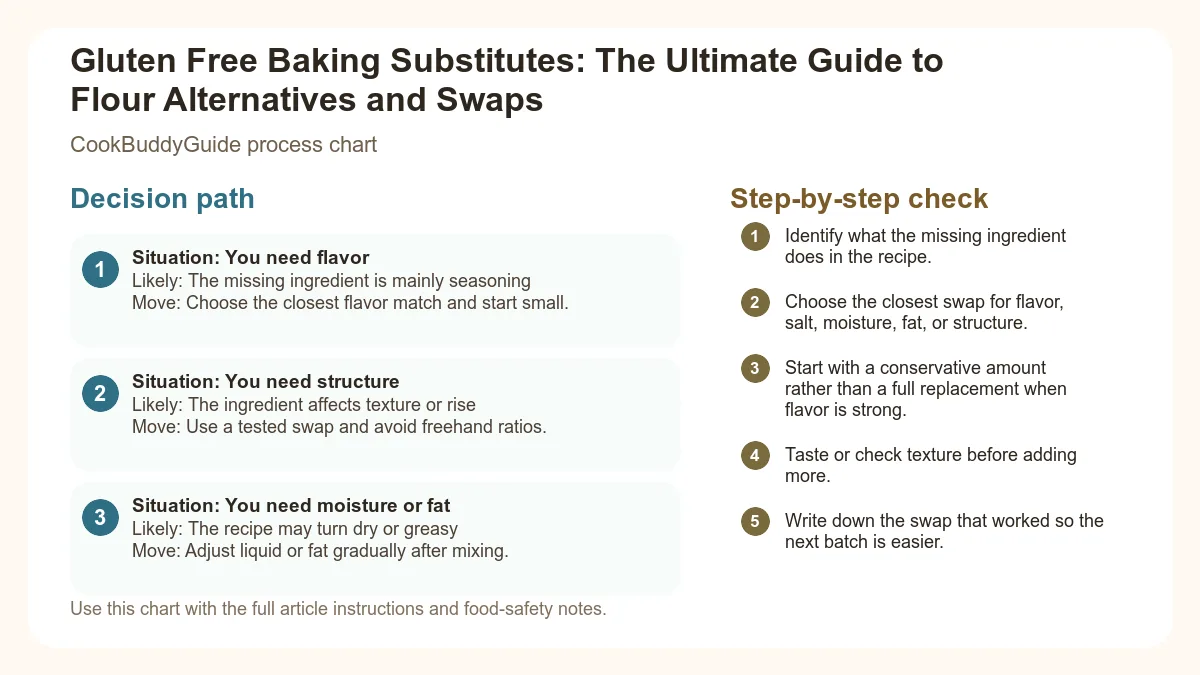
| Situation | Likely cause or meaning | Best move |
|---|---|---|
| You need flavor | The missing ingredient is mainly seasoning | Choose the closest flavor match and start small. |
| You need structure | The ingredient affects texture or rise | Use a practical swap and avoid freehand ratios. |
| You need moisture or fat | The recipe may turn dry or greasy | Adjust liquid or fat gradually after mixing. |
Step-by-step fix
- Identify what the missing ingredient does in the recipe.
- Choose the closest swap for flavor, salt, moisture, fat, or structure.
- Start with a conservative amount rather than a full replacement when flavor is strong.
- Taste or check texture before adding more.
- Write down the swap that worked so the next batch is easier.
Common mistakes
- Replacing a strong ingredient 1:1 before tasting.
- Choosing a flavor match when the recipe actually needs structure.
- Forgetting that salty swaps can change the whole dish.
- Adding extra liquid before the batter, dough, or sauce has time to hydrate.
Related topic hubs
Gluten is the "glue" of the baking world. It provides the elasticity, structure, and chew that we associate with a perfect sourdough or a soft chocolate chip cookie. When you remove it, you aren't just removing a protein; you are removing the structural integrity of your bake. This gluten free flour alternatives guide is designed to take the guesswork out of your kitchen, providing you with the scientific foundation and practical experience needed to produce bakery-quality results every single time.
Table of Contents
- Introduction: Why Gluten-Free Baking is a Science
- The Core Gluten Free Flour Alternatives: A Deep Dive
- The Binding Problem: Xanthan Gum and Beyond
- Commercial 1:1 Blends vs. DIY Flour Mixes
- Application Guide: Best Substitutes for Every Bake
- Adjusting Moisture and Hydration for Success
- Troubleshooting Common GF Baking Disasters
- Conclusion: Your Path to Gluten-Free Mastery
Introduction: Why Gluten-Free Baking is a Science, Not a Guessing Game
The Role of Gluten in Traditional Baking
The CookBuddy Philosophy: Reliable Results for Busy Kitchens
At CookBuddyGuide.com, we know you don't have all day to experiment with expensive ingredients. Our philosophy is rooted in reliability. Whether you are managing Celiac disease or simply reducing gluten for health reasons, you deserve a muffin that tastes like a muffin. This guide focuses on the "why" so you can troubleshoot on the fly, ensuring that your gluten free baking substitutes work the first time, every time.
The Core Gluten Free Flour Alternatives: A Deep Dive
To master this craft, you must understand the individual texture profiles of various flours. No single flour can replace wheat entirely; instead, we use a combination to balance flavor and structure.
Almond Flour: The King of Moisture and Flavor
Oat Flour: The Best for Hearty Textures
Oat flour is perhaps the closest in flavor to whole wheat flour. It provides a wonderful "oat-y" sweetness and a soft, fluffy texture. However, a major caution: cross-contamination is a significant risk with oats. If you are baking for someone with Celiac disease, you must ensure the package is labeled "certified gluten-free." Oat flour absorbs a lot of liquid, so you may need to increase your hydration levels slightly when using it as a primary substitute.
Rice Flour: The Versatile Foundation (Brown vs. White)
Rice flour is the backbone of most gluten free flour alternatives guide recommendations. White rice flour is very neutral and fine, making it great for delicate cakes. Brown rice flour is grittier but adds a lovely nuttiness and extra fiber. According to The Kitchn's guide to gluten-free flour varieties, rice flour is prized for its lightness, but it can often lead to a "sandy" mouthfeel if not balanced with starches.
Tapioca Starch and Arrowroot: The Secret to 'Stretch'
Starches are the unsung heroes of gluten-free baking. Potato starch and tapioca starch provide the "chew" that mimics gluten. They also help facilitate the Maillard reaction—the chemical process that gives bread its golden-brown crust and complex flavor. Without starches, your gluten-free bread will stay pale and unappealing even when fully cooked.
The "CookBuddy" Universal DIY Flour Blend
- 2 cups Fine Brown Rice Flour: For structure and fiber.
- 2 cups White Rice Flour: For a neutral base.
- 1.5 cups Potato Starch: For lightness and browning.
- 0.5 cup Tapioca Starch: For that essential "pull" and chew.
Note: If your recipe doesn't already include a binder, add 1 teaspoon of xanthan gum per 2 cups of this mix.
The Binding Problem: Xanthan Gum and Beyond
In traditional baking, gluten holds the air bubbles produced by leavening. In gluten-free baking, we need a surrogate. This is where binding agents come into play.
What is Xanthan Gum and Why Do You Need It?
Natural Alternatives: Psyllium Husk and Flax Eggs
Commercial 1:1 Blends vs. DIY Flour Mixes
The rise of cup-for-cup or 1:1 blends has made gluten-free baking more accessible than ever. But are they always the right choice?
When a 1:1 Swap Actually Works
A 1:1 swap is most successful in recipes that don't rely heavily on gluten for structure. Think of things like brownies, pancakes, or simple cookies. According to King Arthur's guide on substituting gluten-free flour, these blends are engineered to behave like all-purpose flour in "quick" recipes. However, they often struggle with complex yeast-risen doughs.
The Pros and Cons of Store-Bought Blends
Brands like King Arthur Measure for Measure and Bob’s Red Mill 1-to-1 are fantastic for busy weeknights. In rigorous testing by America's Test Kitchen, these blends performed remarkably well in cakes. The downside? They often contain a high percentage of white rice flour and starches, which can lack nutritional density and flavor compared to a custom mix using Sorghum flour or buckwheat.
Application Guide: Best Substitutes for Every Bake
Cookies: Achieving the Perfect Chew
For cookies, you want a mix of crisp edges and a soft center. Consider a blend of almond flour and a high-starch 1:1 mix. The almond flour provides the fat needed for that "melt-in-your-mouth" feel, while the starches help with the Maillard reaction for browning. If you're looking for a treat to pack for the kids, these work perfectly alongside our toddler friendly dinner ideas.
Cakes and Cupcakes: Light, Airy, and Moist
The biggest challenge with GF cakes is the "sink hole" in the middle. This happens because the structure isn't strong enough to hold the weight as it rises. Use the "reverse creaming" method—mixing the flour and butter first—to coat the flour particles and prevent a gummy texture. Use a blend that includes Coconut flour (just a tablespoon or two!) to help soak up excess moisture and provide a lighter crumb.
Yeast Breads: The Holy Grail of GF Baking
Bread is the hardest to master. You cannot simply swap flour here. You need a mix that includes high-protein grains like Sorghum flour or millet, combined with a significant amount of starches and psyllium husk. The science of gluten-free flour blends suggests that yeast breads require much higher hydration levels than wheat breads—often the dough will look more like a thick cake batter than a traditional dough ball.
Muffins and Quick Breads: The Easiest Starting Point
Muffins are very forgiving. Oat flour is a 1:1 superstar here. It provides a hearty texture that feels "normal." Use oat-based GF muffins as part of my healthy breakfast meal prep. Because muffins have a smaller surface area, they are less likely to collapse than a full-sized cake.
Adjusting Moisture and Hydration for Success
The 'Resting' Rule: Why GF Batter Needs Time
Compensating for Dryness
Gluten-free flours are thirsty. If your batter looks like the Sahara desert, don't be afraid to add an extra tablespoon of milk or a dollop of sour cream. Fat is your friend in GF baking; it provides the "mouthfeel" that gluten usually provides. Add an extra egg yolk to my cakes for added richness and structural support.
Weight vs. Volume: The Scale is Your Best Friend
If you are serious about using this gluten free flour alternatives guide, buy a kitchen scale. A "cup" of flour can vary by as much as 20 grams depending on how you scoop it. In GF baking, where the starch to protein ratio is so delicate, 20 grams can be the difference between a fluffy muffin and a rock.
Troubleshooting Common GF Baking Disasters
This is almost always due to under-hydrated rice flour. Ensure you are using "super-fine" rice flour and always let your batter rest for 30 minutes before it hits the oven.
You likely didn't have enough hydration levels or enough leavening agents. GF bread needs more moisture and often a double dose of baking powder compared to wheat bread. Also, check if your yeast is fresh!
This is usually a sign of too much xanthan gum or the bake being pulled out of the oven too early. Gluten-free items often need to be baked to a higher internal temperature (usually 205°F to 210°F for bread) to set the starches.
Conclusion: Your Path to Gluten-Free Mastery
Mastering gluten free baking substitutes is a journey of patience and curiosity. It’s about more than just avoiding gluten; it’s about discovering the unique flavors and textures that alternative grains like sorghum, almond, and oat bring to the table. According to the science of flour blends at Serious Eats, the key is balance. Once you understand the relationship between protein, starch, and moisture, the entire world of baking opens up to you again.
Happy baking, and remember: at CookBuddyGuide.com, we’re here to make sure every meal (and dessert!) is a success.